


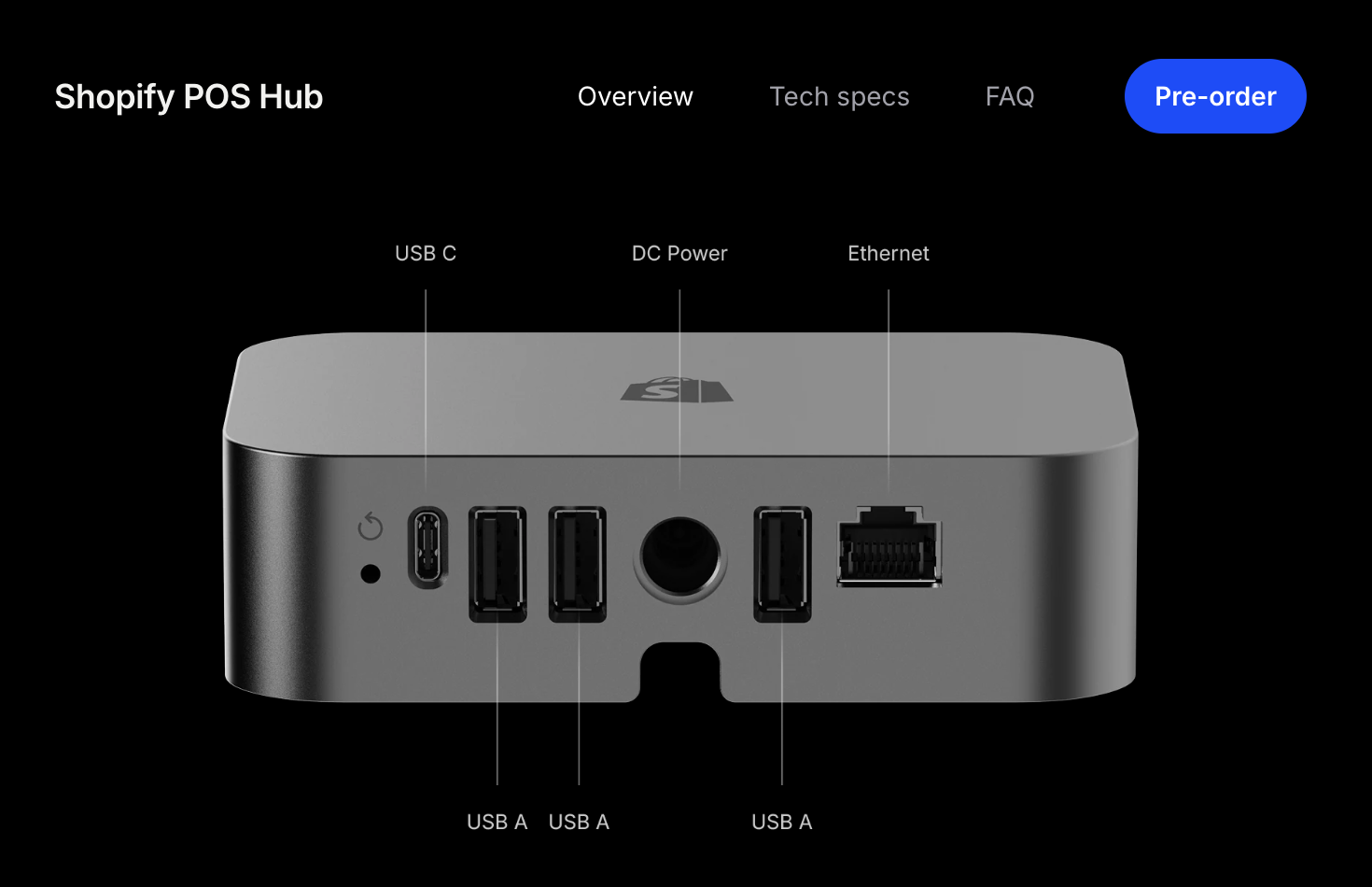
In Shopify’s January 2026 “retail release roundup,” the first announcement is not a new AI feature or a new analytics dashboard. It’s hardware: POS Hub, a compact device meant to sit at the checkout and connect the messy, physical world—scanners, receipt printers, card readers, to a tablet running Shopify POS.
That choice is telling. When a software-first, online-first company puts energy into a “countertop hub,” it is acknowledging what experienced retailers already know: the store is where cloud ideals meet physical reality, cables, power, peripherals, local rules, and “edge cases” that happen so often they become normal.
What POS Hub is (and what it isn’t)
What it is: A wired connectivity and management layer between a tablet (iPad or Android) and USB peripherals, built specifically for Shopify POS, with built-in software that keeps “data flowing” and adds monitoring plus automatic updates.
What it isn’t: It’s not a full POS terminal. It’s not a fiscal solution by itself. And it doesn’t magically remove the need for local devices in regulated markets—it simply makes them easier to attach and manage.
The quick technical picture
From Shopify’s own specs, POS Hub is small (roughly 119 × 80.5 × 32.9 mm) with a die-cast aluminum top, and it provides 3× USB-A, 1× USB-C, and Ethernet (RJ45), powered by an external PSU.
It is also priced like a “swap, don’t repair” accessory: $69 list / $49 sale in the US store, with expected shipping in March 2026 (same shipping month is shown on the EU/CH page).
Why this matters: the return of “edge strategy” in physical retail
Your draft captured the key point: pure cloud is rarely pure in a store. The moment you need dependable peripherals, especially in higher-throughput retail—you need something in the store that can:
- keep devices connected,
- manage device state,
- recover from faults,
- and reduce “Bluetooth chaos.”
That’s exactly what Shopify highlights: health monitoring, automatic fault recovery, and keeping checkout “online” through resilience—not through marketing optimism.
This isn’t a new concept (traditional POS hardware providers like Diebold Nixdorf and others have offered similar “hub/controller” ideas for years). What’s new is who is now investing in it, and what that signals about where retail tech is heading.
The upside: what retailers and POS vendors should like
1) Reliability beats elegance at the checkout
Shopify is explicit: the hub’s job is to eliminate common wireless peripheral problems by moving to stable wired USB connections.
For busy stores, this is not a minor improvement. It’s fewer stalled lines, fewer “re-pair the scanner” moments, and fewer interventions by staff who were hired to sell, not to troubleshoot.
2) Purpose-built for iPad (and designed to stay connected)
POS Hub is Apple MFi-certified and positioned as a way to connect multiple devices to iPad “all at once.”
In the real world, certification matters because it reduces “it worked yesterday” surprises after OS updates.
3) A cleaner physical install than improvised dongles
Shopify includes mounting screws and adhesive pads, and the EU product imagery explicitly references keyhole mounting slots and cable routing channels on the underside, small details that reduce accidental unplugging during cleaning or counter movement.
4) It expands the ecosystem, especially for payments
Shopify’s own help docs list supported peripherals (printers, scanners, cash drawers, USB keyboards) and note broader support after general availability.
And at NRF 2026, industry coverage connected POS Hub with payment ecosystem expansion—e.g., Verifone support for Shopify POS with select devices, “anchored” by POS Hub.
For POS and hardware vendors, this is a clear invitation: Shopify wants more enterprise-grade peripheral options, without giving up control of the core experience.
The downside: the unglamorous trade-offs you still have to own
1) It adds another box, another power supply, more cable management
Your instinct is right: countertop installs fail in boring ways, power bricks, cable clutter, loose connectors. POS Hub uses an external PSU, and most connected peripherals still require their own power.
So the hub reduces wireless fragility, but it can increase under-counter “cable debt” unless you install it properly.
2) Early access reality: compatibility is staged
Shopify says POS Hub is in early access and that some features/devices aren’t available until general availability in early 2026.
If you are a multi-country retailer or a POS vendor rolling out at scale, staged compatibility is not a detail, it’s a project risk.
3) Offline is nuanced—and the hub doesn’t change the fundamentals
The marketing line “Built to keep you selling” can be read as “offline-ready.” But the practical offline story is more specific:
- Shopify POS can continue to operate after login if connectivity drops, with limits (no new products, no sync until reconnection, etc.).
- Offline card payments depend on configuration and constraints; notably, Shopify warns that your local Wi-Fi network must still be working—a full power outage or router failure changes the situation.
- Shopify’s own explainer frames offline payments as transactions stored on the card machine until reconnection.
Conclusion: POS Hub may reduce peripheral disconnects, but it does not eliminate the need for power resilience planning (UPS, router strategy) if you truly care about downtime.
4) Ruggedness questions: outdoor kiosks, humidity, dust
Regarding temperature, humidity, and dust resistance. Here’s the honest read from public materials:
Shopify’s public POS Hub tech specs emphasize ports, power, and construction, but do not publish an IP rating or operating temperature range on the pages above.
So if you plan seasonal outdoor selling, garden centers, winter pop-ups, or semi-outdoor kiosks, treat POS Hub as indoor countertop hardware unless Shopify provides environmental specs in official documentation.
5) Fiscalization and local compliance: the hub is necessary—but not sufficient
Global retailers run into following problem: nine countries can be “simple,” and the 10th introduces a local fiscal device requirement. A hub helps physically connect devices, but compliance still depends on:
- whether Shopify POS supports that fiscal workflow,
- whether the specific fiscal device is supported,
- and whether the required certification model is achievable in that country.
POS Hub is a plumbing upgrade. It’s not a compliance guarantee.
A practical verdict for retailers and POS vendors
When POS Hub looks like a smart buy
- You run tablet-based checkout and want wired stability for scanners/printers/card readers. ´
- You’re scaling from “one store that works” to “20 stores that must behave the same.”
- You want a low-cost way to standardize installs (the pricing is aggressively accessible).
When you should slow down
- You need ruggedized deployments (outdoor, high dust, high humidity) and require published environmental specs.
- You are an enterprise retailer with complex peripherals (scales, label printers, specialty devices) where “USB” is not the same as “supported.”
- You operate in countries where fiscal rules demand specific certified hardware and software flows.
The questions I’d ask before rolling it out to 200 stores
- Do you have published operating temperature / humidity ranges and an IP rating?
- What is the expected behavior during a router outage or full power loss (beyond “offline mode” marketing)?
- How do you handle remote monitoring at scale (alerts, device health, failure prediction)?
- What is the real-world replacement process—swap-only, and what is the warranty path?
- Which peripherals are “USB-compatible” vs “Shopify-supported”?
- For regulated markets: what is the official compliance story per country (not just connectivity)?
Final conclusion: POS Hub is less about ports, and more about admission
POS Hub will be easy to dismiss as “just another hub.” But the more interesting read is strategic:
When Shopify builds a managed hardware layer with monitoring and fault recovery, it is conceding a truth that global retailers and POS vendors have lived for decades:
Retail doesn’t break in the middle. It breaks on the edges, where cables, devices, and local rules live.
POS Hub is Shopify’s attempt to make those edges less painful. For many mid-market retailers, it will likely do exactly that, cheaply. For global and regulated retail, it’s a useful component, but it won’t replace the bigger work: edge architecture, operational discipline, and compliance strategy.
