


I’m an entrepreneur, and I’ve never been able to separate marketing from company strategy.
Strategy is what you decide to do. Marketing is how you make that decision real in the market, how you communicate, how you build trust, how you shape your brand, how you attract talent, how you turn a product into a category, and how you make partners and customers believe in the same future you believe in.
That’s why I don’t see marketing as “promotion.” I see it as a tool for execution.
And right now, execution is getting harder, because the marketing world keeps changing. AI is not just adding new tools; it’s changing speed, expectations, content volume, targeting, measurement, and even what “creative” means. If you’re a founder, the question is not whether you will adapt. The question is whether you will adapt early enough to compound the advantage or you will be too late.
Conferences are one of the fastest ways to learn, if you choose the right ones. The problem is obvious: there are too many. Almost every event looks great on a website. And almost every attendee will tell you it was “worth it” and great – of course, it was ultimately their decision to join it, and nobody wants to admit they made the wrong decision..
That doesn’t help.
So I started treating conferences the same way I treat growth decisions: I look for a fit between the event and the job I need it to do.
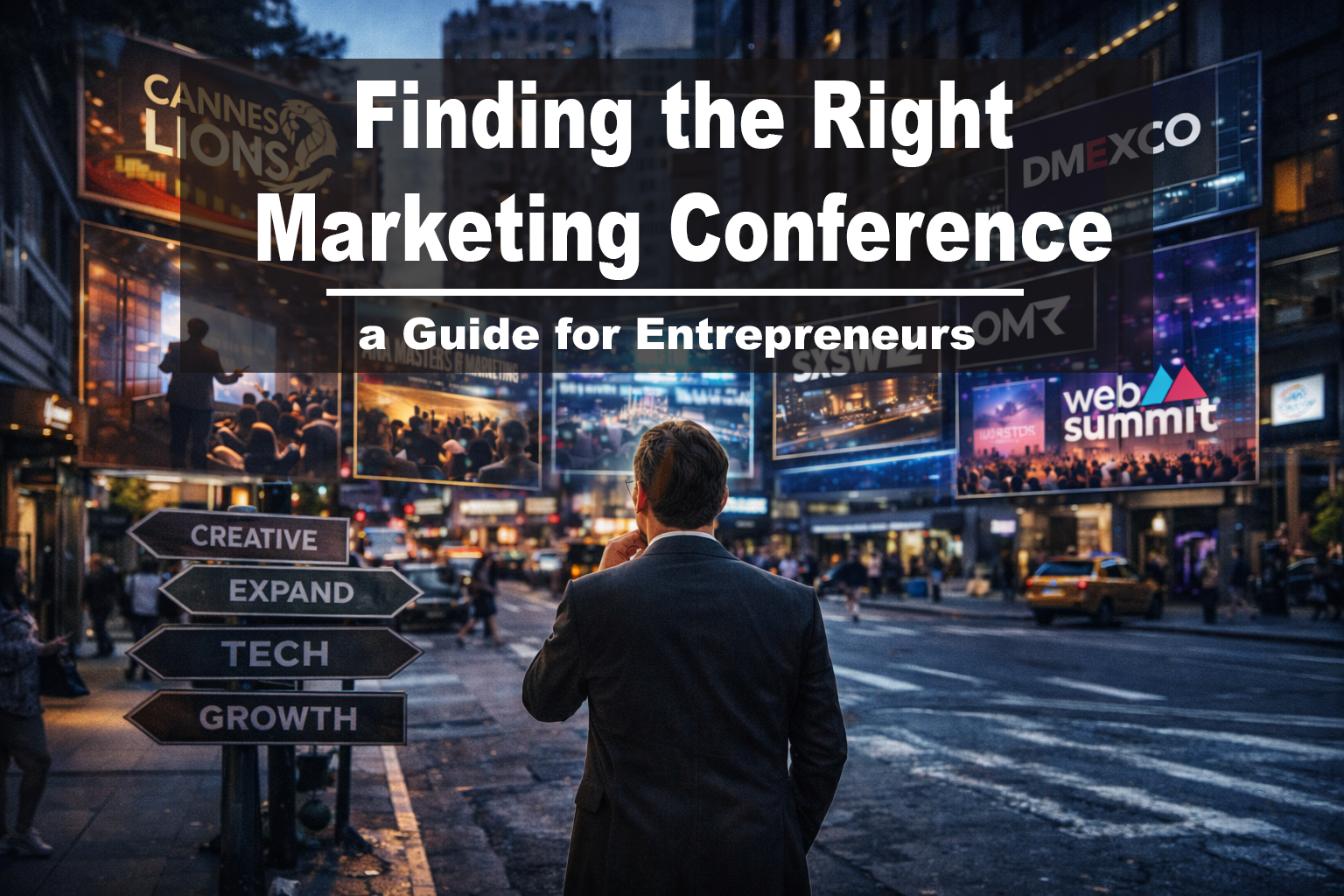
Below is how I think about six of the most influential marketing and adjacent conferences, what they’re really good for from my point of view, where they can disappoint, and how I would choose between them as an entrepreneur.
The first question: do you need better craft, better leadership, better distribution, or better signals?
If you strip away the hype, most marketing conferences serve one of four purposes.
Some sharpen craft and taste, how brands tell stories and how creative work earns attention. Some are about leadership, how senior marketers think about growth, budgets, teams, and boardroom credibility. Some are about distribution, channels, platforms, tools, and partners that move revenue this quarter. And some are about signals, where culture and technology are going next, before it becomes obvious.
Once you’re clear on that, the “best conference” becomes less universal, and more personal.
Cannes: where creative becomes currency
Cannes Lions International Festival of Creativity (22–26 June 2026) is the place where brand storytelling is treated as serious business, not decoration.
If your growth problem is that you are undifferentiated, your messaging looks like everyone else’s, your product is hard to explain, or your brand lacks emotional gravity, this is where you recalibrate your standards. You don’t go to Cannes to “learn tactics.” You go to reset what “excellent” looks like, and to meet the people and agencies who shape cultural attention.
The downside is also clear: it can be expensive, intense, and easy to mistake inspiration for implementation. Cannes is powerful when you bring a strategic question and you use it to filter everything you see.
ANA: the boardroom version of marketing
ANA Masters of Marketing Conference in Orlando (20–23 October 2026) is a different kind of room. It’s closer to enterprise brand leadership than to “growth hacks.”
If you’re building a company that must operate at scale, multiple markets, multiple teams, multiple product lines, this is the sort of event that helps you think like a CMO even if you don’t have one yet. It tends to be strong on leadership language: what to measure, how to organize teams, how to protect brand while still driving performance, and how to make marketing credible in strategy discussions.
The trade-off is that it’s less about the newest tools and more about how leaders make decisions. That’s a feature, not a bug, if your goal is maturity and clarity, not novelty.
DMEXCO: Europe’s marketplace for marketing tech and partners
DMEXCO in Cologne (23–24 September 2026) is positioned as a major meeting place for digital marketing and tech.
For entrepreneurs, DMEXCO shines when you want distribution power: platform relationships, vendor comparisons, media and commerce partnerships, and a quick scan of what the market is selling and buying. It’s especially useful if you’re building your marketing stack, evaluating partners, or trying to open doors in Europe.
The risk is that it can become “expo gravity”, hours lost in booths without decisions. DMEXCO rewards founders who arrive with a shortlist: who you must meet, what you must evaluate, and what you will ignore.
OMR: the operator’s festival for growth and commerce
OMR Festival in Hamburg (5–6 May 2026) is one of the strongest European events if your mindset is practical execution, digital marketing, commerce, content, and growth operations.
OMR is where you go when you want energy, real-world case studies, and a dense mix of practitioners and vendors. If your company is in the stage where speed matters, building pipeline, improving conversion, fixing funnel leaks, OMR often delivers ideas you can apply quickly.
The trade-off is the same as its strength: it’s intense, crowded, and “festival-like.” The value is high when you plan your days well and leave space for meetings, not just stages.
SXSW: culture, creativity, and the early signals of “what’s next”
SXSW in Austin (12–18 March 2026) is less a marketing conference and more a global sensor for culture, media, creativity, and innovation.
If your marketing strategy depends on understanding people, how they consume content, how trust is built, how culture shifts, SXSW is valuable because it widens your frame. It’s a good place for founders who need narrative clarity, product positioning inspiration, and a better feel for where attention is moving.
The downside is focus. It is easy to drown in options and come home with ideas that are interesting but not relevant. SXSW is best when you go with one sharp question, not ten vague hopes.
Web Summit: marketing inside the global tech ecosystem
Web Summit in Lisbon (9–12 November 2026) is a global tech event where marketing is an important track, but still one slice of a bigger ecosystem: startups, platforms, investors, product leaders, AI, and enterprise tech. (Web Summit)
For entrepreneurs, Web Summit is powerful when marketing is tied to partnerships and platform strategy, when distribution depends on alliances, integrations, and being present where the tech world connects. If your company’s growth will be shaped by tech shifts, Web Summit can be a shortcut to relevant conversations.
The trade-off is that it won’t hand you a “marketing playbook” the way a marketing-first event might. You have to create your own agenda and book the right meetings, otherwise the scale becomes noise.
An overview
Here’s a side-by-side comparison of the six conferences optimised for entrepreneurs, offering a practical “why go/why not” perspective.
| Event | Where / when (2026) | Core focus | Best for | Biggest value | Main trade-off |
|---|---|---|---|---|---|
| Cannes Lions International Festival of Creativity | Cannes, France — 22–26 Jun 2026 | Creative excellence + brand storytelling + awards | Brand leaders, creative leaders, agencies, global partnerships | The strongest “creative currency” in the industry (work, awards, connections). | Expensive + can feel like “industry bubble” if you need hands-on growth tactics. |
| ANA Masters of Marketing Conference | Orlando, United States — 20–23 Oct 2026 | CMO / client-side brand leadership + strategy | Senior brand marketers, enterprise teams, decision makers | High signal networking with brand leaders; practical leadership perspective. | More “brand leadership” than “martech deep-dive”; US-centric audience. |
| DMEXCO | Cologne, Germany — 23–24 Sep 2026 | Digital marketing + media + tech ecosystem | Performance marketing, martech/adtech, partnerships in Europe | Very strong expo density: vendors, platforms, partners, deals. | Can be vendor-heavy; you need a sharp agenda to avoid “booth wandering.” |
| SXSW | Austin, US — 12–18 Mar 2026 | Culture + innovation + media + tech trends | Brand innovation, content, consumer insight, future storytelling | “What’s next” signal + cross-industry creativity. | Less focused on classic marketing execution; lots of parallel tracks → FOMO risk. |
| OMR Festival | Hamburg, Germany — 5–6 May 2026 | Digital marketing + growth + commerce (very practitioner-heavy) | Retail/ecom marketers, growth teams, European operators | Huge energy + very actionable marketing & commerce content; big expo. | Germany/Europe-centered; can be crowded and “festival-style” rather than quiet deep work. |
| Web Summit | Lisbon, Portugal — 9–12 Nov 2026 | Global tech ecosystem (startups, platforms, investors) + marketing track | Partnerships, platform relationships, tech scouting, global network | Massive scale and network; strong for cross-industry connections. | Marketing is a slice of a much broader tech event; you must plan meetings to get ROI. |
What I would do as a founder, in plain terms
If I had to choose with limited time and budget, I wouldn’t chase “the best” conference. I would build a learning portfolio.
One event should sharpen taste and brand clarity, because in a world of AI-generated sameness, distinctiveness becomes a competitive advantage. That is the role Cannes can play.
One event should strengthen execution, channels, partners, tools, and performance learning you can apply fast. That’s where OMR or DMEXCO often wins, depending on whether you want an operator festival or a more classic marketing-tech marketplace.
Then, if your business is shaped by technology shifts, or if your competitive set is global, you add one signal event. SXSW is a cultural signal. Web Summit is a tech ecosystem signal. Choose the one that matches the future you’re building.
The real mistake founders make is not choosing the “wrong” conference. It’s going without a mission. If you can’t explain, in one sentence, what you want to come home with, new positioning, a new distribution partner, a clearer narrative, a shortlist of tools, a hiring pipeline, then even the best event becomes expensive entertainment.
Marketing is strategy in public. Conferences are one of the few places where you can compress learning time. But only if you pick the room that matches the problem you’re trying to solve—and you show up with intent.
If you tell me what you’re optimizing for right now—brand clarity, lead generation, partnerships, hiring, or entering a new market, I can recommend the single best event from this list for your situation in 2026, and how to structure your agenda so it pays back.
