


When people talk about innovation in tax, they often jump straight to AI. But the more important shift is quieter and more structural: tax is moving from periodic reporting to continuous visibility. In retail, where transactions reveal consumer behavior, pricing logic, product taxonomy, and cross-border complexity, this change lands first and hits hardest.
A recent report by Deloitte, based on a survey of 1,000 tax and finance leaders and interviews with multinational heads of tax across the world, captures this moment with unusual clarity. The findings read like a roadmap for where the tax function is heading, and, for retailers and POS vendors, a warning that tax is no longer a back-office activity. It’s becoming an operating model.
The new complexity isn’t the rulebook. It’s the data.
The first trend Deloitte highlights is that regulators’ demand for more granular data is increasing complexity, not because the regulations are “hard,” but because companies must now produce tax-relevant data at a level of detail their systems were never designed to deliver.
This is particularly visible in three areas that matter directly to retail: cross-border reporting of corporate tax data (including OECD Pillar Two), the rise of e-invoicing and e-reporting that gives tax authorities near real-time access to indirect tax data, and the steady expansion of software-driven fiscalization and real-time control models.
Retailers understand this instinctively because retail data is messy by nature. One SKU can exist in multiple variants, bundled offers, promotions, and channel-specific price logic. Returns and exchanges distort the story further. Add cross-border fulfillment, marketplaces, and mixed baskets that include products taxed differently, and “granular” becomes a polite word for “painful.”
I liked one example in the report because it shows where tax authorities are going next. A tax leader from The LEGO Group notes that authorities increasingly want “the precise content of our different products and how they are made.” That quote is not about toys. It’s about the future. Tax is moving upstream into product master data, bill of materials logic, category mapping, and the data lineage behind every transaction.
If you are a retailer or POS vendor, the implication is blunt: compliance risk is increasingly created at the point where data is born, POS, e-commerce checkout, item master, and pricing engines, not where reports are compiled.
What tax and finance leaders fear most is exactly what retailers feel daily
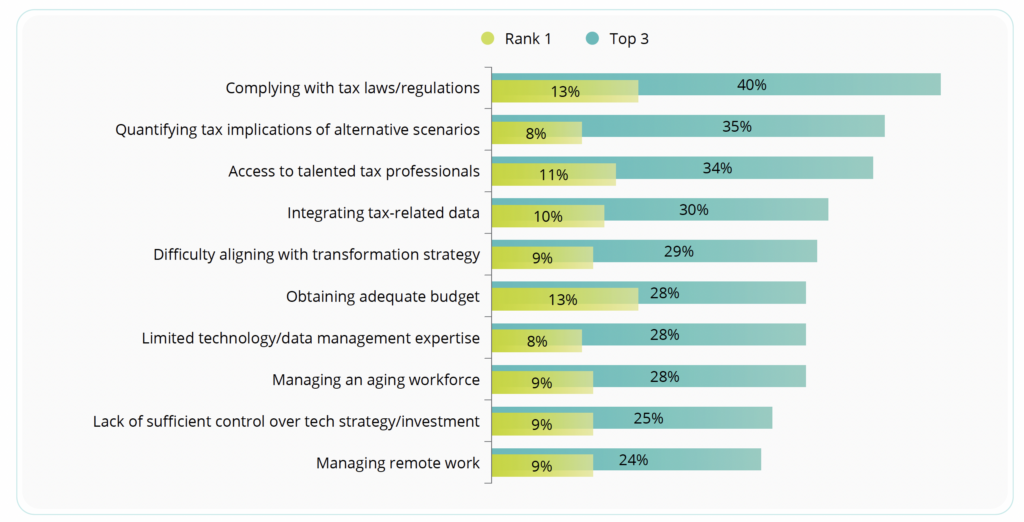
When Deloitte asked respondents to rank their top challenges for the next three to five years, the top three tell a story that every global retailer will recognize: complying with changing tax laws remains the top concern, quantifying tax implications of alternative scenarios is close behind, and access to talented tax professionals is third.
It’s also telling what did not top the list. The headline fears are not “technology budgets” or “tools.” They are risk, decision uncertainty, and talent.
In retail, “alternative scenarios” are not theoretical. They are everyday boardroom questions: What happens to margins if we shift fulfillment? If we introduce a subscription model? If we move assortment across borders? If we add new marketplaces? If we change pricing and promotion cadence? Every one of these decisions has tax implications, and increasingly those implications depend on detailed data that lives in retail systems, not in tax spreadsheets.
The talent gap is evolving: it’s not AI talent versus tax talent; it’s hybrid talent
The second trend is one I see everywhere: the market is hunting for professionals who can bridge tax, data, and automation. Deloitte’s respondents ranked “specialist AI skills” as the most needed skill over the next one to two years (45%), followed by data analytics and data management (42%), and then specialist tax technical skills (36%).
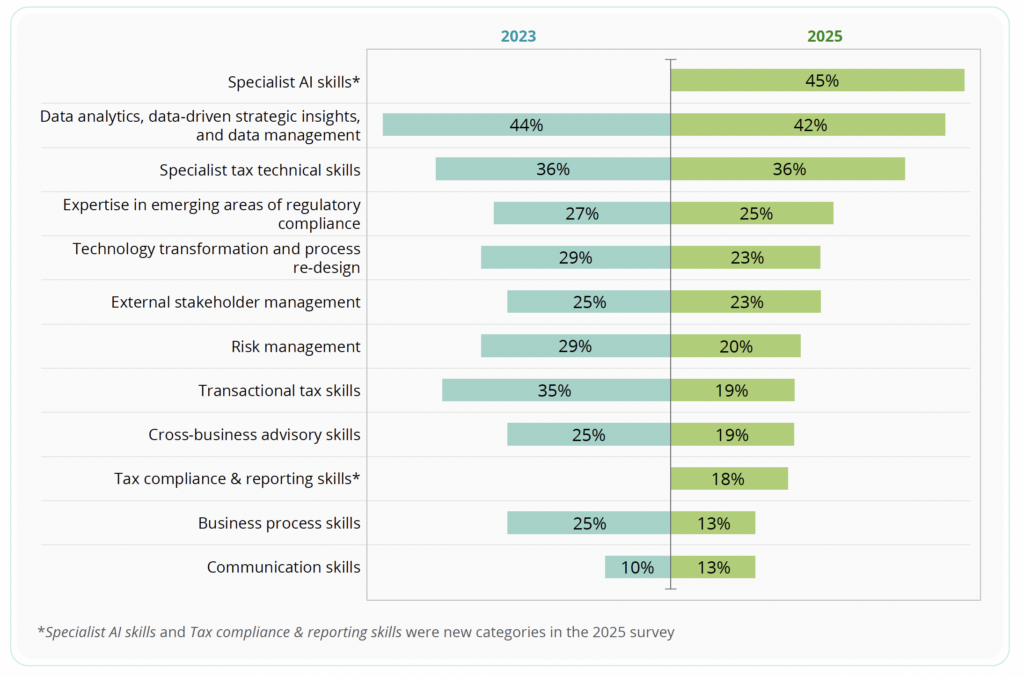
That ordering matters. It doesn’t mean tax knowledge is becoming irrelevant. It means tax knowledge alone is no longer enough to run a modern tax operation, because the work is increasingly about finding the right data points, validating them, and operationalizing compliance in systems.
Retail amplifies the shortage because retail requires both indirect tax depth and systems literacy. A person who understands VAT, e-invoicing, and fiscalization but cannot navigate POS architectures, ERP constraints, and data pipelines will struggle. The inverse is also true: a strong technologist without tax fluency will move quickly and break things, exactly what you cannot afford in compliance.
So, the “talent gap” is really a design problem. Companies must design operating models that do not require unicorn profiles for every task. That brings us to the next trend.
Cost pressure is pushing tax toward centralization and standardization, and retail should welcome it
Deloitte describes a clear move toward centralization and standardization as a response to cost pressure and complexity. This is not surprising. Complexity creates inefficiency, and inefficiency becomes cost. The only sustainable response is to simplify processes, standardize data flows, and centralize what can be governed consistently.
One quote from Coca-Cola Europacific Partners captures the logic well:
“Anything that we can centralize, we centralize.”
What I find especially important is how this shift is changing job design inside tax departments. Deloitte reports that the most common new roles added in the last two years are operational: tax transformation lead (49%), data and innovation lead (46%), and tax operations lead (43%). The era of tax as purely technical interpretation is giving way to tax as an industrialized, data-driven function.
For retail leaders, this is good news, if you act on it. Centralization is the only realistic way to keep multi-country compliance sane when local rules keep evolving and reporting becomes closer to real-time.
Outsourcing is no longer a “nice to have.” It’s becoming the default lever.
If the shift to centralization sets the direction, the shift to outsourcing shows how companies plan to get there.
Deloitte’s data is unambiguous: outsourcing in some form is the most popular cost-reduction strategy, rising from 69% in 2023 to 81% in 2025. Shared services centers are second at 58%, also increasing.
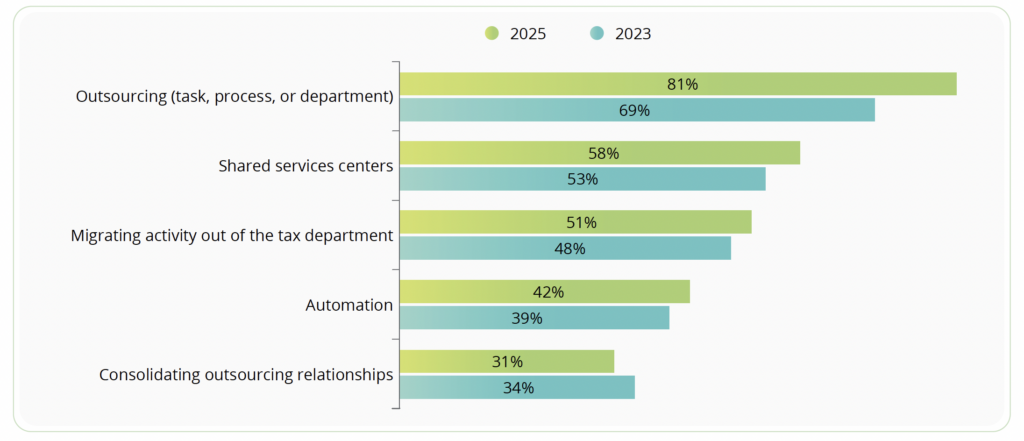
In other words, many organizations have concluded they cannot solve this purely by hiring more people or asking internal teams to “try harder.” They are rebalancing the resource mix, core tax leadership in-house, supported by shared services and specialist external partners.
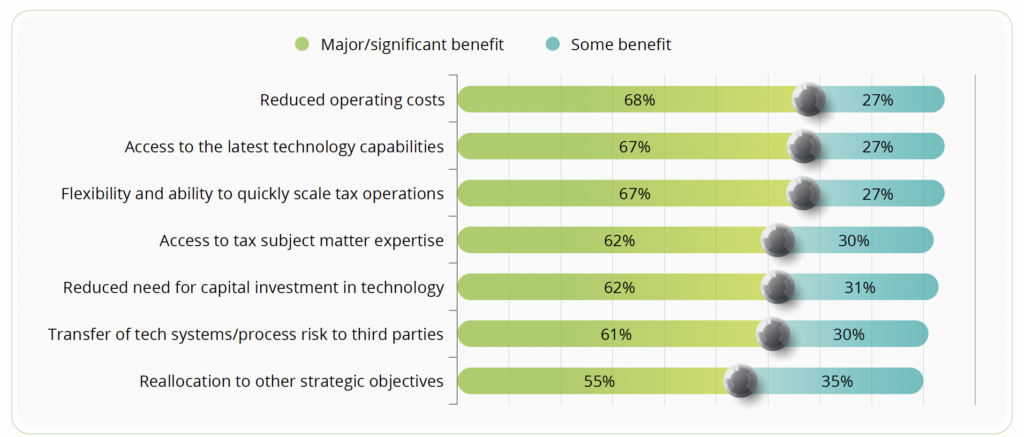
And the perceived value of outsourcing has matured. The top benefits cited include reduced operating costs (68%), access to the latest technology capabilities including AI (67%), and flexibility and ability to scale (67%). In the largest organizations, risk transfer around technology systems and process reliability rises even higher in importance.
Retailers should pay attention here, because retail compliance is a classic “narrow but mission-critical” domain. When the rules change, you cannot pause stores. When connectivity fails, you still need compliant receipts. When a country introduces new reporting, you cannot redesign core POS globally. This is precisely the kind of domain where specialist external capability, middleware, monitoring, and focused consulting, creates disproportionate value.
The most targeted cost area is the one many retailers underestimate
One result in the report made me pause because it aligns strongly with what I see in retail: “Global tax provision” is the top process targeted for lower-cost resourcing, increasing from 40% in 2023 to 47% in 2025, and prioritized by 60% of the largest companies.
Tax provision sounds like accounting. In practice, it is a data problem, timeliness, consistency, reconciliation, and traceability across entities and systems. Retail organizations, with high transaction volumes and complex legal entity structures, feel this pain acutely. If you can standardize and automate the data foundation, provision becomes faster, less risky, and less expensive. If you cannot, it becomes a recurring fire drill.
This is one area where my own experience, and the strategy behind Fiscal Solutions, matches the market direction. We focused on building scalable approaches to fiscal compliance and tax-related operational complexity precisely because it is a small part of the POS landscape in code footprint, but a massive part in business risk. The report’s emphasis on global provision and cost reduction confirms that the business case is expanding.
AI is a priority, but the market is still negotiating trust
Deloitte reports unanimous exploration of GenAI: all respondents identified at least one area where AI rollout is a top priority. But the report also captures the most important reality: tax leaders are cautious, especially for high-judgment areas, and they are prioritizing safer use cases first, automation of routine data entry and processing, improving accuracy in calculations, and analyzing large datasets for compliance.
The most revealing statistic is about tolerance for imperfection. Deloitte notes that 77% of respondents would accept AI accuracy of 90% or more if it delivers greater efficiency, while accuracy below 80% is acceptable only to a minority (29%). That is the real AI debate in tax: not whether it is useful, but what error rate is tolerable given regulatory exposure.
Retail again is the stress test. One wrong tax decision can scale across thousands of stores and millions of receipts. AI will help, but only if it is anchored in clean data, governed processes, and audit-friendly controls. In other words, AI does not replace the need for better tax architecture. It increases it.
The hidden constraint: tax doesn’t control its own technology budget
Finally, Deloitte highlights a structural tension many retailers know too well: tax depends on systems owned by finance and IT, but tax priorities don’t always align with their budgets or roadmaps. When tax departments lack control over technology investment, compliance modernization becomes a negotiation—and sometimes a delay.
For retail executives, the lesson is simple: tax transformation is not a tax project. It’s an enterprise architecture project. The organizations that win will treat tax data requirements as first-class requirements in POS, ERP, e-commerce, and data platforms.
What this means for retailers and POS vendors
The Deloitte research doesn’t just describe trends. It signals an outcome: tax is becoming a real-time, data-driven function embedded into operations.
Retailers should assume that tax authorities will continue moving upstream, closer to transaction data, product data, and near real-time reporting. POS vendors should assume that “compliance-ready” will increasingly mean more than country-specific features; it will mean standardized data models, clean APIs, strong audit trails, and the ability to adapt quickly without re-implementing core software in every market.
And the strategic conclusion is one I have argued for years: you reduce risk and cost by centralizing what can be centralized, standardizing what can be standardized, and partnering for the specialist domains that change fastest. That is why fiscal middleware, continuous monitoring, and expert advisory services will keep growing—not as optional add-ons, but as foundational components of modern retail architecture.
If you want a practical benchmark for your own roadmap, this is it: can your organization produce tax-relevant data that is accurate, granular, and timely enough to satisfy real-time regulatory models, without heroics? If the answer is “not yet,” you’re in good company. The market is moving, and the report makes clear that the organizations that act now will not just comply better, they will run better.
(For context on our approach to this challenge in global retail environments, my company Fiscal Solutions works with retailers and POS vendors on scalable fiscal compliance and operational tax complexity across countries: www.fiscal-solutions.com.)
Source
https://www.deloitte.com/global/en/services/tax/research/tax-transformation-trends.html
If you’d like more reflections at the intersection of technology, society, and retail, subscribe to my personal newsletter Future of the High Street: https://darkopavic.substack.com/
