


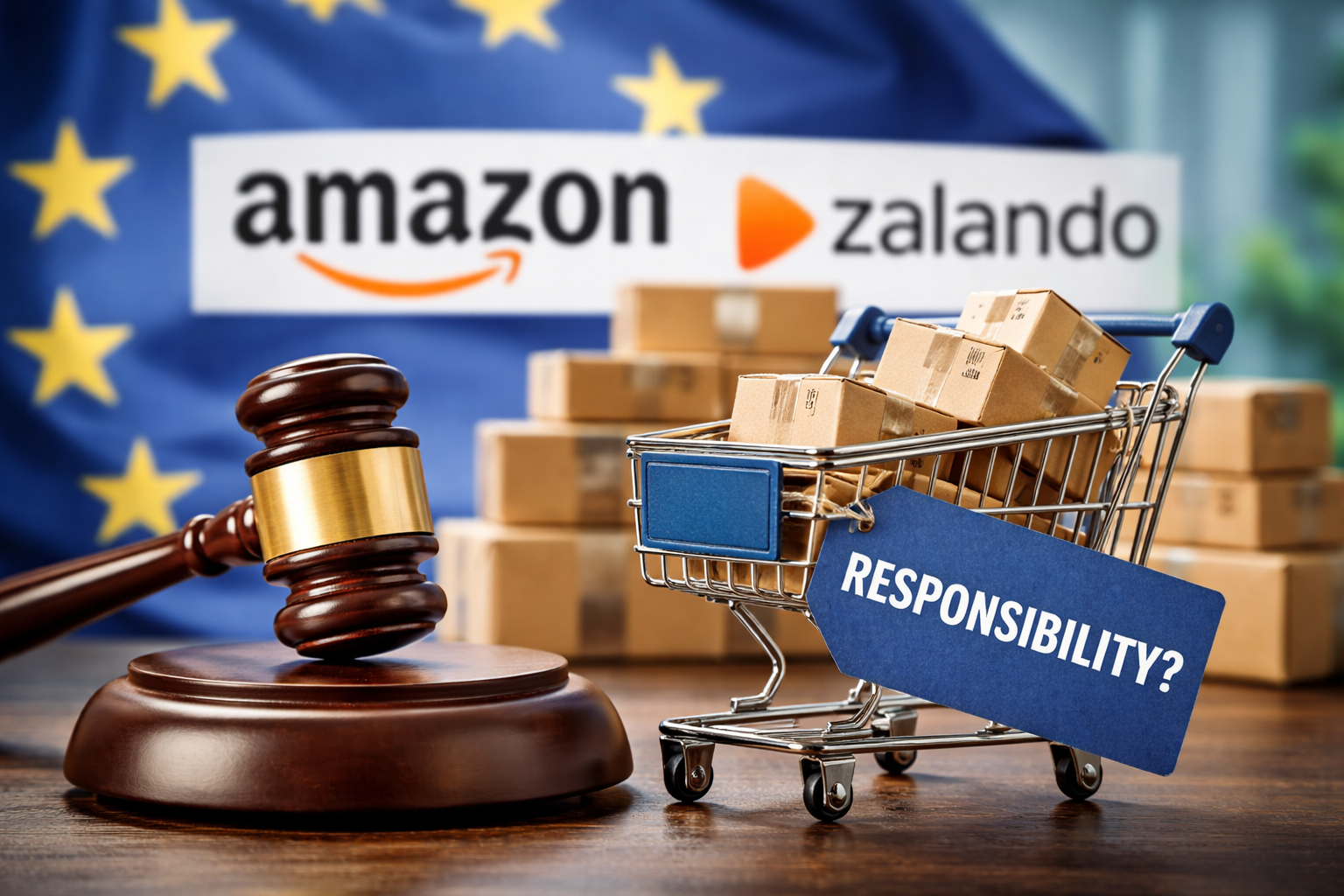
Counterfeits, unsafe goods, missing certifications: the legal trend is not “platform neutrality,” it’s accountability by control.
Estée Lauder’s February 2026 lawsuit against Walmart over allegedly counterfeit fragrances is more than a brand-protection headline. It is a symptom of a deeper shift: courts and regulators are increasingly uncomfortable with the idea that a marketplace can engineer trust, monetize the transaction, and still claim it is merely a passive venue. As platforms blur the line between “listing” and “selling,” legal systems in both the United States and the European Union are responding with a principle that is simple, operational, and hard to evade. The more control you exercise over commerce, the more responsibility you inherit.
Retail executives should read the legal landscape this way because the risks are now systemic. Counterfeits attack brand equity, but they also attack consumer confidence in the platform itself. Unsafe products and missing certifications, whether that is flammability compliance in children’s apparel or electrical safety in low-cost electronics, move quickly from customer service problems to enforcement events. And once regulators treat “online” as just another distribution channel, liability questions stop being academic.
The short answer to whether there are U.S. and EU laws that can make e-commerce platforms responsible for counterfeit, unsafe, or non-compliant third-party products is yes.
The longer answer is that the mechanism differs by jurisdiction.
In the U.S., the pressure comes through trademark law, federal product-safety enforcement, and state product-liability doctrine.
In the EU, the framework is more structured: the Digital Services Act (DSA) raises the compliance bar for marketplaces through trader traceability and systemic-risk duties, while product-safety law adds explicit obligations for online marketplaces and trademark case law narrows the space for “we were only hosting.”
Start in the U.S. with counterfeits, where the legal logic runs through the Lanham Act and the concept of secondary (contributory) liability. Estée Lauder’s case against Walmart is built on allegations of trademark infringement and counterfeiting tied to products offered on Walmart’s website under brands such as Tom Ford and Clinique. The litigation will turn on facts that platforms often prefer to frame as operational details: what the platform knew, what it controlled, and how it responded when problems were identified. The standard for “knowledge” in the platform context is shaped by the Tiffany v. eBay decision, where the Second Circuit held that generalized awareness of counterfeits is not enough; liability turns on more specific knowledge connected to particular infringing listings or sellers and a failure to act appropriately.
Product safety is where U.S. regulation is moving most aggressively, because the consumer safety regulator does not need to wait for private plaintiffs to build a perfect record.
In July 2024, the U.S. Consumer Product Safety Commission issued a Decision and Order determining that Amazon was a “distributor” of certain hazardous products sold by third-party sellers through the “Fulfilled by Amazon” program, and therefore bore legal responsibility for the recall under federal safety law. In January 2025, the CPSC issued a final order outlining remediation plans for more than 400,000 affected items, including faulty carbon monoxide detectors, hairdryers lacking electrocution protection, and children’s sleepwear violating flammability standards. Amazon has challenged the agency’s approach in court, arguing it is a logistics provider rather than a seller, but the policy signal is unmistakable: in the eyes of safety regulators, the operational reality of distribution can trump contractual labels.
Then there is U.S. product-liability exposure when consumers are injured. Here, the law is largely state-based and outcomes vary, but the direction is relevant for any platform that wants to scale. California’s Bolger v. Amazon decision is repeatedly cited because the court held Amazon could be strictly liable for a defective product sold through its marketplace when Amazon played an integral role in the transaction and positioned itself between buyer and third-party seller in the chain of distribution. Other jurisdictions have been more reluctant to extend strict liability to marketplaces, which is why the U.S. picture remains uneven. Still, the trend is clear: as platforms deepen their role in payment, fulfillment, and post-sale handling, plaintiffs and courts have more grounds to argue that the platform functionally behaves like a seller.
Now look at the European Union, where the regulatory architecture is overtly designed to reduce the gap between platform scale and accountability. The Digital Services Act includes a trader-traceability obligation (Article 30) requiring online marketplaces to collect key identification information from traders and make “best efforts” to assess whether that information is reliable before allowing them to offer goods to EU consumers. The DSA also empowers regulators to impose significant penalties for systemic failures; in enforcement actions, the Commission has pointed to potential fines of up to 6% of global annual turnover for confirmed breaches.
Enforcement is not theoretical. In July 2025, the European Commission said Temu was in breach of the DSA for failing to prevent the sale of illegal products, following an investigation that included mystery shopping and referenced risks tied to non-compliant goods such as toys and small electronics. And in September 2025, the EU’s General Court dismissed Zalando’s challenge to its designation as a “very large online platform” (VLOP) under the DSA, reinforcing that major retail platforms headquartered in Europe are expected to meet the same governance standards as the global tech giants.
Product safety regulation in Europe adds another layer. The EU’s General Product Safety Regulation, Regulation (EU) 2023/988, includes specific obligations for providers of online marketplaces related to product safety (Article 22), pushing platforms toward faster response, stronger internal processes, and more cooperation with authorities when unsafe products are identified. In practical terms, this is the compliance counterpart to the business reality: when shopping happens online at scale, safety surveillance must operate online at scale too.
Trademark law in Europe closes one more door that marketplaces used to leave ajar. In Louboutin v. Amazon, the Court of Justice of the European Union indicated that a marketplace may face direct trademark liability when the platform’s presentation of third-party offers leads the average consumer to believe that the goods are being marketed in the platform’s own name, rather than by an independent third party. As marketplaces work to make shopping feel seamless, uniform templates, platform-branded advertising, integrated logistics, the legal system is increasingly willing to treat seamlessness as a form of responsibility.
Put these developments together and a pattern emerges that retail leaders should treat as strategic, not legalistic.
Platform responsibility is no longer a binary question of “are we liable or not.” It is a sliding scale driven by control: control over onboarding and identity verification, control over listings and compliance documentation, control over payment and fulfillment, and control over how the offer is framed in the customer’s mind. The more a platform optimizes commerce like a retailer, the more it will be judged like a retailer.
For marketplaces, the implication is that disclaimers will not be a durable strategy. The durable strategy is compliance architecture: seller verification that can survive scrutiny, product documentation workflows that scale, detection and takedown systems that are defensible, and recall-ready operations that do not depend on goodwill. For brands and sellers, the implication is equally practical: marketplace compliance will increasingly require proof, not promises, because platforms will be forced, by enforcement, by litigation, and by reputational risk, to demand it.
Sources (URLs)
Reuters – Estée Lauder sues Walmart over alleged counterfeit fragrances (Feb 10, 2026)
Tiffany (NJ) Inc. v. eBay Inc., 600 F.3d 93 (2d Cir. 2010) – case reference (WIPO WIPOLex)
https://www.wipo.int/wipolex/en/judgments/details/941
Finnegan – Commentary on Tiffany v. eBay
https://www.finnegan.com/en/insights/articles/the-second-circuit-s-decision-in-tiffany-v-ebay.html
CPSC – Press release: CPSC finds Amazon responsible as distributor (Jul 30, 2024)
Reuters – U.S. agency puts onus on Amazon for sale of hazardous third-party products (Jul 30, 2024)
CPSC – Press release: Final order outlining remediation plans (Jan 17, 2025)
AP News – Amazon sues CPSC over recall order (context on challenge)
https://apnews.com/article/cbc117a5cc2c322bded2b3b93736121e
Bolger v. Amazon.com, LLC (California Court of Appeal, Aug 13, 2020) – Justia
https://law.justia.com/cases/california/court-of-appeal/2020/d075738.html
EU Digital Services Act – Official text (Regulation (EU) 2022/2065) on EUR-Lex
https://eur-lex.europa.eu/eli/reg/2022/2065/oj/eng
DSA Article 30 (traceability of traders) – accessible reproduction
https://www.eu-digital-services-act.com/Digital_Services_Act_Article_30.html
European Commission – Q&A on the Digital Services Act
https://ec.europa.eu/commission/presscorner/detail/en/qanda_20_2348
Reuters – EU says Temu in breach of rules to prevent sale of illegal products (Jul 28, 2025)
Reuters – Zalando loses challenge to VLOP designation (Sep 3, 2025)
EU General Product Safety Regulation – Regulation (EU) 2023/988 on EUR-Lex
https://eur-lex.europa.eu/eli/reg/2023/988/oj/eng
EU General Product Safety Regulation – PDF (Regulation (EU) 2023/988, Article 22)
https://eur-lex.europa.eu/legal-content/EN/TXT/PDF/?uri=CELEX%3A32023R0988
KPMG Law – GPSR overview (Dec 5, 2024)
https://kpmg-law.de/en/gpsr-what-the-new-eu-product-safety-regulation-means
CJEU – Louboutin v Amazon joined cases C‑148/21 & C‑184/21 (CURIA)
EU IP Helpdesk – Summary of Louboutin v Amazon