


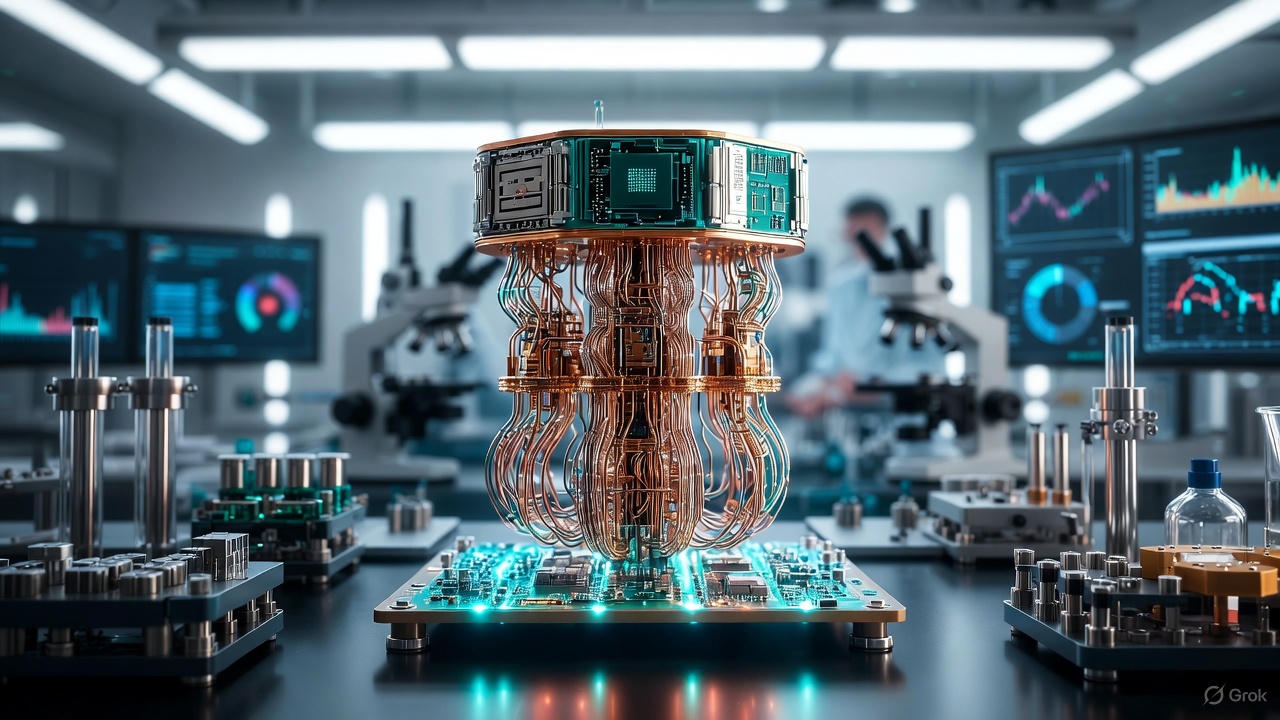
Summary of the Chinese Optical Quantum Chip
The article from Tom’s Hardware discusses a breakthrough in Chinese quantum computing technology: an optical quantum chip developed by the Chip Hub for Integrated Photonics Xplore (CHIPX), a consortium involving researchers from Tsinghua University and the Chinese Academy of Sciences. This chip, reportedly named “Tianji” in some contexts (though not explicitly in the article), uses photonic technology, leveraging light (photons) integrated with electronics on a monolithic 6-inch silicon wafer containing over 1,000 optical components. It’s touted as the world’s first scalable, “industrial-grade” quantum chip compatible with mass production and deployment. The key claim is that it processes AI workloads up to 1,000 times faster than high-end Nvidia GPUs (e.g., the H100), with potential applications in aerospace, finance, and data centers. However, production yields are low, limiting the number of functional chips per wafer, despite the firm reportedly producing 12,000 wafers annually. The claims stem from a research paper and announcements covered by the South China Morning Post (SCMP), emphasizing its role in boosting China’s AI capabilities amid U.S. export restrictions on advanced semiconductors.
Insights from Other Sources
Multiple outlets corroborate and expand on the Tom’s Hardware report, primarily drawing from the same SCMP article. Here’s a synthesis:
- SCMP (Original Source): The chip provides a “1,000-fold speed boost” for AI data centers by using light-based quantum processing, addressing a “century-old problem” in integrating photons and electronics. It’s an award-winning development from a Tsinghua-led team, with energy efficiency gains (potentially 100x better than GPUs) and scalability for industrial use. Challenges include low yields due to manufacturing complexities in photonic integration.
- Reddit and Aggregators (e.g., r/singularity, Ooda Loop): These echo the 1,000x speed claim and low yields, sparking discussions on whether this represents a true quantum leap or quantum-inspired acceleration for specific AI tasks like matrix operations. Skepticism arises around verification, as independent benchmarks are lacking.
- LinkedIn Analysis and YouTube (SCMP Video): One analysis notes the 1,000x speedup is “true but misleading,” applying mainly to niche analog-like computations (e.g., matrix multiplications in AI), not general-purpose tasks where GPUs excel. Energy efficiency is highlighted as a bigger win, potentially reducing AI training costs.
- Related but Distinct Developments: Some sources confuse this with a separate Peking University analog AI chip (not quantum), also claiming 1,000x speed over Nvidia H100 for specific tasks. This analog chip uses resistive RAM and is energy-efficient but not photonic quantum. The Tianji chip appears distinct, focusing on optical quantum elements for broader quantum simulation in AI.
Overall, sources agree on the hype around speed and scalability but emphasize unverified claims, low yields (potentially <10% functional chips per wafer, though not quantified), and geopolitical implications (e.g., bypassing U.S. sanctions). No major contradictions, but calls for third-party testing persist.
Overview of Google’s Quantum Chip
Google’s latest quantum chip is Willow, announced in December 2024 as the successor to the 2019 Sycamore processor. Willow is a superconducting quantum chip with improved error correction, enabling it to scale while reducing errors exponentially—a key milestone toward fault-tolerant quantum computing. In October 2025, Google demonstrated the first verifiable quantum advantage algorithm on Willow, called “Quantum Echoes,” which simulates complex quantum phenomena (e.g., molecular chemistry or black hole physics) faster than classical supercomputers. Sycamore (53 qubits) achieved “quantum supremacy” in 2019 by solving a random circuit sampling task in 200 seconds versus 10,000 years on a supercomputer. Willow builds on this, with recent uses including probing exotic phases of matter beyond classical simulation. Google’s Quantum AI lab aims for a large-scale, error-corrected quantum computer by the end of the decade. As of 2025, quantum computers like Willow exist but are experimental, not yet mainstream for practical applications.
Comparison Between the Chinese Optical Quantum Chip and Google’s Willow/Sycamore
To compare, note that both represent advances in quantum tech, but they differ fundamentally in approach, maturity, and focus. Below is a table breaking down key aspects based on available data:
| Aspect | Chinese Optical Quantum Chip (Tianji/CHIPX) | Google’s Superconducting Quantum Chip (Willow/Sycamore) |
| Technology Type | Photonic (optical, using photons integrated with electronics on silicon wafers). Potentially operates at room temperature, easier to integrate with classical systems. | Superconducting transmon qubits (requires cryogenic cooling to near absolute zero). Focuses on gate-based quantum operations. |
| Performance Claims | 1,000x faster than Nvidia GPUs (e.g., H100) for AI workloads like matrix operations; energy-efficient (up to 100x). Claims are task-specific and unverified independently. | Achieves quantum advantage: Willow outperforms classical supercomputers on algorithms like Quantum Echoes (e.g., simulating quantum systems in minutes vs. years). Sycamore: 10^4x speedup on random sampling. Not directly benchmarked against GPUs for AI. |
| Scalability & Production | Designed for industrial scalability; 12,000 wafers/year, but low yields hinder mass production. Monolithic design aids integration. | Lab-scale; Willow scales with error correction (errors drop as qubits increase). Not mass-produced; focuses on research prototypes. |
| Applications | Targeted at AI acceleration in data centers, finance, and aerospace; hybrid quantum-classical for practical workloads. | General quantum simulation: Chemistry, materials science, optimization; recent probes of exotic matter and black hole analogs. Emerging AI uses, but not primary. |
| Challenges | Low yields, unverified claims, potential overstatement for specific tasks; geopolitical barriers. | High error rates (though improving), cryogenic requirements, limited qubits (53 in Sycamore; Willow advances this). |
| Maturity & Verification | Early industrial prototype; claims from internal research, needs external validation. | Established research tool; peer-reviewed demonstrations (e.g., quantum supremacy in Nature). |
In summary, the Chinese chip emphasizes practical AI acceleration via photonics, potentially bridging quantum and classical computing faster for specific industries, but its claims are bolder and less verified. Google’s Willow/Sycamore prioritizes fundamental quantum advantage for simulation tasks, with stronger scientific backing but slower path to commercialization due to hardware demands. Direct head-to-head isn’t apples-to-apples, as the Chinese tech is more hybrid/AI-focused, while Google’s is pure quantum. Both signal accelerating global quantum progress in 2025.
Quantum Computing Advancements on Retail Technologies
The topic of the Chinese optical quantum chip (with its claimed 1,000x speedup for AI workloads) and Google’s Willow/Sycamore chips highlights rapid progress in quantum tech, particularly in AI acceleration and simulations. While still emerging, these could transform retail by solving complex problems faster and more efficiently than classical systems. Based on current trends, here are key implications for retail technologies, focusing on areas like e-commerce, supply chains, and customer experiences. I’ll break them down with specific examples tied to the chips’ strengths.
1. Hyper-Personalized Customer Experiences and Recommendations
Quantum machine learning (QML) could analyze vast datasets in real-time, enabling ultra-precise personalization. For instance, the Chinese chip’s photonic AI acceleration might process customer behavior, preferences, and trends 1,000x faster than GPUs, allowing retailers like Amazon or Walmart to deliver instant, tailored suggestions or virtual try-ons. This could boost conversion rates by 20-30%, as seen in predictive models reducing excess inventory through better demand forecasting. Google’s simulation focus might enhance this indirectly by modeling consumer psychology or product interactions at a molecular level, but the Chinese chip’s AI emphasis makes it more immediately applicable for retail apps.
2. Supply Chain and Inventory Optimization
Retail relies on solving NP-hard problems like routing, demand prediction, and inventory allocation. Quantum algorithms (e.g., via simulation) could optimize these exponentially faster, minimizing disruptions and costs. The Chinese chip, with its hybrid quantum-classical design for data centers, might enable real-time adjustments in global supply chains, reducing overstock by up to 20% as demonstrated in case studies. For example, retailers could simulate scenarios for disruptions (e.g., weather or tariffs) more accurately. Google’s Willow, with its error-corrected simulations, could model complex material flows or sustainable sourcing at a molecular level, but scalability issues might delay retail adoption compared to the Chinese chip’s production-oriented approach.
3. Dynamic Pricing and Fraud Detection
Faster AI processing from the Chinese chip could revolutionize dynamic pricing, analyzing market data, competitor prices, and customer elasticity in seconds to maximize profits. In fraud detection, quantum-enhanced ML might spot anomalies in transactions with unprecedented accuracy, reducing losses in e-commerce. Quantum cryptography trends (e.g., QKD) could secure retail payments against future quantum attacks, protecting sensitive data in online shopping. Google’s chips might contribute to quantum-resistant algorithms, but retail’s immediate need is for efficient AI, where the Chinese tech shines.
4. Dynamic Security and Data Privacy
As quantum tech advances, it poses risks (e.g., breaking current encryption) but also solutions via post-quantum cryptography. Retailers handling vast customer data could adopt quantum-secure systems to prevent breaches, fostering trust in e-commerce. The Chinese chip’s integration with existing silicon could accelerate hybrid systems for secure retail clouds.
5. Geopolitical and Adoption Challenges
Amid US-China tensions, the Chinese chip’s development (bypassing export restrictions) could shift retail tech supply chains toward Asian suppliers, affecting costs and availability for Western retailers. Quantum cloud computing trends allow access without owning hardware, but low yields in production might delay widespread retail use. By 2030, up to 2,800 companies might use QCaaS, including retailers for competitive edges.
| Implication Area | Potential Benefits | Challenges | Relevance to Chinese/Google Chips |
| Personalization | Real-time recommendations, higher sales | Data privacy concerns | Chinese: AI speedups; Google: Simulations for deeper insights |
| Supply Chain | Cost reductions (e.g., 20% inventory cuts) | High initial integration costs | Chinese: Industrial scalability; Google: Complex modeling |
| Pricing/Fraud | Accurate dynamic models, reduced losses | Algorithm biases | Chinese: Task-specific AI; Google: Emerging optimization |
| Security | Quantum-resistant encryption | Threat of quantum attacks | Both: Drive post-quantum standards |
| Overall Adoption | Efficiency gains up to $250B globally | Maturity, yields, geopolitics | Chinese: Faster commercialization; Google: Scientific validation |
In summary, these advancements could make retail more predictive and efficient, but full impact might take 5-10 years due to current limitations like error rates and yields. Retail leaders should prepare by exploring quantum-as-a-service for pilots in AI and optimization.
Sources and Links
Here is a list of all sources referenced in the analysis, with their corresponding links:
- Tom’s Hardware Article: https://www.tomshardware.com/tech-industry/quantum-computing/new-chinese-optical-quantum-chip-allegedly-1-000x-faster-than-nvidia-gpus-for-processing-ai-workloads-but-yields-are-low
- South China Morning Post (SCMP): https://www.scmp.com/news/china/science/article/3286236/chinese-scientists-claim-breakthrough-optical-quantum-chip-boost-ai-computing-power-1000-times
- Reddit r/singularity Discussion: https://www.reddit.com/r/singularity/comments/1gpz1z7/new_chinese_optical_quantum_chip_allegedly_1000x/
- Ooda Loop: https://www.oodaloop.com/technology/2024/11/07/new-chinese-optical-quantum-chip-allegedly-1000x-faster-than-nvidia-gpus-for-processing-ai-workloads-but-yields-are-low/
- LinkedIn Analysis (Example Post): https://www.linkedin.com/pulse/chinas-new-optical-quantum-chip-1000x-faster-nvidia-gpus-ai-kumar
- YouTube Video: https://www.youtube.com/watch?v=L4ICwoXa3Lg
- Peking University Analog Chip (Related): https://spectrum.ieee.org/analog-ai-chip
- Additional SCMP Coverage: https://www.scmp.com/tech/tech-trends/article/3281298/chinese-researchers-develop-ultra-fast-ai-chip-3000-times-faster-nvidias-a100
- Google’s Willow Announcement: https://blog.google/technology/ai/google-quantum-ai-willow-chip/
- Nature Paper on Sycamore: https://www.nature.com/articles/s41586-019-1666-5
- Google Quantum AI Blog on Exotic Matter: https://quantumai.google/blog/exotic-phases-matter
- TechCrunch on Willow: https://techcrunch.com/2024/12/09/google-quantum-supremacy-willow/
- Wired on Quantum Echoes: https://www.wired.com/story/google-quantum-advantage-algorithm-willow/
- MIT Technology Review on Quantum Supremacy: https://www.technologyreview.com/2019/10/23/132509/google-quantum-supremacy-sycamore/
- Google Research on Black Hole Simulations: https://research.google/blog/quantum-simulation-black-holes/
- Forbes on Quantum Challenges: https://www.forbes.com/sites/forbestechcouncil/2025/01/15/quantum-computing-2025-challenges-opportunities/
- Google Quantum AI Lab Updates: https://quantumai.google/hardware
- Scientific American on Sycamore: https://www.scientificamerican.com/article/google-claims-quantum-computing-milestone/
- McKinsey on Quantum in Retail: https://www.mckinsey.com/capabilities/quantumblack/our-insights/quantum-technology-sees-record-investments-progress-on-talent-gap
