


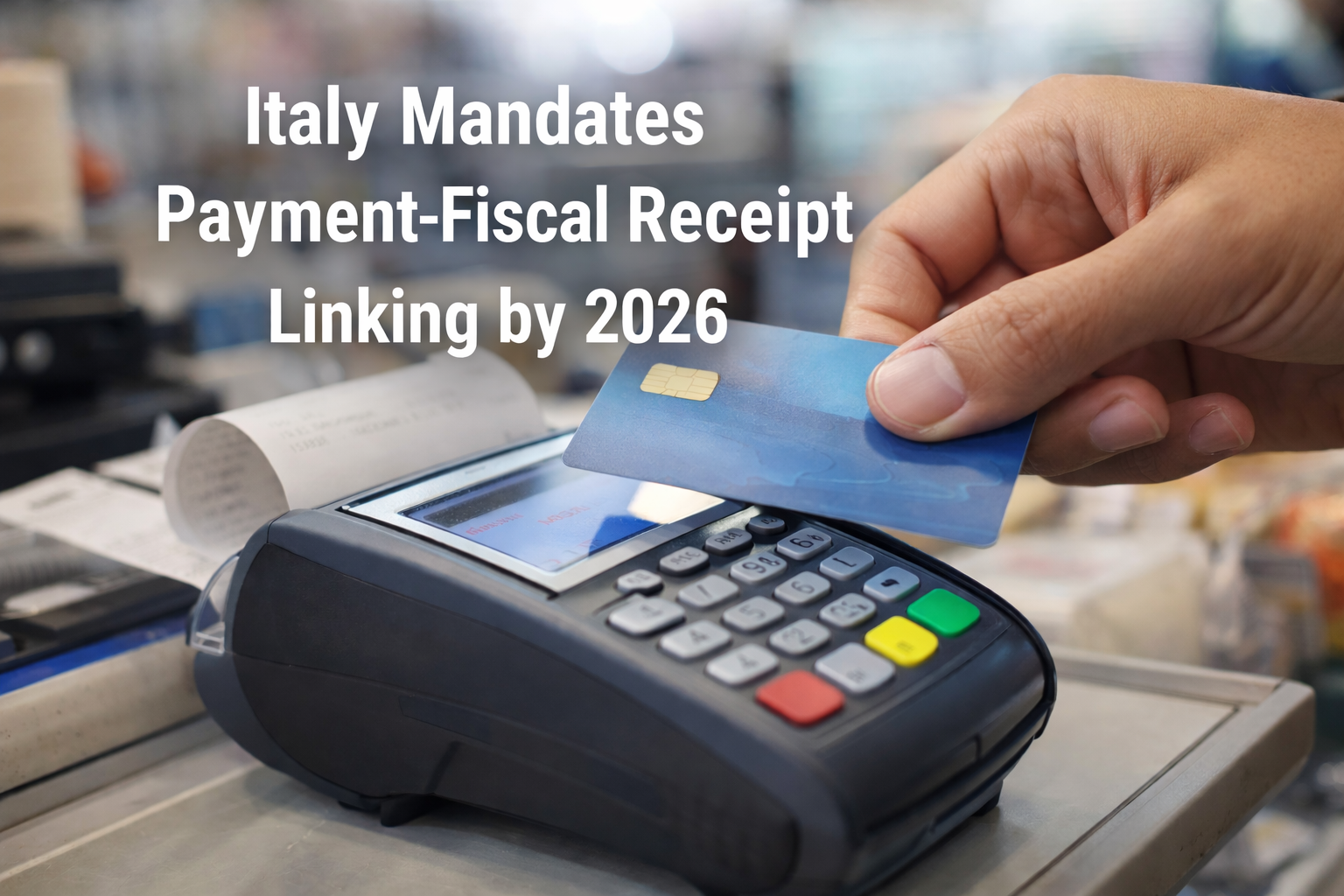
Why the Revenue Agency’s POS–cash register linkage turns reconciliation into law, and what retailers should do now.
Retail has always lived on a fragile promise: the moment money changes hands, the paperwork must tell the same story. In Italy, that promise is now being enforced in a more literal way. The Italian Revenue Agency is requiring merchants to create a logical, digital link between payment terminals (POS) and the devices that certify receipts—registratori telematici (RT) and RT servers. What looks like a small technical step is really a policy shift: reconciliation is no longer an internal control. It becomes part of the compliance perimeter.
The motivation is straightforward. Card payments are already traceable. Fiscal receipts are already transmitted. The gap is the “human space” between them: mismatches, missing records, and unverifiable exceptions. By forcing a declared association between the acceptance device and the fiscal device, the tax authority gains a cleaner path to compare what was paid with what was certified. For retailers, this is not a finance story. It is a checkout architecture story.
The first practical point is also the most reassuring: the linkage is not a physical cabling project. It is a logical association registered through the Revenue Agency’s portal “Fatture e Corrispettivi.” That means no new cables and, in many cases, no new hardware. But “no new hardware” does not mean “no work.” The work moves from the store floor to systems inventory, governance, and exception handling.
In the operational guide (Allegato 2 – Manuale Operativo, February 2026), the Agency describes the web procedure step by step. The merchant—or a delegated intermediary—logs into the portal with a digital identity (SPID/CIE/CNS) or Entratel/Fisconline credentials, enters the “Corrispettivi” area, and then uses the “Collegamento dispositivi – POS” function to manage connections. The linkage can be performed in a simplified mode for merchants with a small number of RTs, or in a standard mode for larger estates. For retailers with many stores, the implication is obvious: you are not “linking one POS.” You are managing a fleet of devices, and your compliance becomes only as strong as your asset register.
The mechanics reveal why this requirement will surface hidden complexity. For a physical terminal, the system expects key identifiers, including the Terminal ID and the acquirer (the payment provider). If a terminal is missing in the portal lists, the Agency’s FAQ points merchants back to their acquirer: the initial device lists are transmitted by payment providers, so the first troubleshooting step is often to confirm the Terminal ID and the provider metadata. Retailers who rely on multiple acquirers across banners will feel this immediately, because the same store can become a small ecosystem of contracts and identifiers.
Large retailers will also recognize the second pressure point: many environments do not link every lane to a standalone RT. They use an RT server. In those cases, the linkage must point to the RT server serial number rather than to individual lanes. This is a subtle detail, but it matters because it changes who owns the task: if your fiscal device architecture is centralized, the linking exercise becomes an IT and infrastructure discipline, not a POS discipline.
The third pressure point is scale. The guide provides a “collegamento massivo” option for merchants who need to communicate many links. The approach is classic enterprise compliance: download a template CSV, fill it with device identifiers (including acquirer data, terminal IDs, and RT/RT server serials), and upload it through the portal. The guide even warns about preserving leading zeros in key fields—one of those details that looks trivial until it breaks a migration or causes an unexpected mismatch later. This is not glamorous work, but in compliance, boring details are often the most expensive.
Then there are the cases that decide whether this rule becomes manageable or chaotic. The system includes a function called “POS non collegati,” which allows merchants to flag terminals that are no longer in their availability, that they do not recognize as theirs, or that are used exclusively for activities exempt from the obligation to issue a fiscal receipt. This matters because the portal can otherwise keep expecting matching fiscal records for devices that are effectively out of scope. In other words, the new rule does not only introduce a new obligation; it introduces a new category of operational hygiene: keeping the portal’s device inventory aligned with reality.
Exemptions exist, but they are not a free pass. Certain sectors remain outside the obligation, such as vending machines, fuel, EV charging, and monopoly goods (for example tobacco). The important nuance, confirmed in professional commentary, is the “mixed business” case: if the same payment terminal is used for both exempt and non-exempt sales, the connection is still mandatory. That single rule will catch many retailers off guard, because it turns a category exemption into a device governance question. You do not manage exemptions by category alone; you manage them by how payment terminals are actually used.
Deadlines and penalties turn the linkage from “nice to have” into a board-level hygiene factor. Industry summaries of the implementing framework highlight that the obligation applies from 1 January 2026, that the portal procedure becomes operative in early 2026, and that merchants must complete the linkage within prescribed windows—particularly for devices already active at the start of the year. Non-compliance can trigger penalties that have been reported in the range from €1,000 to €4,000 for missing linkage, with additional penalties tied to missing recording/transmission of payment data. Whether a retailer experiences this as a quick administrative update or as a painful incident depends on one question: do you treat compliance as local configuration, or as a platform capability with clear ownership and monitoring?
The strategic lesson is the one Italy keeps teaching the market. Compliance is steadily moving from “documents” to “systems.” When the tax authority becomes part of the transaction flow, resilience becomes a checkout topic. Queues, retries, fallbacks, and monitoring are no longer only IT concerns; they are compliance controls. The retailers who will handle this best are not the ones who can fill a portal form fastest. They are the ones who can run a clean device inventory, keep acquirer identifiers consistent, automate bulk operations, and prove, quickly, how a payment event becomes a fiscal record.
If you operate in Italy, this is the moment to make the linkage boring before it becomes urgent. Treat it like what it is: a small administrative action that exposes big architectural truths.
Sources
Allegato 2 – Manuale Operativo (Agenzia delle Entrate), February 2026: “Procedura WEB per collegare i POS ai registratori telematici” (uploaded PDF).
Confartigianato Imprese Marca Trevigiana (5 Nov 2025): summary of the obligation and penalty ranges.
AgendaDigitale.eu (20 Feb 2026): overview of the POS–RT linkage framework and legal context.
Farmacista33.it (Feb 2026): operational timing notes and practical explanations.
StudioBarberi.it (23 Feb 2026): practical explanation of logical linkage, acquirer metadata, and mixed-use edge cases.
Italian Revenue Agency guide: linking payment terminals and cash registers, https://www.fiscal-requirements.com/news/5099
