


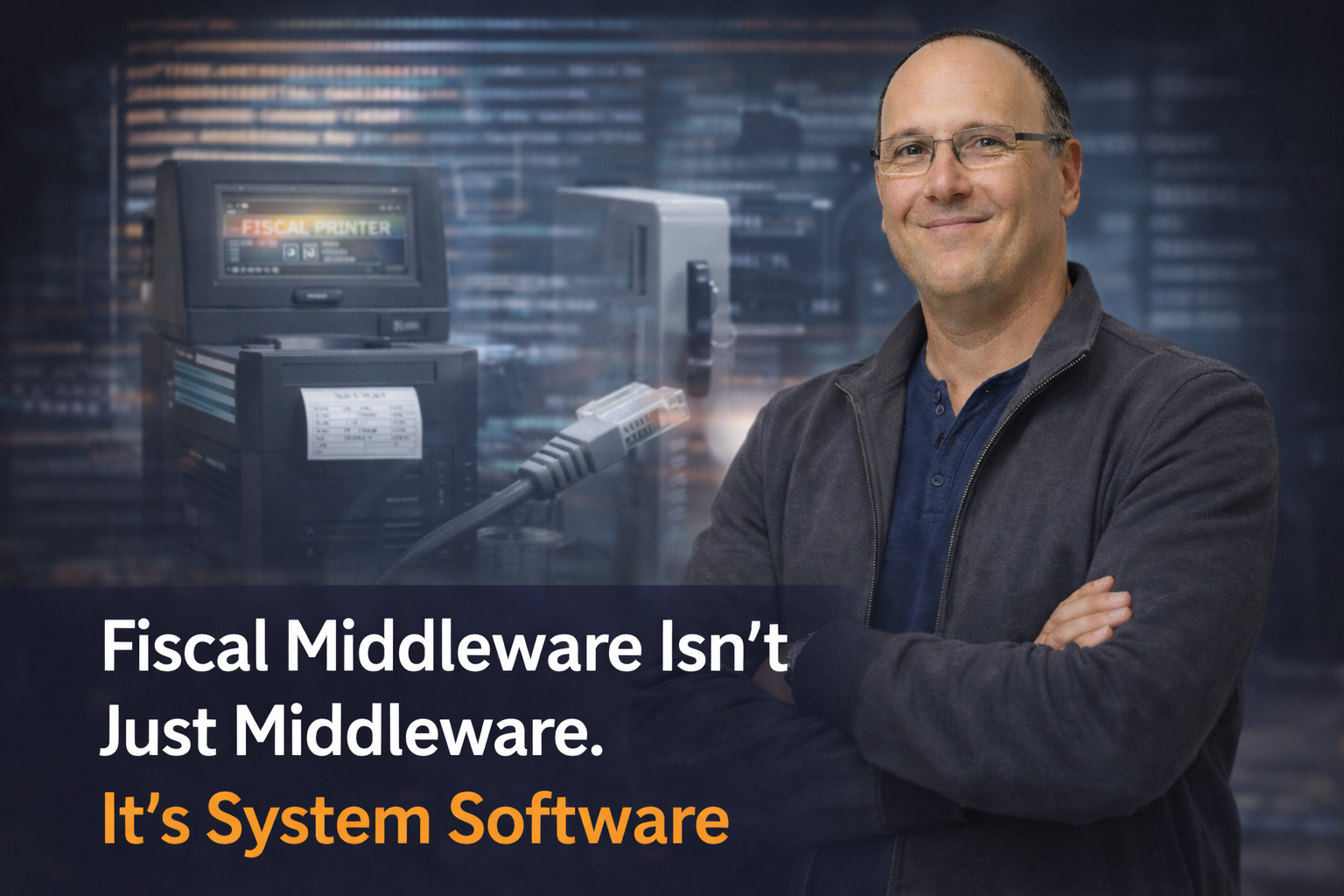
Why the fiscalization layer belongs in the same technical family as device drivers, runtimes, and operating environments.
In retail technology, words travel fast and get simplified on the way. One of those words is “middleware.” We use it as shorthand for anything that sits between a point-of-sale application and something complicated; devices, networks, authorities, certified services, and the slow-moving realities of regulation.
Architecturally, the label is understandable. A fiscalization layer does sit in the middle. But if we switch from architecture diagrams to software classification, “middleware” is only part of the story. The more accurate category is system software: the kind of software that makes other software run safely on top of a controlled environment.
This distinction is not academic. It changes how retailers and POS vendors govern, test, monitor, and invest in fiscalization. When a fiscalization component is treated like an “integration add-on,” it inherits project thinking. When it is treated like system software, it is managed like infrastructure: versioned, monitored, hardened, and expected to be boringly reliable, because stores depend on it to sell.
The reason I care about the label is simple. Fiscal Solutions started in the most unglamorous corner of fiscalization: device control. Early fiscal markets required fiscal printers, fiscal memories, signature units, and secure elements. That meant low-level communication with peripherals, handling device quirks, and enforcing sequences that could not be broken without legal consequences. In plain terms, it looked and behaved like driver work.
Over the years, fiscalization evolved. Many countries moved from hardware fiscalization to online and software-based models: real-time reporting, certified cloud endpoints, cryptographic signing, audit trails, and time-bound rules that remain valid even when networks fail. The fiscalization layer expanded accordingly. Today, it is not merely a connector. It is a runtime environment for legally valid transactions, local and cloud together, operating below business logic but above the operating system.
To make the case clearly, it helps to use definitions that engineers and standards bodies already agree on.
Encyclopaedia Britannica describes system software as the operating system and the utility programs that come with it, controlling a computer’s internal functioning and peripherals such as monitors, printers, and storage devices. The emphasis is important: system software manages resources and devices so that applications can run without dealing with the messy details of every peripheral and every low-level rule.
The IEEE Computer Society’s Systems and Software Engineering Vocabulary (based on ISO/IEC/IEEE 24765 and ISO/IEC 2382) uses language that is remarkably consistent with that idea. It frames system software as software intended to facilitate the operation and maintenance of a computer system and, in another formulation, as application-independent software that supports the running of application software.
Middleware, on the other hand, is commonly used for the layer that helps applications communicate and coordinate in distributed environments. Microsoft Azure describes middleware as the software that fills the gap between operating systems and the applications that run on them, often acting as a translation layer for communication and data management. IBM calls it “software glue” that binds different systems together across a network. These definitions fit the classic picture: application servers, message brokers, transaction monitors, integration platforms, and service runtimes.
So where does fiscal middleware belong?
In practice, the fiscalization layer looks less like a feature and more like a system service. It controls specialized peripherals and security components when they exist. It manages durable local records and sequencing when connectivity fails. It handles cryptographic keys, certificates, signing, and verifiable integrity. It normalizes protocols and message formats for tax-authority endpoints and certified intermediaries. It provides stable interfaces that allow the POS application to behave consistently across countries, even while the underlying rules vary widely.
In that sense, fiscalization software resembles a hybrid of device drivers, security services, and a compliance runtime. Cashiers do not “use” it. It does not compete with the POS user experience. It runs underneath, as a background service with a lifecycle owned by IT and platform teams. It is updated cautiously, rolled out with controls, and monitored because failure is not just a bug; in many jurisdictions it is a business interruption.
Operating-systems literature provides a helpful analogy.
Andrew Tanenbaum describes an operating system as serving two core goals: providing programmers a clean, abstract set of resources instead of messy hardware resources, and managing those hardware resources. If we swap “hardware resources” for “fiscal devices and government endpoints,” we get a close description of the fiscalization layer’s job. The POS developer should not have to master every device protocol, every signature workflow, every timing rule, and every authority-specific error code. A system layer should provide a clean abstraction and enforce correct behavior.
This is where the word “middleware” becomes misleading. Middleware is a good architectural label for “the component in the middle.” But as a technical classification, it underplays the resource-control responsibilities that fiscalization software carries. A fiscalization layer is not only integrating systems; it is controlling inputs and outputs that have legal meaning, and it is responsible for creating an unbroken chain of records that can be proven later.
In the Fiscal Solutions model, that chain is enforced by a split architecture designed for real-world retail constraints. A local component runs close to the POS and handles device control, offline operation, event sequencing, and local persistence. A cloud component connects to authorities and certified services when required, manages country-specific protocols, and centralizes monitoring, configuration, and updates. Together they behave like system software in a distributed setting: a service layer that applications rely on, but customers never see.
Why does it matter how we name it?
Because the name drives the mindset. System software is governed differently from application software. It is tested differently. It is deployed differently. It is monitored differently. Retailers do not treat an operating system as a local project; they treat it as platform infrastructure. Fiscalization deserves the same approach: stable interfaces, predictable behavior, regression testing, change management, and continuous monitoring for regulatory updates.
Calling fiscalization “system software” also clarifies the boundary that modern POS organizations need.
Promotions, pricing, loyalty, UI design, and customer experiences belong in application software. Fiscal integrity, signing, mandated formats, audit logs, and authority communication belong in the system layer. When those concerns are mixed, every country rollout becomes a rewrite. When they are separated, POS teams move faster and compliance risk drops.
None of this is an argument that “middleware” is a forbidden word. On architecture slides, it is useful. But for engineering teams and executives responsible for risk, the better classification is system software.
Fiscalization is not a business feature. It is an operating environment for legally valid retail transactions.
That is the real point. Once you see fiscalization as system software, you stop treating it as a scattered set of local requirements. You start treating it as a platform capability, one that belongs at the same layer of seriousness as databases, security services, and the operating systems your stores rely on every day.
Sources and further reading
Encyclopaedia Britannica, “System software.” https://www.britannica.com/technology/system-software
Encyclopaedia Britannica, “Driver (computer program).” https://www.britannica.com/technology/driver-computer-program
IEEE Computer Society, Systems and Software Engineering Vocabulary (entry showing “system software” definition). https://pascal.computer.org/sev_display/printSearch.action?source=&term=Software+Design
ISO, “ISO/IEC/IEEE 24765:2017 — Systems and software engineering — Vocabulary” (standard overview). https://www.iso.org/standard/71952.html
Microsoft Azure, “What is middleware?” https://azure.microsoft.com/en-us/resources/cloud-computing-dictionary/what-is-middleware/
IBM, “What is middleware?” https://www.ibm.com/think/topics/middleware
Tanenbaum & Bos, Modern Operating Systems (quote appears in a public preview). https://studentebookhub.com/wp-content/uploads/2024/preview/9780137618934.pdf
