


Retail tax audits used to be seen mainly as an accounting event. A tax authority arrived, documents were reviewed, figures were compared, and the finance department carried most of the pressure.
That view is no longer enough.
In modern retail, a tax audit is increasingly a technology test. It is a test of the POS system. It is a test of data integrity. It is a test of whether the retailer, the POS vendor, the ERP provider, the store team and the compliance function are all operating from the same reality.
I have worked with fiscalization projects across many countries, and one lesson has repeated itself again and again: in international retail expansion, fiscalization is often underestimated.
Retailers invest enormous energy into store concepts, logistics, assortment, pricing, loyalty programs and customer experience. But when the discussion turns to local fiscal rules, receipt requirements, certified software, transaction signing, data exports or audit readiness, the topic is too often treated as a technical detail that can be solved late in the project.
That is a dangerous assumption.
Fiscalization is not a local administrative formality. It is one of the core conditions for legally operating a retail business in many markets. When it is misunderstood, delayed or implemented only superficially, the consequences can be serious. A store opening can be blocked. A rollout can be delayed. A POS implementation can become more expensive than expected. A retailer can face penalties, reputational risk and operational disruption.
And in the worst cases, a problem that started with a missing technical document or an incomplete export file can grow into a full tax audit.
The story behind our own Fiscal Portal began with exactly this kind of practical pain. In the early 2000s, we were developing fiscal drivers for fiscal printers in retail projects. At that time, the work was highly technical. Developers had to communicate directly with fiscal printers, often through serial interfaces and device-specific command protocols.
One project for a large chain of convenience stores became blocked because the necessary technical documentation for a fiscal printer protocol was difficult to obtain. The technology team could not move forward without the right fiscal documentation.
That experience shaped my view of global fiscalization.
Even the best developer cannot build a compliant fiscal solution without the right rules, protocols and legal documentation. Even the best POS system cannot be compliant if the requirements are not understood, documented and implemented correctly.
This is still true today, even in the age of AI. AI can support analysis, but fiscal compliance still requires reliable source documentation, clear interpretation and practical implementation experience.
That is why I believe the future of retail tax compliance will belong to retailers and POS vendors who treat fiscalization as a strategic capability, not as an afterthought.
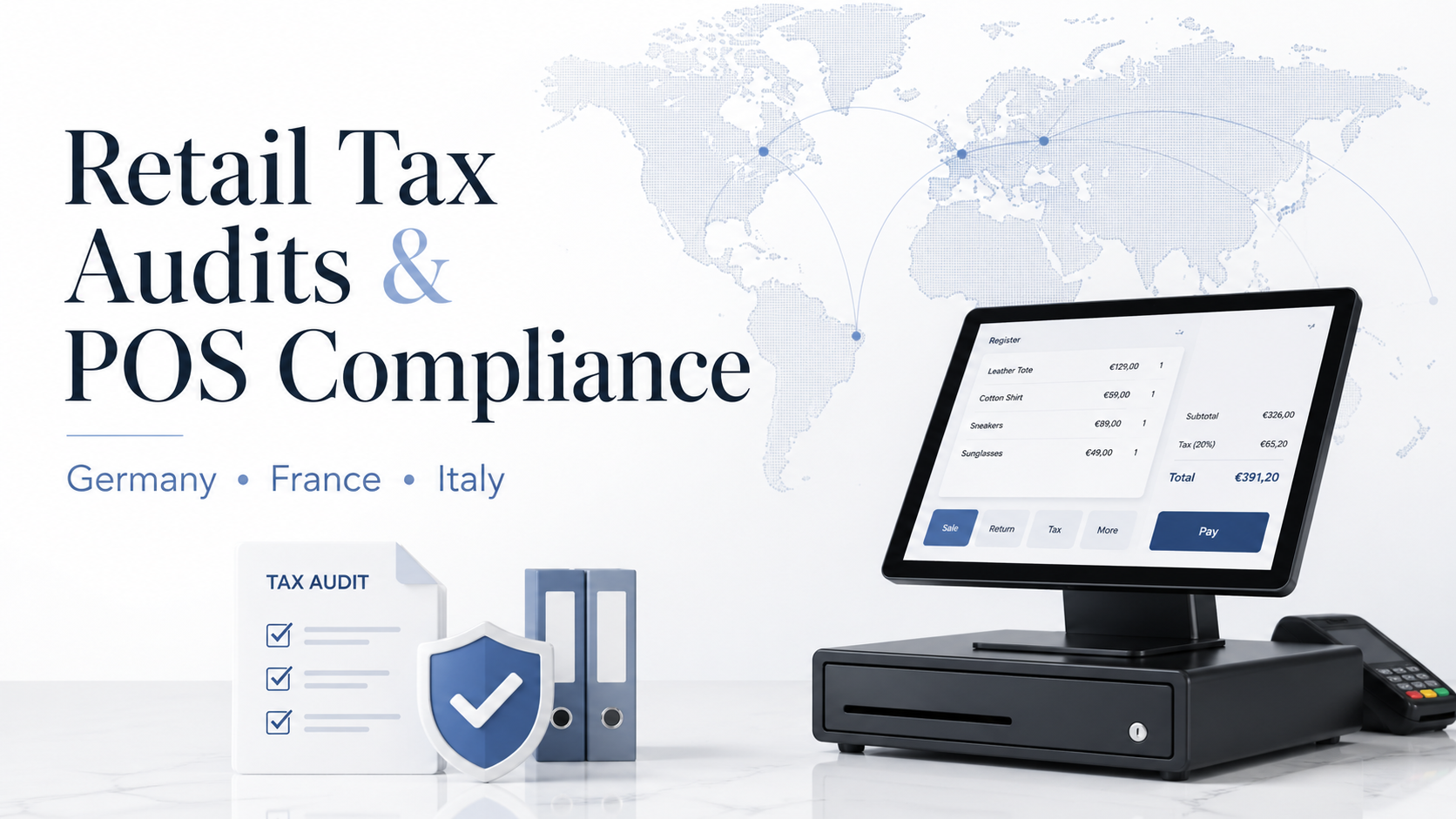
Germany, France and Italy show this shift very clearly. Each country has its own model, its own audit logic and its own technical expectations. But all three point in the same direction: tax authorities want better data, faster access and stronger proof that retail transactions are complete, secure, traceable and correctly reported.
Germany is a strong example of audit readiness as an operational discipline. The German fiscalization model is based on a technical security element, commonly known as TSE, which digitally protects transaction data. The POS application itself does not need to be certified in the same way, but the electronic recording system, the TSE and the related reporting obligations create a clear compliance environment.
The important practical point is not only the legal structure. The important point is how audits work in the real retail environment.
In Germany, cash register inspections can be unannounced and can happen during business hours. Auditors may request access to the POS system, TSE data, electronic records, exports and documentation. They may observe the sales process or conduct a test purchase. For retailers, this means that compliance cannot be prepared only when an audit letter arrives. The store must be ready every day.
This is where many organizations underestimate POS compliance.
It is not enough that the head office has a policy. It is not enough that a system was once implemented correctly. The real question is whether the retailer can prove compliance immediately, at store level, with the data and documentation that the auditor requests.
Can the staff respond correctly? Can the required exports be produced? Are the transaction records complete? Does the data in the POS match the ERP and reported figures? Are the system descriptions, operating manuals and TSE documentation available?
I have seen how POS vendors struggle with local compliance because they often look at these questions only from a software-delivery perspective. But fiscalization is not just a feature in the POS backlog. It is a legal and operational responsibility that lives inside the daily transaction flow.
When an auditor asks for data, the answer cannot be, “We will check with development.” The system either produces the required evidence, or it does not.
France approaches fiscalization differently, but the direction is similar. The French model is built around core principles such as inalterability, security, traceability and archiving. The focus is on whether the software solution preserves transaction integrity and prevents manipulation.
Certification or a valid compliance certificate plays a central role, but the real audit question goes deeper than the certificate itself.
A French audit may examine whether the POS system truly follows the required principles. Authorities can look at grand totals, periodic reports, technical logs, digital signatures and the chain of transactions. If the data shows gaps, inconsistencies or signs of modification, the retailer may face serious consequences.
In this model, compliance is not only about having a document in a drawer. It is about whether the system behavior, the audit trail and the transaction history tell a consistent story.
France also shows where retail tax compliance is heading more broadly. With the move toward electronic invoicing and e-reporting, authorities will receive more transaction data in a more structured and regular way. That changes the balance of power.
Traditional audits will not disappear, but the trigger for an audit may increasingly come from data analysis. If the authority has greater visibility into transaction flows, unusual patterns can be identified earlier. For retailers, this means that compliance errors can become visible much faster than before.
Italy offers another important lesson. Its fiscalization system has long been hardware-based, with the RT fiscal device playing a central role, while software fiscalization is also developing. Italy is characterized by daily transmission of data to the tax authority, automatic storage of transactions and the obligation to issue fiscal receipts.
From a retailer’s perspective, Italy shows why fiscalization must be planned as part of the entire operating model. The fiscal device, the POS, the receipt process, the data transmission, the local legal framework and the store process all have to work together.
A retailer cannot treat the fiscal printer or fiscal device as an isolated component. It is part of a wider compliance chain.
This is where I believe many international retailers and POS vendors need to change their mindset.
Global fiscalization is not one project repeated in many countries. It is a series of local compliance models that must be managed through a global architecture. The challenge is to create a scalable POS and compliance strategy while respecting local rules that may differ completely from one market to another.
Germany wants immediate readiness and secure exportable data. France focuses on certified software behavior, traceability and transaction integrity. Italy emphasizes formal procedures, fiscal devices, daily transmission and structured audit requirements.
Other countries have their own models again. Some require online communication. Some require fiscal hardware. Some require certified software. Some require real-time reporting. Some combine several of these elements.
For a retailer expanding internationally, this is not a side topic. It is part of the expansion strategy.
