


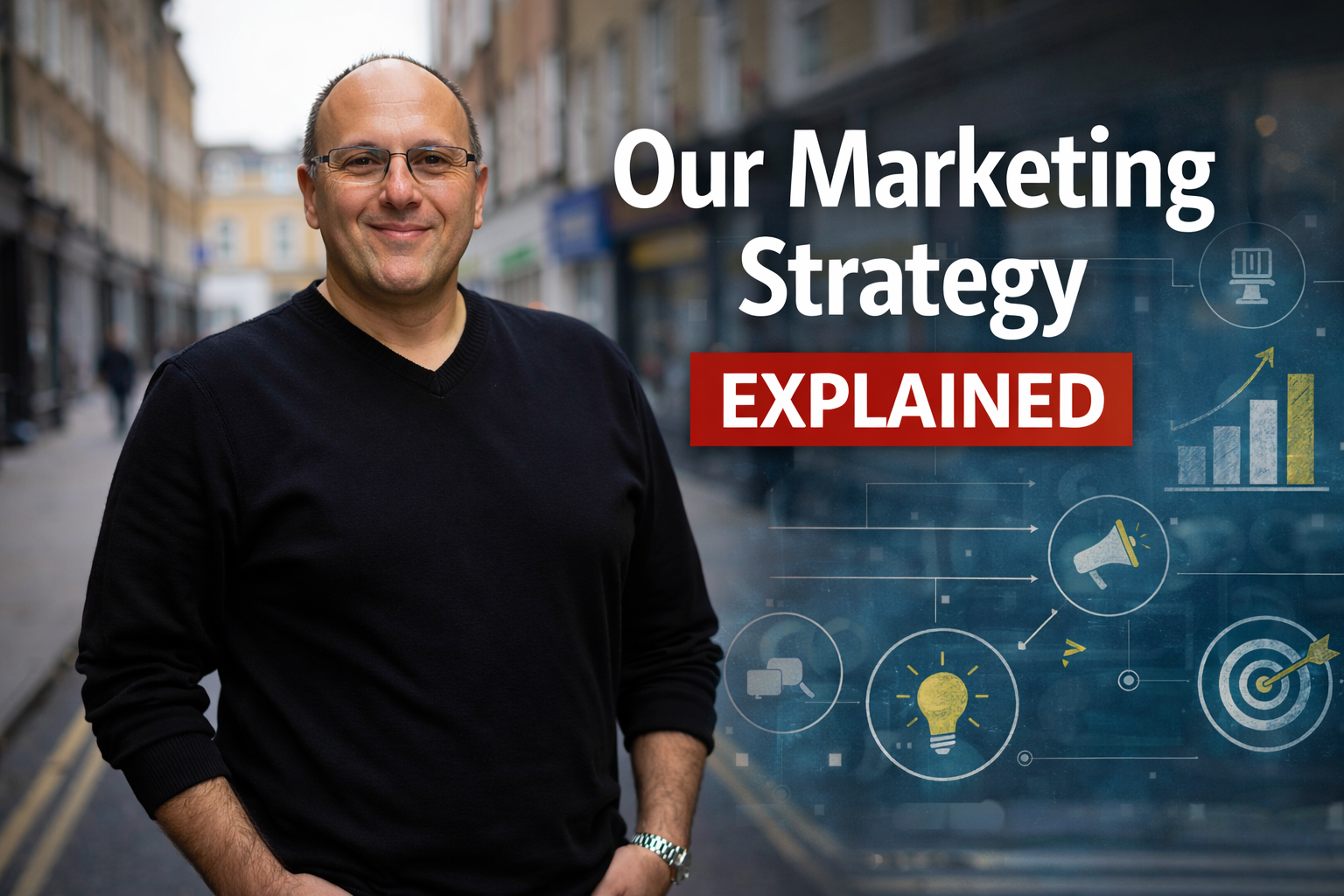
Why, at Fiscal Solutions, marketing begins long before communication
When people speak about marketing, they often mean campaigns, messaging, branding, or promotion. Those elements matter, but they are not where marketing begins.
At Fiscal Solutions, we understand marketing in a broader and more strategic way. We do not see it as a layer added on top of the business. We see it as the visible expression of the business itself.
A company communicates even when it says nothing. Every decision it makes, every priority it chooses, every product it builds, every event it organizes, and every expert it puts in front of the market sends a message. In that sense, marketing is not only what a company says. It is what a company does, consistently and publicly.
That is why our marketing strategy is inseparable from our company strategy.
Marketing as strategic behavior
For us, marketing is not primarily about describing who we are. It is about behaving in a way that makes our identity clear to the market.
This view simplifies many things.
It means we do not rely on complicated campaign structures or abstract brand definitions to create market presence. Instead, we focus on a small number of strategic principles and make sure they are reflected in the way we operate, the way we communicate, and the way we create value.
At Fiscal Solutions, our marketing strategy is built on two principles:
-
Show up
-
Do remarkable things so that others can talk about us
These two ideas are simple, but they are demanding. Together, they define how we build visibility, reputation, and trust.
The first principle: show up
In theory, showing up should be easy. In practice, it has become harder than ever.
The digital world is saturated with content. AI has made content production faster and easier, which means the market is overwhelmed by messages, opinions, and material of every kind. Attention has become scarce. Visibility is no longer guaranteed simply because something has been published.
Yet one thing has not changed.
People still respond most strongly to people.
Technology changes. Platforms change. Formats change. But credibility still depends on human expertise, real knowledge, and authentic professional presence. For that reason, our approach to visibility is highly specific.
When we say “show up,” we do not mean becoming influencers. We do not mean producing content for the sake of activity. We do not mean chasing broad attention without purpose.
We mean helping our experts become visible to the people who need their expertise.
This is not a superficial personal branding exercise. It is a deliberate effort to ensure that our specialists are seen, recognized, and respected for their competence. We want them to stand out not because they are loud, but because they are relevant, knowledgeable, and credible.
That distinction matters.
We are not trying to be visible to everyone. We are trying to be visible to the right audience. In our case, that means global retailers, POS software vendors, and other decision-makers who value deep expertise in fiscalization.
The second principle: do remarkable things
Visibility alone is not enough.
Showing up without substance creates noise. In the long run, noise does not build a serious brand.
That is why the second principle is equally important: we aim to do work that is remarkable enough that others will naturally talk about it.
This is one of our strongest beliefs: a company does not build a meaningful brand by speaking endlessly about itself. A brand becomes strong when the market begins speaking about the company.
That market includes customers, prospects, partners, analysts, industry peers, and, at times, even competitors.
The broader and more relevant that conversation becomes, the stronger the brand.
This is also why we are comfortable making choices that may appear unusual at first glance. One example is our approach to webinars and public knowledge-sharing. We do not prevent competitors from attending. Some might see that as giving away too much. We see it differently.
Anyone who attends a webinar becomes part of the conversation around it. That matters. The more industry participants talk about our ideas, our experts, and our work, the stronger our position becomes. In addition, professional markets are dynamic. Today’s competitor may be tomorrow’s customer, partner, or employer of a future buyer.
Just as importantly, anyone who joins one of our webinars becomes part of the audience that witnesses our expertise directly.
That is valuable.
We do not seek attention for its own sake. We seek to create work that is useful, credible, and distinctive enough to earn discussion.
Why both principles must work together
Our strategy works only because these two principles support one another.
If a company shows up without doing anything remarkable, it may become visible, but not respected.
If a company does remarkable work but fails to show up, it may deserve recognition, but remain invisible.
Sustainable market presence requires both.
We therefore invest in the visibility of our experts and in the quality of the work behind them. We want our people to be present in the market, and we want the market to find enough value in what we do that our ideas continue to travel beyond our own channels.
That is the real purpose of our strategy: to create the conditions in which others carry our reputation forward.
A deliberately narrow focus
No strategy becomes powerful without focus.
Our focus is intentionally narrow. We are not trying to serve every industry, every type of company, or every level of complexity.
We focus on global retailers and POS software vendors, especially those operating internationally or preparing for international growth.
If a POS software vendor is beginning to expand into multiple countries and needs a reliable way to support compliance across markets, that company is relevant to us.
If a retailer already operates internationally and faces growing fiscal complexity, that company is relevant to us as well.
This focus is important because it shapes the clarity of our message and the relevance of our expertise. We understand large-scale international retail environments. We understand store systems, rollout complexity, local legal requirements, and the operational realities behind global retail and POS strategies.
Historically, our center of gravity has been the store. But as regulatory requirements increasingly move into online and hybrid environments, we are moving with them.
Why we chose depth over breadth
Retail compliance is a broad domain. It includes many different areas, from consumer protection and privacy to tax, invoicing, reporting, and transaction controls. Every area contains multiple legal frameworks, local interpretations, and implementation challenges.
For more than two decades, Fiscal Solutions has chosen to go deep into one of those areas: fiscalization.
That decision was deliberate.
Rather than building a broad compliance portfolio across many loosely connected topics, we chose to specialize deeply in one highly complex and strategically important field. Over time, that depth has become one of our greatest advantages.
In simple terms, our business can be described in one sentence:
We do fiscalization for global tier-one retail businesses.
Some companies in our space pursue horizontal growth. They extend their offering into adjacent compliance categories such as e-invoicing and other tax-related domains. That is a valid strategic choice.
Our choice has been different.
We believe in vertical growth. We want to go deeper, build stronger competence, conduct better research, and innovate inside our chosen space. We believe this is how true distinction is created.
Depth produces insight. Insight produces better decisions, better products, better services, and more remarkable outcomes.
And remarkable outcomes, in turn, strengthen our marketing strategy.
What this means in practice
When translated into daily work, our strategy is straightforward.
We show up in front of global retailers and POS software vendors. We make our expertise visible through people, events, knowledge, and public presence.
At the same time, we work to produce results, ideas, and contributions that are strong enough to be noticed and shared by the market itself.
This is only possible if what we do genuinely improves the business or the professional life of the people we serve.
That is a crucial point.
People do not talk about a company because it tries hard to be seen. They talk about it when the company helps them think better, act faster, reduce risk, or understand something important more clearly.
That is why we place so much emphasis on the substance of our work. Communication matters, but it cannot compensate for a lack of real value.
Why marketing and company strategy are inseparable
This is also why we do not separate marketing from the broader strategy of the company.
To create work that people want to discuss, the company must first become capable of producing that kind of work. That capability cannot come from the marketing department alone. It has to be embedded in the organization.
It must be visible in the way the company thinks, researches, develops products, supports customers, organizes knowledge, and invests in expertise.
For us, marketing is therefore not decoration. It is not packaging applied after the fact.
It is the visible consequence of strategic choices made throughout the business.
In that sense, marketing is not a support function standing beside the company. It is one of the ways the company becomes legible to the market.
The strategic conclusion
Our marketing strategy can be expressed in a few words, but it takes discipline to execute.
We aim to show up.
We aim to do remarkable things.
And we aim to create the conditions in which others will talk about us.
That is how we build trust.
That is how we build reputation.
That is how we build brand.
At Fiscal Solutions, marketing is not separate from the business. It is the business strategy made visible through expertise, action, and consistency.
