


For years, retailers treated AI as a tool for efficiency. Adobe’s latest traffic analysis suggests that this is now too small a view. The bigger change is happening at the very start of the shopping journey. Adobe says its findings are based on more than 1 trillion visits to U.S. retail sites, supported by a March 2026 survey of more than 5,000 U.S. consumers. In the first quarter of 2026, traffic from AI sources to U.S. retail sites rose 393% year over year. In March alone it was up 269%, after already rising 693% during the 2025 holiday season. This is U.S. data, not a global census, but the direction is hard to ignore.
The most important part of Adobe’s report is not the traffic spike. It is the quality of that traffic.
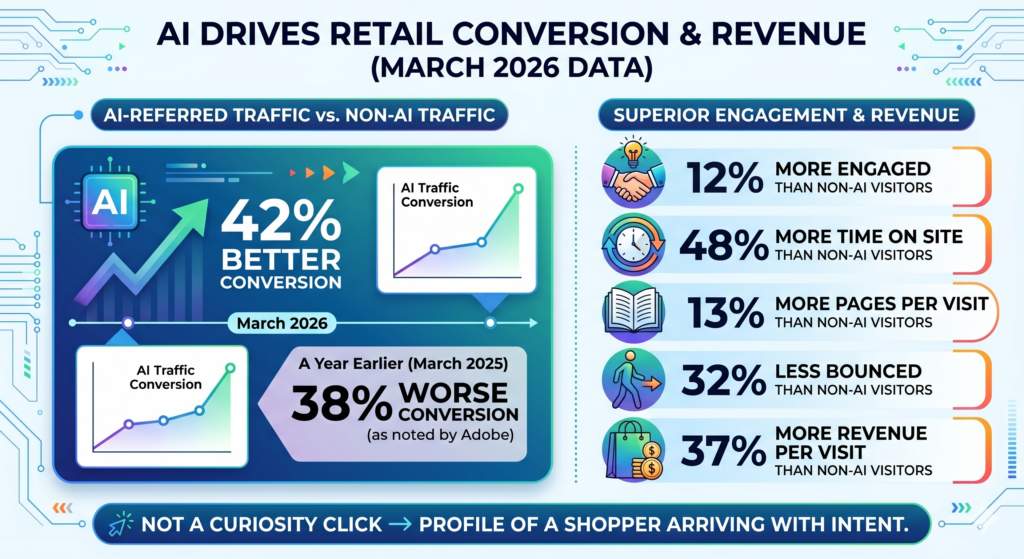
In March 2026, AI-referred retail traffic converted 42% better than non-AI traffic. A year earlier, Adobe says it converted 38% worse. AI-referred visitors were also 12% more engaged, spent 48% more time on site, viewed 13% more pages per visit, bounced 32% less, and generated 37% more revenue per visit than non-AI visitors. That is not the profile of a curiosity click. It is the profile of a shopper arriving with intent.
That change matters because it shows how fast AI has moved down the funnel. In Adobe’s August 2025 retail analysis, AI was still mainly a research companion. At that point, 53% of surveyed consumers said they used AI for research, 40% for product recommendations, and 36% for finding deals, while AI traffic still converted 23% worse than non-AI traffic. By March 2026, Adobe’s newer data shows AI had become a much stronger purchase driver. The shift is not subtle. Retailers are watching discovery, comparison, confidence and conversion move closer together in a single conversational step.
The second pattern is less comfortable for retailers. Not every brand is equally visible to AI systems. Adobe found that the average AI-readability score for U.S. retail homepages was 75, for category pages 74, and for product pages only 66. The gap between top-performing and low-performing retailers is especially large at the entry layer. In Adobe’s February 2026 readability analysis, top AI-traffic performers had a 52% advantage on homepage readability, a 32% advantage on search-results pages, and a 23% to 30% advantage on blog and buying-guide pages. In plain language, many retailers are still building websites mainly for human eyes, while the new discovery layer increasingly depends on machine readability.
This is likely to become one of the clearest new competitive gaps in retail. Adobe’s report shows that top performers do not win only because they have stronger product pages. They also win because they have stronger entry and discovery pages, clearer structure, and fewer content gaps on high-impact pages such as homepages, brand landing pages, search pages, store pages, and returns pages.
The third pattern is that AI is strongest where shopping starts with uncertainty, inspiration or comparison. Adobe’s March 2026 retail breakdown shows the strongest AI-referral boosts in categories such as toys, baby and toddler products, apparel, personal care products and sporting goods. Moderate boosts appeared in categories such as appliances and electronics, while weaker boosts showed up in grocery and some home-related basics. That pattern makes sense. AI is especially useful when the shopper wants help narrowing options, comparing trade-offs or discovering something new. In other words, AI does not only help sell products. It helps reduce decision fatigue.
The fourth pattern comes from outside retail, and it may be even more important. Adobe found that AI-driven traffic is growing across every major sector it tracks. Retail had the fastest growth in Q1 2026, but travel rose 233%, financial services 158%, media and entertainment 84%, and tech/software 63%. Tech/software also had the highest AI visit share, roughly twice media and entertainment and four times retail. Travel offers the clearest clue about what comes next: AI traffic there still trails non-AI traffic in conversion, but the gap narrowed from 86% in October 2024 to 14% in March 2026. That suggests a pattern retailers should take seriously. In research-heavy categories, AI first wins attention, then time, then trust, and only after that does it begin to reshape conversion.
What should retailers do now?
So what should retailers do now if they want to turn this shift into advantage rather than react to it late? First, they should stop treating AI traffic as a side effect of search and start managing it as a new acquisition channel. Adobe’s data says half of consumers using AI for shopping click the links provided by the AI assistant, and 27% say they make purchases directly through those links. That is already meaningful behavior. Retailers that still review AI traffic only as a curiosity in analytics dashboards are probably underestimating the speed of change.
Second, retailers should rebuild their content model for two audiences at once: people and machines. Brands now need to think not only in keywords, but in prompts; not only in pages, but in systems. Product attributes, taxonomy, pricing, availability, offers and support content need to be structured so AI systems can interpret them correctly and in near real time. This is especially urgent on product pages, which Adobe found to be among the weakest points in retail AI readability.
Third, retailers should pay much more attention to what happens outside their own websites. One of the sharpest observations of Adobe is that AI systems decide not just what gets seen, but what gets trusted. That trust is shaped by a wider ecosystem that includes social platforms, Reddit, reviews, gift guides and third-party content. In that world, digital shelf strategy expands far beyond SEO. It becomes a mix of structured site content, strong product data, current reviews, helpful editorial pages and brand presence in the places AI systems use as evidence.
Finally, retailers should redesign the landing experience for AI-referred visitors. Adobe’s data shows these users arrive with higher intent. That means the website should not greet them with a generic front door. It should greet them with relevance. Adobe’s strategy team argues that landing pages need to be fast, readable, personalized and closely aligned with the prompt or question that brought the visitor in. It also points to a likely next step: on-site AI assistance. As shoppers get used to natural-language interaction in AI tools, their patience for old search boxes and rigid navigation is likely to fall. Retail sites that feel conversational will have an advantage over sites that still feel like folders.
The deeper lesson in Adobe’s report is simple. AI is no longer just another marketing tool. It is becoming a decision layer between shoppers and brands. Retailers who adapt early will not simply get more traffic. They will be easier to find, easier to trust and easier to buy from. That is a very different kind of edge. And it may turn out to be one of the most important retail advantages of the next few years.
Sources
Adobe, 2026 Q2 AI Traffic Report.
Adobe for Business Blog, “Adobe report: U.S. retailers see surge in AI traffic, but many websites are not entirely readable by machines.”
Adobe Experience Cloud webinar transcript, “Adobe Digital Insights: GenAI Traffic Update.”
Adobe for Business Blog, “Generative AI-powered shopping rises with traffic to U.S. retail sites.”
Adobe for Business Blog, “2026 AI and Digital Trends – 4 key takeaways at the intersection of AI, agents, and human-centered customer experience.”