


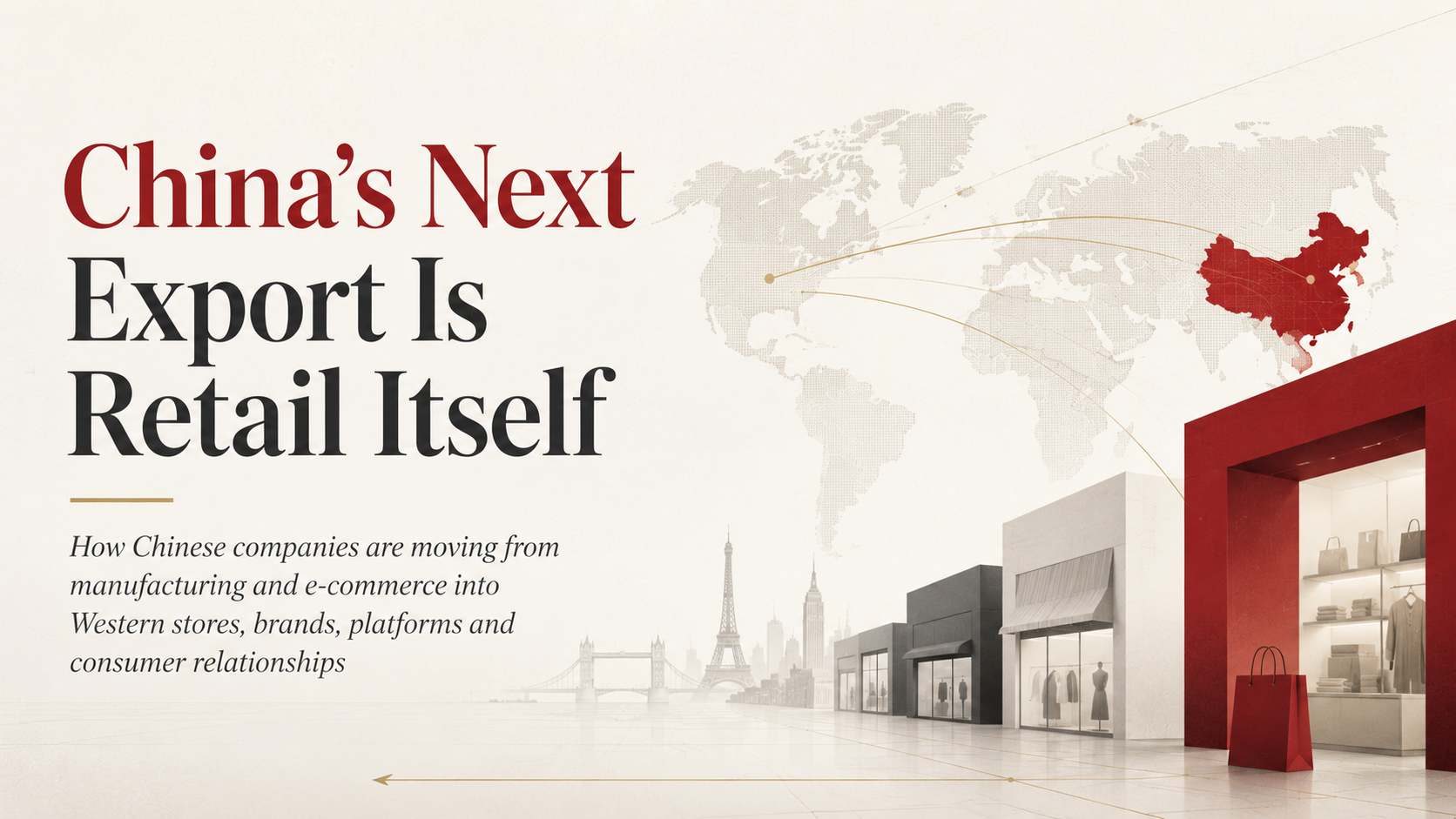
How Chinese companies are moving from manufacturing and e-commerce into Western stores, brands, platforms and consumer relationships
For decades, the Western retail story about China was simple. China made the products. Western retailers built the brands, owned the customer relationship and controlled the store experience. That model is beginning to look old.
A new pattern is emerging. Chinese companies are no longer only supplying Western retail. They are buying Western brands, entering Western shopping streets, opening stores in prime locations, acquiring retail infrastructure, taking strategic stakes in global consumer companies and exporting retail concepts that were first proven in China’s brutally competitive domestic market.
This is not a collection of isolated deals. It is a strategic movement. The first phase of China’s economic transformation was industrial. China became the manufacturing powerhouse of the world. The second phase was digital. China built some of the most advanced e-commerce, payment, logistics, social-commerce and live-shopping ecosystems in the world. The next phase may be retail expansion: Chinese companies taking their operational models, consumer brands and data-driven store concepts into Western markets.
That shift deserves attention from every international retailer, landlord, POS software vendor, payment provider and compliance specialist. It will change competition, store formats, customer expectations and the technology stack behind cross-border retail operations.
The first drama is ownership. JD.com’s move toward Ceconomy, the owner of MediaMarkt and Saturn, is not just another acquisition headline. It gives a Chinese e-commerce and logistics player a route into one of Europe’s most important electronics retail networks, with around 1,000 stores in several European countries and one of the largest online electronics platforms in Europe. That is not only digital commerce entering physical retail. It is Chinese retail infrastructure entering Europe at scale.
The second drama is brand control. Anta’s deal to buy a 29.06% stake in Puma makes the Chinese sportswear group the largest shareholder in one of Germany’s best-known global sports brands. HSG’s majority investment in Golden Goose shows a similar appetite for Western lifestyle and luxury assets. These deals are not about cheap manufacturing. They are about owning desire, distribution, brand heat and premium positioning.
The third drama is direct store expansion. Pop Mart, MINISO, Luckin Coffee, Chagee, Mixue and Shein show that Chinese retail concepts no longer need to hide behind Western intermediaries. They can face the Western consumer directly. Some are emotional IP machines. Some are ultra-efficient beverage chains. Some are low-price lifestyle retailers. Some are digitally native fashion platforms testing physical stores not because they need shelves, but because they need visibility, legitimacy and a deeper consumer relationship.
This is where the story becomes more uncomfortable for Western retailers. Chinese concepts are not only arriving with low prices. They are arriving with operational learning from one of the most competitive retail environments in the world. China’s domestic market forced retailers to master speed, data, social commerce, mobile ordering, community traffic, platform integration and rapid assortment reaction. Many Western retailers still treat these topics as innovation projects. For many Chinese players, they are operating muscle.
The Pattern Behind Recent Moves
The following table combines two connected trends: Chinese investment or acquisition activity involving Western retail brands and Western retail operations, and Chinese retail concepts expanding directly into Western markets. Some deals are confirmed, while a few reported transactions should be treated with care until all parties confirm them publicly. The pattern, however, is already visible.
| Timing | Chinese company / investor | Western retailer or market | Type | Strategic meaning |
| Oct 2024 | S’Young Group | RéVive Skincare | Acquisition | Chinese beauty groups are moving into premium Western beauty brands, not only distribution. |
| Jan 2025 | HongShan / HSG | Marshall Group | Majority stake | Consumer-brand ownership with DTC and retail-channel relevance. |
| Apr 2025 | Chagee | United States | Store expansion | Chinese tea chains are entering premium U.S. retail locations. |
| Jul 2025 | Luckin Coffee | United States | Store expansion | App-first, pickup-focused coffee retail moves into New York. |
| Jul–Nov 2025 | JD.com | Ceconomy / MediaMarkt-Saturn | Takeover / control acquisition | A major Chinese retail and logistics platform gains access to European retail infrastructure. |
| Oct–Nov 2025 | Shein | France | Permanent physical stores | A digital ultra-fast-fashion model tests physical retail as visibility and legitimacy. |
| Nov 2025 | Boyu Capital | Starbucks China | Majority JV stake | Chinese capital gains control of a Western retailer’s China operations. |
| Nov 2025 | CPE | Burger King China | Majority JV stake | Local Chinese capital takes a larger operational role in Western food retail in China. |
| Dec 2025 | HSG / HongShan | Golden Goose | Majority stake | Chinese capital enters Western luxury lifestyle and sneaker retail. |
| Dec 2025 | MINISO | Europe | Store expansion | Chinese lifestyle retail expands through flagship and concept stores in major European cities. |
| Dec 2025 | Mixue | United States | Store expansion | A mass beverage and ice-cream chain tests a low-price, scalable Western model. |
| Jan 2026 | ANTA Sports | Puma | 29.06% strategic stake | Chinese sportswear becomes the largest shareholder of a global Western sports brand. |
| Mar–Apr 2026 | Centurium / Luckin ecosystem | Blue Bottle Coffee | Acquisition of cafe business | Chinese coffee capital meets a premium Western specialty coffee experience brand. |
| Mar 2026 | JD.com / Joybuy | Europe | Marketplace launch | JD attacks Europe not only through stores, but also direct online marketplace expansion. |
| May 2026 reported | Shein | Everlane | Reported acquisition | If confirmed, it would mark a symbolic purchase of a U.S. sustainability-positioned apparel brand. |
Why This Is Different
There is a temptation in the West to read this as another version of globalization. That would be too soft. This is not only capital moving across borders. It is the export of retail operating models that have been stress-tested in China’s environment of speed, digital adoption and intense consumer competition.
The Chinese domestic retail market created a different kind of retailer. Many of these companies learned to operate with mobile-first customer journeys, rapid store rollout, social-media-led demand creation, data-driven assortment, aggressive price-value engineering and strong supply-chain integration. When those capabilities move West, they do not arrive as theory. They arrive as operating practice.
Pop Mart is a good example. It is not simply a toy retailer. It is an IP-driven emotional commerce machine. Its 2025 interim results showed explosive growth in the Americas and Europe, with Americas retail stores rising from 10 in the first half of 2024 to 41 in the first half of 2025, and Europe and other regions rising from 9 stores to 18. Its model is built around scarcity, collectability, characters, community and social visibility. That is a very different retail logic from traditional toy distribution.
Luckin is another signal. It does not approach coffee primarily as a cafe ritual. It approaches coffee as a technology-enabled, app-driven, operationally efficient daily habit. When a company like that enters the U.S. and its controlling-investor ecosystem acquires Blue Bottle’s cafe business, the contrast becomes fascinating. Luckin represents speed and digital efficiency. Blue Bottle represents premium experience and slow coffee culture. The combination says a lot about where global coffee retail could go.
The conflict will not be simple. Western consumers do not automatically accept foreign retail concepts. Regulation will matter. Data protection, consumer rules, product safety, labor standards, sustainability claims, customs rules, taxation and geopolitical tension will all create friction. Shein’s physical-store move in France shows how quickly Chinese retail expansion can become political. Retail is no longer only commercial space. It is also cultural, regulatory and geopolitical space.
The larger lesson is that Western retailers should not underestimate the new competitors. The old assumption was that Chinese companies were strong at production but weaker at brands, stores and consumer emotion. That assumption is breaking. Pop Mart sells emotional characters. MINISO sells affordable lifestyle discovery. Chagee sells modern tea culture. Mixue sells price-accessible fun. Shein sells speed and algorithmic assortment. JD sells logistics, platform power and now potentially physical infrastructure.
These are not the same models. But they share a common direction: Chinese companies want more of the retail value chain. They do not want to remain invisible behind someone else’s brand. They want the customer, the data, the store, the brand, the platform and the transaction.
What Happens Next
I expect this trend to become much stronger over the next five years. The logic is too powerful to stop. Chinese companies face slower growth at home, rising competition, geopolitical pressure and the need to build global brands. Western markets offer prestige, purchasing power, brand validation and retail infrastructure that can be acquired, partnered with or disrupted.
The next wave will probably move in several directions at once. More Chinese brands will open directly operated stores in Europe and North America, especially in toys, lifestyle, beauty, tea, coffee, snacks, sportswear and affordable fashion. More Chinese capital will buy minority or majority stakes in Western brands that have strong identity but need growth, digital capabilities or access to Asia. More Western retailers will become partners with Chinese investors in local joint ventures, especially where China remains strategically important but operationally difficult. And more platform players will try to connect e-commerce, logistics and physical retail into hybrid Western operating models.
The most interesting question is not whether Chinese retailers can expand. They already are. The question is which Western retail categories are most vulnerable. I would watch categories where the product is emotional but operationally scalable: collectibles, beauty, beverages, fashion accessories, affordable lifestyle goods and specialty food. I would also watch categories where Western incumbents are slow, fragmented or burdened by legacy store economics.
For technology providers, this shift matters as much as it matters for retailers. Chinese retailers entering Western markets will need POS localization, fiscalization, e-invoicing, tax reporting, payments, ERP integration, data compliance and omnichannel architecture. Western retailers reacting to Chinese competition will need faster operating models, better store intelligence and more flexible retail platforms. The battle will not be won only by marketing. It will be won by operating systems.
The Prediction
My prediction is simple: China’s next major export will not be only goods. It will be retail concepts.
The first phase was made in China. The second phase was sold online from China. The next phase may be experienced in stores, cafes, shopping streets and malls across the West, operated by Chinese companies or backed by Chinese capital.
Western retailers should not panic. But they should pay attention. The arrival of Chinese retail concepts is not only a competitive threat. It is also a lesson. Speed matters. Store experience matters. Data matters. Community matters. Pricing architecture matters. Supply-chain control matters. And most of all, the ability to turn a product into a cultural object matters.
China learned how to manufacture for the world. Now its most ambitious retailers want to sell to the world, operate in the world and shape consumer behavior in the world. That is the real story. And it is only beginning.
Sources used
- Reuters, JD.com / Ceconomy / MediaMarkt-Saturn reporting and regulatory coverage, 2025-2026.
- Bundeskartellamt, clearance statement on JD.com acquisition of CECONOMY, 2025.
- Reuters, HSG / HongShan Capital Group and Golden Goose reporting, 2025.
- Reuters, Anta Sports acquisition of 29.06% Puma stake, 2026.
- Reuters, Shein permanent stores in France and related coverage, 2025.
- Pop Mart interim results announcement for the six months ended 30 June 2025.
- MINISO official / PR Newswire announcements on European store openings, 2025.
- TechNode / Inside Retail Asia coverage of Chagee’s first North American store, 2025.
- China Daily / Comunicaffe coverage of Mixue’s first U.S. store in Los Angeles, 2025.
- Yicai Global, 36Kr and coffee-industry coverage of Centurium / Blue Bottle Coffee transaction, 2026.