


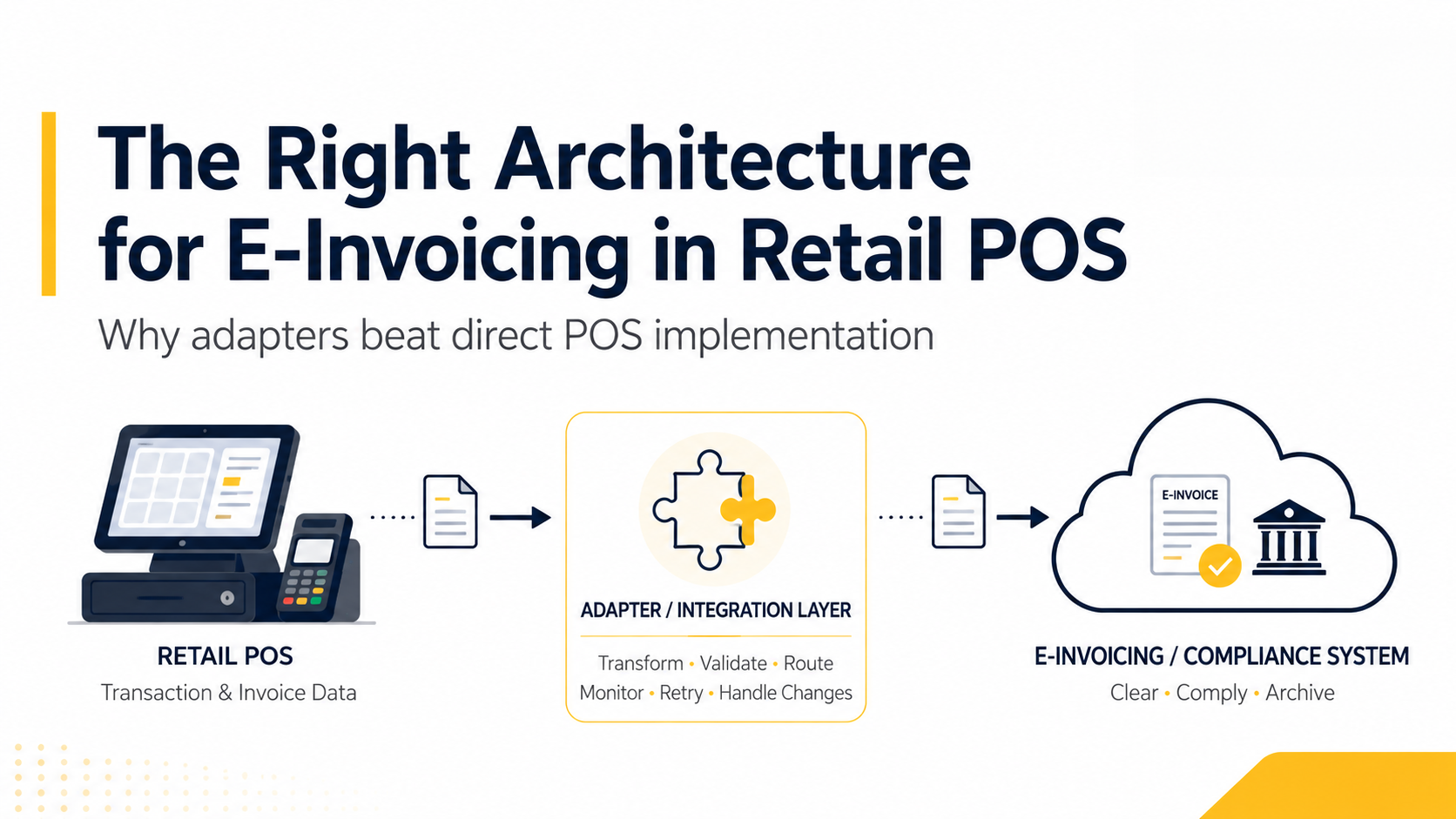
Why the POS should not become the e-invoicing system, and why large retailers need adapters that connect store transactions to the accounting and e-invoicing layer.
Executive thesis
E-invoicing is becoming one of the central compliance topics for retailers, but the architectural answer is often misunderstood. The point of sale is a critical system in the retail landscape, yet it should not become a second e-invoicing engine inside the store. The POS should capture the commercial transaction, perform the country-specific fiscalization where required, collect the data needed for a B2B invoice, and send that data through a controlled adapter to the retailer’s existing accounting, ERP or e-invoicing platform.
The reason is simple but strategically important. Large retailers already need an e-invoicing solution in the back office because they receive supplier invoices, issue B2B invoices, process accounting entries, archive legally relevant documents and manage tax reporting from systems that are not the POS. Rebuilding the same e-invoicing process inside the POS creates a parallel invoice domain, duplicates compliance responsibility and increases operational risk. In a complex international retail environment, every duplicated master process becomes a future source of chaos.
The POS should not implement e-invoicing as a second financial process. It should provide a reliable, legally complete transaction payload to the system that already owns invoicing, accounting and statutory reporting.
The store is already complex enough
Every large retailer lives with two forms of complexity. The first is technical complexity. A modern store is no longer a cash register with a few connected peripherals. It is a network of POS software, payment terminals, self-checkout, mobile POS, loyalty systems, pricing engines, inventory systems, fiscal devices, digital receipt services, workforce applications, security components, back-office interfaces and country-specific add-ons. Each system performs a task, but the real cost often comes from the integrations between them. When this architecture is multiplied across dozens of countries, languages, currencies, tax regimes and legal requirements, the store becomes one of the most difficult technology environments in the enterprise.
The second form is operational complexity. Retail processes rarely stay inside one system or one department. Product maintenance starts in master data management and ERP. Promotions may involve marketing, pricing, store operations and POS execution. Sales touch payment, inventory, loyalty, fiscalization and accounting. Returns connect customer service, stock management, refund logic and sometimes original invoice correction. When country-specific processes are added to this already connected landscape, retailers do not only face more software work. They face a governance problem.
This distinction matters because e-invoicing is often discussed as if it were only another technical mandate. It is not. E-invoicing sits at the intersection of tax, accounting, customer data, legal archiving, invoice lifecycle management and sometimes real-time reporting to tax authorities. It therefore belongs to the financial and compliance architecture of the retailer, not to the narrow operational boundary of the store.
Retail depends on clear ownership of master processes
The cleanest retail architectures are built around clear process ownership. Item master data is a useful example. The definition of an item, its attributes, its purchasing conditions, its sales price, its VAT classification and its country availability are normally governed centrally. Stores consume this data, but they do not own it. A POS may display an item, sell it and apply the relevant price or tax code, but it should not become the master system for maintaining items. If every store or POS instance began maintaining item master data independently, the result would be inconsistent pricing, broken reporting, wrong tax treatment and a loss of central control.
The same logic applies to invoicing. Accounting and ERP systems are usually the master systems for financial documents. They process supplier invoices, issue customer invoices, maintain accounting records, archive legally relevant documents and connect to tax reporting obligations. In many global retailers, there may also be an external e-invoicing provider or tax compliance platform that handles the local technical connection to clearance platforms, Peppol networks, tax authority systems or national reporting models.
Once this architecture exists, the POS should not become a second invoice master. It may initiate an invoice-relevant transaction in the store, especially in B2B scenarios, but the invoice lifecycle should still be governed by the financial system. Otherwise, the company creates two authorities for the same legal document. One authority sits in the accounting domain, where invoicing already belongs. The other sits in the store domain, where the system was designed primarily to execute sales transactions, not to manage the full legal and accounting life of invoices.
E-invoicing changes the format and reporting obligation, not the ownership of invoicing
The global move toward e-invoicing does not change the fundamental ownership of invoicing inside the retailer. It changes the format, the transmission channel, the validation model, the reporting timeline and the evidence requirements. The European Union’s VAT in the Digital Age reform is a good example of this direction. The European Commission states that digital reporting requirements will affect cross-border B2B transactions from 1 July 2030 and that Member States with domestic real-time reporting obligations must align with the EU model and standards by 1 January 2035. This confirms the broader movement from periodic tax reporting toward structured, transaction-level digital reporting based on e-invoicing.
Individual countries are also moving in the same direction at different speeds. Germany has introduced mandatory B2B e-invoicing in phases, with companies required to receive structured e-invoices from 2025 and broader issuance obligations following transitional rules. France is preparing mandatory B2B e-invoicing and e-reporting from 2026 and 2027, while Italy has already operated a mandatory B2B and B2C e-invoicing model through the Sistema di Interscambio since 2019. These examples show that e-invoicing is no longer an isolated local requirement. It is becoming part of the standard financial infrastructure of the enterprise.
That trend strengthens the case for a centralized or back-office-led architecture. Retailers will need e-invoicing capabilities anyway, independent of the POS. They will need them for supplier invoices, head-office B2B invoices, intercompany flows, e-commerce scenarios, marketplace interactions, credit notes, corrections and statutory reporting. Placing another e-invoicing engine in the store does not remove the need for the back-office solution. It only creates another place where the same compliance responsibility has to be configured, tested, monitored and maintained.
The store B2B transaction is real, but it does not justify POS-owned e-invoicing
There are legitimate cases where a business customer buys goods in a physical store and needs an invoice for the company. In that moment, the POS is involved because the sale happens at the POS. The cashier or self-service process may need to capture customer identification, VAT number, address, invoice reference, payment information and other country-specific fields. In some countries, fiscalization may also apply to the store transaction before, during or after the sale.
This does not mean that the POS should become the system that owns the e-invoice. The POS should create a complete and reliable transaction record and send it to the system that already owns invoicing. That system may be an ERP module, an accounting system, a dedicated e-invoicing platform, or a tax compliance solution such as SAP, Sovos, Avalara or another provider used by the retailer. The architectural role of the POS is to collect and transmit the invoice-relevant transaction data, not to replicate the full invoice lifecycle.
The best analogy is not technical but organizational. The store is the place where the sale happens. The finance function is the place where the invoice is owned. Store systems should serve the financial process with accurate data, but they should not fragment it.
The right architecture separates sales execution from invoice governance
The correct model for large retailers is a separation of responsibilities. For B2C transactions, the POS creates the sales transaction, applies the correct prices and taxes, performs fiscalization where the country requires it, processes payment and sends the relevant data to downstream systems. In many countries, a receipt or fiscal receipt may be legally required, but this is not the same as building a full e-invoicing engine inside the POS.
For B2B transactions in the store, the POS creates the sale and collects the invoice-relevant customer and transaction data. It then sends that data through an adapter to the retailer’s accounting or e-invoicing solution. The back-office solution creates, validates, transmits, archives and reports the e-invoice according to the applicable country rules. This architecture respects the point of sale as the source of the store transaction while preserving the accounting system as the authority for invoicing.
For B2B invoices issued outside the store, the POS has no role. These invoices may arise from wholesale, corporate sales, online B2B orders, intercompany flows, service charges or other financial processes. They belong fully to the accounting or ERP landscape. Any architecture that puts e-invoicing logic into the POS must still handle these non-store invoices somewhere else, which proves the core issue. The retailer needs a back-office e-invoicing capability regardless of what the POS does.
The adapter is the strategic layer
The most valuable POS-related investment is therefore not a POS-native e-invoicing module. It is an adapter layer that connects the POS to the retailer’s e-invoicing and accounting architecture. This adapter should understand the data requirements of store transactions, the country-specific fiscalization context, the mapping to invoice fields, the handover to the e-invoicing provider and the error-handling process when something fails.
In a global retail environment, this adapter is not a small technical connector. It becomes a governance layer between store execution and financial compliance. It must normalize transaction data, enrich it where required, validate completeness, route the information to the correct system and preserve traceability. It should also support country-specific differences without forcing the POS to become a country-specific financial application.
This is where POS software vendors and fiscal middleware providers can create real value. The opportunity is not to rebuild e-invoicing engines that already exist in the back office. The opportunity is to make the handover between store transaction and e-invoice generation safe, standard, repeatable and compliant across countries.
Parallel invoicing creates hidden risk
Implementing e-invoicing directly inside the POS may look attractive at first because the transaction starts there. In reality, it introduces hidden risk. The retailer must maintain invoice logic in the POS and in the back office. Legal changes must be implemented twice. Country-specific rules must be tested twice. Audit evidence may be stored in multiple places. Corrections, cancellations and credit notes may become inconsistent. Customer data governance may become fragmented. Reconciliation between POS-created invoices and accounting records may become more difficult than the original compliance requirement.
The larger the retailer, the more dangerous this becomes. A local workaround in one country may appear manageable, but the model does not scale across twenty or thirty countries. Every local exception becomes a future integration burden. Every duplicated process becomes a control weakness. Every additional invoice authority increases the possibility that sales, accounting and tax reporting will no longer tell the same story.
The problem is not that the POS is technically unable to generate an electronic invoice. Many systems could be made to do it. The problem is that technical ability is not the same as architectural responsibility. A good architecture does not ask every system to do everything it can technically do. It assigns responsibility to the system that should own the process over time.
Fiscalization and e-invoicing should not be confused
Fiscalization and e-invoicing are related compliance domains, but they are not the same. Fiscalization is usually connected to the legal registration, signing, reporting or control of sales transactions, often at the moment of sale or close to it. It is strongly connected to the POS because the POS is the system where the retail sale is executed. E-invoicing, by contrast, concerns the legal invoice document, its structured format, its exchange with the recipient, its validation by a platform or authority, its archiving and its accounting treatment.
There are countries where these domains interact and countries where they overlap in specific transaction types. That does not justify merging them into one POS-owned process. It creates an even stronger need for clean architecture. The POS and fiscal middleware must provide the transaction truth. The accounting and e-invoicing layer must provide the invoice truth. The integration between them must be controlled and verifiable.
This distinction is especially important for global retailers because tax authorities do not design their systems around the internal architecture of retailers. They define legal outcomes, data formats, reporting deadlines and validation rules. Retailers must then choose an architecture that can meet those obligations without destroying internal process governance.
Why this matters for POS vendors
POS vendors are under increasing pressure to cover more compliance topics. Customers ask for fiscalization, e-receipts, e-invoicing, reporting, digital signatures, QR codes, tax authority interfaces and local legal documentation. Artificial intelligence will make it easier for software teams to understand requirements and generate parts of an implementation. This will create the impression that every compliance function can be added directly to the POS.
That impression is dangerous. The future strength of a POS vendor will not come from turning the POS into an ERP, an accounting system, a tax engine and an e-invoicing platform at the same time. It will come from understanding the boundary of the POS and providing reliable, standardized interfaces to the systems that own the adjacent processes.
A POS vendor that implements e-invoicing as a full internal process may win a short-term project but inherit a long-term maintenance problem. A POS vendor that provides a clean e-invoicing adapter can support many back-office providers, many country requirements and many customer architectures without claiming ownership of a process that belongs elsewhere.
A better model for retailers and vendors
The better model is a store transaction compliance architecture built around clear responsibilities. The POS executes the sale. The fiscal middleware handles fiscalization and country-specific transaction compliance where required. The adapter prepares and sends the data needed for invoicing. The accounting or e-invoicing solution creates and manages the legal invoice. The reporting and archiving components remain aligned with the financial system of record.
This architecture allows each system to do what it is designed to do. It reduces duplication, protects accounting governance, simplifies audits, and avoids the uncontrolled growth of local POS-specific invoicing logic. It also gives retailers flexibility because they can change e-invoicing providers, ERP modules or country-specific compliance platforms without rebuilding the core POS process every time.
The same principle applies to global expansion. When a retailer enters a new country, the store technology should not become a collection of local exceptions. The company should have a repeatable model. Store systems capture the transaction. Compliance middleware handles local transaction obligations. Back-office financial systems handle invoices and statutory accounting processes. The adapter connects these layers without confusing their responsibilities.
The conclusion for large global retailers
E-invoicing is not a store feature. It is an enterprise financial compliance process that may be triggered by a store transaction. This distinction is more than semantics. It determines whether a retailer builds a scalable architecture or creates a second invoice world inside the POS.
The right architecture is not to implement full e-invoicing on every POS. The right architecture is to build adapters that connect POS-generated B2B transaction data to the e-invoicing solution the retailer must have anyway. This keeps invoice governance in the accounting domain, keeps store systems focused on sales execution, and gives the retailer a cleaner foundation for country-by-country compliance.
Large retailers should resist the temptation to solve every new compliance requirement inside the system where the transaction begins. They should solve it in the system where the process belongs. For e-invoicing, that place is the accounting and e-invoicing layer, supported by a strong adapter from the POS. Everything else may work in a pilot, but at global scale it creates the kind of complexity that retail architecture is supposed to avoid.
Architecture summary for management review
The article argues for a separation of responsibilities rather than a POS-native e-invoicing implementation. The following summary can be used internally to align product and architecture discussions.
| Scenario | POS role | Adapter role | Back-office / e-invoicing role |
| B2C store transaction | Creates sale, processes payment, fiscalizes where required, produces receipt or fiscal receipt. | Sends relevant transaction data to downstream systems when needed. | Receives transaction data for accounting, reporting, reconciliation and analytics. |
| B2B store transaction | Creates sale and captures invoice-relevant customer and transaction data. | Validates, normalizes and transfers invoice payload to the appropriate e-invoicing or accounting system. | Creates, validates, transmits, archives and reports the e-invoice according to country requirements. |
| B2B invoice outside the store | No operational role. | No role unless store transaction data is involved. | Owns the complete invoice lifecycle. |
| Supplier invoice received by retailer | No role. | No role. | Receives, validates, processes, archives and accounts for the invoice. |
Sources and fact base
European Commission – VAT in the Digital Age – Used for the EU-wide direction toward digital reporting requirements from 1 July 2030 and alignment of domestic real-time reporting systems by 1 January 2035.
European Commission – Adoption of the VAT in the Digital Age package – Used for the confirmation that the ViDA package was adopted in March 2025 and will be rolled out progressively until January 2035.
European Commission Digital Building Blocks – eInvoicing in Germany – Used for the German B2B e-invoicing mandate and the requirement to receive EN 16931 e-invoices from 2025.
European Commission Digital Building Blocks – eInvoicing in France – Used for France’s 2026 and 2027 rollout of e-invoicing and real-time reporting obligations.
European Commission Digital Building Blocks – eInvoicing in Italy – Used for Italy’s mandatory B2B and B2C e-invoicing regime through SdI since 2019.
Peppol – Used as general context for cross-border electronic exchange of invoices, purchase orders and other business documents.