


Fiscalization is the legal and technical framework that determines how businesses must create, secure, store, issue, and report transactions. This guide explains how fiscalization affects POS systems, receipts, transaction data, reporting, system architecture, and international retail operations.
Fiscalization is the legal and technical framework through which a country regulates how businesses create, secure, store, issue, and report transaction records. Depending on the jurisdiction, fiscalization may involve certified cash registers, fiscal devices, cryptographic signatures, security modules, real-time reporting, fiscal receipts, electronic invoices, or direct communication with a tax authority.
Darko Pavic’s practical definition: Fiscalization is the set of national laws, technical rules, and control mechanisms that determine how retailers must record a transaction and produce reliable evidence that it was processed correctly.
For retailers, fiscalization is not merely a tax-reporting obligation. It can become part of the operational path of every sale, return, cancellation, receipt, and store-closing procedure.
Key takeaways
- Fiscalization gives tax authorities greater visibility into business transactions.
- It often affects POS software, receipts, security components, data storage, reporting, and audit processes.
- There is no single global fiscalization model; every country defines its own scope and architecture.
- Fiscalization and e-invoicing can overlap, but they are not the same concept.
- For international retailers, fiscalization should be managed as a permanent platform capability rather than as a series of unrelated local integrations.
Table of contents
- What fiscalization includes?
- What fiscalization does not automatically include?
- Why fiscalization exists?
- Does fiscalization improve tax compliance?
- How fiscalization works?
- Types of fiscalization
- Effects on POS systems
- Why fiscalization is critical for international retailers
- Fiscalization versus related concepts
- Selected international models
- Common misconceptions
- Darko Pavic’s perspective
- Implementation checklist
- Frequently asked questions
What does fiscalization include?
Fiscalization usually begins with a legal obligation to document a transaction and preserve evidence that the transaction record is complete, authentic, traceable, and available for tax control.
Depending on the country, the framework may regulate:
- which transactions must be recorded;
- when a transaction becomes legally relevant;
- which POS systems or devices may be used;
- whether software, hardware, or security components require certification;
- how transaction numbers must be generated;
- which data must appear on a receipt;
- whether transactions must be signed or chained cryptographically;
- when data must be transmitted to the tax authority;
- how corrections, returns, voids, and cancellations must be processed;
- how long records must be stored;
- what must happen during network, device, or authority outages;
- how audit data must be exported.
Fiscalization frequently applies to B2C transactions recorded by cash registers or POS systems, but some frameworks also extend into B2B invoices, accounting records, inventory movements, transport documents, and payment information. The IMF notes that fiscalization may use fiscal cash devices for B2C activity and e-invoices or standardised reporting files for B2B activity, while also stressing that electronic reporting does not inherently require electronic invoicing.
What fiscalization does not automatically include
Fiscalization is connected to several other compliance areas, but those areas should not be treated as interchangeable.
Fiscalization does not automatically determine:
- the correct VAT rate;
- the legal place of supply;
- whether a product is exempt;
- whether a payment was successfully settled;
- whether a B2B invoice was accepted by the customer;
- whether an accounting entry was posted correctly;
- whether consumer-protection requirements were fulfilled.
A POS system can calculate the correct VAT but still fail to fiscalize the transaction. A payment can be authorised while the required fiscal receipt is missing. A legally valid B2B e-invoice may also follow a different process from a B2C fiscal receipt.
Why does fiscalization exist?
Fiscalization exists primarily to increase the visibility and reliability of business transactions.
Traditional tax systems often relied on periodic returns containing aggregated values. Those returns told the tax administration how much a business claimed to have sold, but they did not necessarily provide transaction-level evidence showing how the totals were created.
Modern fiscalization brings the tax authority closer to the source of the transaction. It can make individual sales visible, reduce opportunities for deleting or manipulating records, and enable tax administrations to compare sales, purchases, payments, inventories, and tax returns.
The underlying objectives typically include:
- reducing undeclared sales;
- discouraging manipulation of POS records;
- increasing VAT and income-tax compliance;
- improving audit evidence;
- creating a more level competitive environment;
- detecting inconsistencies more quickly;
- supporting pre-filled tax declarations;
- encouraging customers to request receipts;
- improving the quality and timeliness of tax data.
The European Commission defines the VAT compliance gap as the difference between the revenue that would be collected under full compliance and the revenue actually collected. Its 2025 report estimated the EU VAT compliance gap at 9.5% of total VAT liability for 2023. Fiscalization is one of several tools governments use to improve transaction visibility and reduce parts of that gap, although it cannot address every reason for lost tax revenue.
Does fiscalization improve tax compliance?
Fiscalization can improve compliance, but implementation quality matters more than the mere existence of a device or reporting obligation.
An IMF study of electronic fiscal devices concluded that such systems require effective monitoring, analysis, taxpayer support, and enforcement. Without those supporting capabilities, electronic devices can reproduce many of the same weaknesses found in traditional systems.
Academic evidence is similarly nuanced. Research on VAT e-invoicing in Peru found that mandatory electronic invoicing increased reported sales, purchases, and VAT liabilities by more than 5% in the first year after adoption. Research from Tanzania, however, found that the introduction of electronic fiscal devices did not automatically deliver the expected improvement in VAT collection and that customer behaviour and perceived enforcement risks remained important.
The practical lesson is clear:
Fiscalization is not only a data-collection technology. It is a compliance operating model involving law, software, data quality, risk management, enforcement, taxpayer communication, and consumer participation.
How fiscalization works
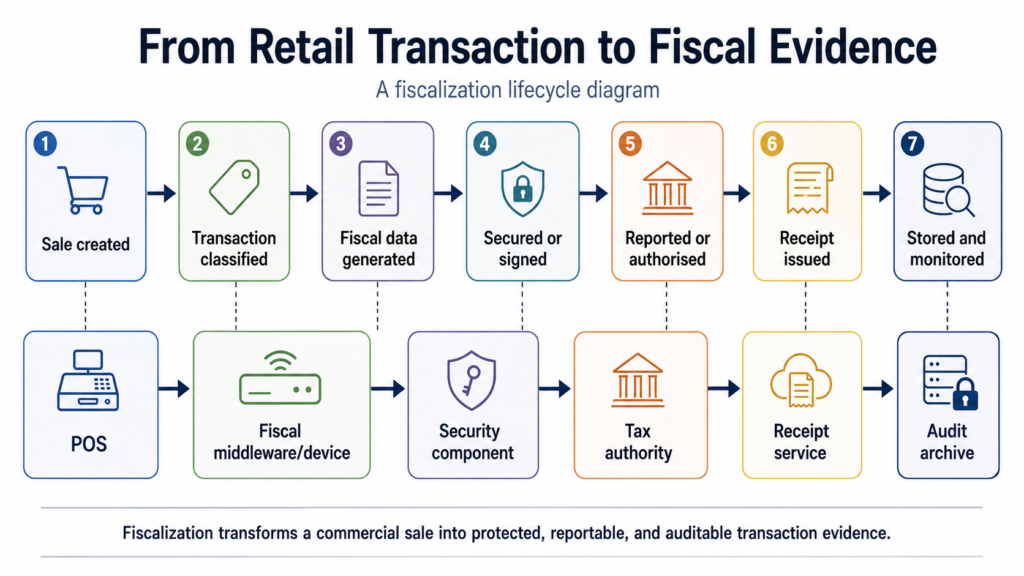
Although national models differ, a typical retail fiscalization process contains several common stages.
1. A transaction is created
The POS, cash register, e-commerce platform, mobile application, self-checkout, or other selling system creates the commercial transaction.
The system must determine relevant information such as:
- seller identity;
- business location;
- POS or device identifier;
- date and time;
- items or services;
- quantities;
- prices and discounts;
- tax categories;
- payment method;
- transaction type.
2. The transaction is classified
The solution determines whether the event is:
- a normal sale;
- a return;
- a cancellation;
- a void;
- a deposit;
- an advance payment;
- a training transaction;
- a copy;
- a correction;
- a delivery or pickup transaction;
- another legally defined process.
This classification matters because fiscal rules often require different references, receipt content, signatures, or reporting messages for different transaction types.
3. Fiscal data is generated
The POS or fiscal component extracts the legally required data and converts it into the format defined by the relevant technical specification.
This may include:
- sequential fiscal numbers;
- transaction identifiers;
- tax breakdowns;
- cryptographic values;
- references to earlier transactions;
- software and device identifiers;
- prescribed receipt fields.
4. The transaction is secured or validated
Depending on the country, the transaction may be:
- written into fiscal memory;
- processed through a certified control unit;
- signed by a technical security module;
- signed using a taxpayer certificate;
- cryptographically linked to previous transactions;
- submitted to the tax authority for validation or authorisation.
Germany, for example, requires covered electronic recording systems and their digital records to be protected by a certified technical security system.
5. Data is reported
Reporting may happen:
- before the receipt is issued;
- during the receipt-creation process;
- immediately after issue;
- at store closing;
- periodically in batches;
- only when requested during an audit.
Croatia’s B2C model sends prescribed receipt data to the Tax Administration during receipt issuance. The authority generates and returns a unique receipt identifier, which is then included in the receipt provided to the customer.
6. The receipt or fiscal document is issued
The customer may receive:
- a paper fiscal receipt;
- a digital receipt;
- a commercial document containing a fiscal identifier;
- a QR code;
- a receipt carrying information generated by a security device;
- an invoice validated by the tax authority.
The receipt is not always the entire fiscal record. Important technical, signing, and audit data may exist behind the visible customer document.
7. Records are stored and made auditable
The retailer may need to retain:
- source transaction data;
- fiscal messages;
- authority responses;
- receipt copies;
- signatures;
- device journals;
- system events;
- software-version information;
- configuration records;
- audit exports.
The ability to recreate the complete lifecycle of a transaction is often as important as the receipt itself.
What types of fiscalization exist?
There is no universally accepted global taxonomy. The following is a practical classification based on the location and timing of the fiscal control.
| Fiscalization model | Main control mechanism | Typical POS effect |
|---|---|---|
| Fiscal-memory model | Transaction data is stored in protected fiscal memory within a cash register, printer, or device | POS must use or communicate with approved hardware |
| Control-unit or security-module model | A certified component signs, records, or protects transactions | POS must integrate every relevant event with the security component |
| Online reporting model | Transaction data is sent electronically to the tax authority | POS requires authority communication, certificate management, retries, and outage handling |
| Clearance or authorisation model | A transaction or document is submitted for approval before or during legal issuance | Checkout or document issuance may depend on a successful authority response |
| Software or cloud fiscalization model | Approved software performs signing, sequencing, storage, and reporting functions | Fiscal logic can be centralised, but requires strict control of versions, identity, availability, and audit evidence |
| Hybrid model | Hardware, software, security components, and online reporting are combined | POS architecture must coordinate multiple local and central components |
The IMF uses a complementary data-collection classification consisting of centralised models, clearance models, automated reporting after issue, and real-time reporting models. It distinguishes closed systems, where the tax authority controls the document-issuance process, from open systems, where the taxpayer issues the document and reports it to the authority.
Fiscal-memory systems
Older and still-active fiscalization frameworks may require a fiscal cash register or fiscal printer containing protected memory. The objective is to prevent ordinary users from deleting or changing the legally relevant totals stored by the device.
These systems can place substantial responsibility on hardware manufacturers, service technicians, local distributors, and certification bodies.
Security-module systems
A general POS application can remain commercially flexible while a certified component protects the fiscal evidence.
Germany’s technical security system and Sweden’s certified control-unit approach illustrate versions of this concept. Sweden requires many businesses accepting cash or card payments to use a certified cash register and register the cash register and control unit with the Swedish Tax Agency.
Online transaction-reporting systems
In an online model, the POS generates a fiscal message and transmits it to the tax authority. The authority may return a confirmation code, record the data without blocking the transaction, or validate the document before it is considered complete.
Online systems introduce new operational dependencies:
- internet connectivity;
- certificate validity;
- authority availability;
- timeout rules;
- message queues;
- retry mechanisms;
- duplicate prevention;
- reconciliation.
Telematic reporting systems
Italy’s electronic receipts framework replaced traditional fiscal receipts progressively with electronic storage and telematic transmission of daily consideration data. A telematic register stores individual operations, issues the commercial document, and transmits the required data.
Software and cloud models
Fiscalization is increasingly moving from dedicated hardware into certified or controlled software environments.
This does not necessarily make compliance simpler. The compliance boundary moves into software architecture, version control, certificate management, cloud availability, central services, local fallback behaviour, and auditability.
How fiscalization affects POS systems
Fiscalization can influence almost every layer of a POS environment.
Checkout flow
A sale may no longer be complete when the payment is approved. The POS may need to wait for a signature, fiscal number, security response, or authority confirmation before issuing the final receipt.
Poorly designed fiscal integration can therefore increase checkout time or create queues during authority outages.
POS architecture
Retailers may need to introduce:
- local fiscal devices;
- central fiscal middleware;
- country-specific adapters;
- certificate services;
- transaction queues;
- fiscal databases;
- audit archives;
- monitoring dashboards;
- offline processing components.
The most scalable international architecture separates commercial POS logic from country-specific fiscal controls while preserving a reliable and traceable connection between them.
Receipts
Fiscal regulations may prescribe:
- receipt numbering;
- taxpayer details;
- location identifiers;
- operator or cashier identifiers;
- fiscal codes;
- QR codes;
- signature values;
- references to original transactions;
- payment information;
- mandatory wording.
A receipt-template change can therefore be a legal change, not merely a design decision.
Transaction data
Fiscal data models frequently require more precise information than a retailer’s commercial reporting model.
Retailers may need to distinguish between:
- sale and payment time;
- gross and net values;
- item and transaction discounts;
- tax categories;
- deposits;
- gift cards;
- vouchers;
- tips;
- delivery charges;
- returns;
- cancellations;
- exchanged products;
- partially refunded transactions.
Security
A fiscal system may require secure keys, certificates, signatures, protected storage, controlled user rights, and evidence of software integrity.
Security is therefore not separate from fiscal compliance. In many models, security is the technical mechanism through which fiscal integrity is established.
Availability and offline operation
Retail cannot simply stop whenever a tax-authority service or internet connection becomes unavailable.
Every implementation must define:
- whether sales may continue offline;
- what evidence must be generated locally;
- how long offline operation is permitted;
- when data must be retransmitted;
- how duplicate messages are prevented;
- what the receipt must display;
- how unresolved failures are monitored.
Returns and cancellations
Returns are often more complex than normal sales because the fiscal system may require a reference to the original receipt, the original fiscal identifier, the original device, or the original reporting period.
International retailers should test complete business processes, not only successful standard sales.
Why fiscalization is critical for international retailers
Fiscalization is often one of the most operationally critical compliance topics in international retail because it sits directly in the transaction path.
A corporate-income-tax calculation can usually be corrected through a later filing. A failed fiscal process may prevent the retailer from issuing a legally valid receipt while the customer is waiting at the checkout.
The difficulty is intensified by national variation. One country may require certified hardware, another a cryptographic security module, another real-time communication, and another an authorised electronic document. The same commercial transaction can therefore require a different technical lifecycle in each market.
For an international retailer, fiscalization affects:
- market-entry timelines;
- POS selection;
- local vendor dependencies;
- certification;
- testing;
- store operations;
- customer service;
- audit risk;
- release management;
- business continuity;
- total cost of ownership.
This is why fiscalization should not be treated only as a local tax requirement. It is a global retail-platform concern.
Fiscalization versus related concepts
| Concept | Primary purpose | Main system | Typical timing |
|---|---|---|---|
| Fiscalization | Protect and report legally relevant transaction evidence | POS, fiscal component, invoicing or reporting system | At, near, or after the transaction |
| E-invoicing | Create, exchange, validate, and process structured invoices | ERP, invoicing, AP/AR platforms | During the invoice lifecycle |
| VAT determination | Calculate the applicable VAT treatment and amount | Tax engine, ERP, POS | Before document completion |
| Payment processing | Authorise, capture, settle, or refund money | Payment terminal, gateway, PSP, acquirer | During and after payment |
| VAT reporting | Declare aggregated or transaction-level tax information | ERP, tax-reporting platform | Periodically or continuously |
| POS compliance | Meet all legal and operational obligations affecting the POS | POS ecosystem | Throughout the transaction lifecycle |
Fiscalization may use e-invoices, but e-invoicing is not always fiscalization. Fiscalization may capture payment information, but payment approval is not proof of fiscal compliance. The processes must be connected without being confused.
Selected international models
Germany: certified technical security
Germany requires relevant electronic recording systems to record transactions individually, completely, correctly, promptly, and in an orderly manner. The systems and their digital records must be protected through a certified technical security system.
The German model therefore focuses heavily on transaction integrity and tamper protection rather than requiring every sale to be authorised online by the tax administration.
Sweden: cash register and control unit
Sweden requires many businesses that accept cash or card payments to use certified cash registers. The cash register and certified control unit must be reported to the Swedish Tax Agency.
This separates the commercial register from an independent control component that protects and records transaction information.
Italy: electronic storage and telematic transmission
Italy’s electronic consideration model combines electronic transaction storage, commercial-document issuance, and transmission of daily data through telematic registers or approved alternatives.
The Italian approach demonstrates how a fiscal-device system can evolve into a connected reporting architecture.
Croatia: real-time transaction exchange
In Croatia’s B2C process, the checkout solution extracts the required data, sends a fiscalization message to the Tax Administration, receives a unique identifier, and includes it in the receipt. From 2026, the scope of B2C fiscalization has expanded across payment methods, while the country also operates a separate e-invoice fiscalization process for relevant B2B and B2G transactions.
Croatia illustrates why fiscalization and e-invoicing must sometimes be managed as connected but separate compliance processes.
Common misconceptions
“Fiscalization means using a fiscal printer”
A fiscal printer is only one possible implementation. Modern systems may use security modules, cloud services, online reporting, structured invoices, or software-based controls.
“Fiscalization applies only to cash payments”
Some countries originally focused on cash transactions, but modern regimes increasingly cover card payments, transfers, digital payments, and other payment methods. Croatia’s current B2C rules, for example, apply irrespective of the payment method.
“A successful payment means the transaction is compliant”
Payment processing proves that money was authorised or transferred. It does not prove that the transaction was recorded, secured, reported, or documented according to fiscal law.
“Fiscalization and e-invoicing are the same”
They can overlap, but they have different objectives and operational lifecycles. E-invoicing centres on the invoice exchange and processing lifecycle, while B2C fiscalization often operates at the moment of sale.
“Once implemented, fiscalization is finished”
Fiscal laws, technical specifications, certificate requirements, receipt formats, interfaces, and reporting models continue to change. Fiscalization requires continuing monitoring, regression testing, documentation, and release management.
“Sending more data automatically eliminates tax evasion”
Data collection can improve visibility, but tax administrations still require analytics, enforcement, communication, and risk-management processes. The IMF specifically warns against assuming that fiscalization will solve every form of non-compliance.
Darko Pavic’s perspective
In my view, fiscalization should be treated as system software for legally valid retail transactions, not as an isolated POS feature.
Commercial functions such as promotions, loyalty, product search, and user-interface design can change quickly. Fiscal sequencing, signatures, audit logs, receipt integrity, and authority communication require a different level of control.
This distinction changes how retailers should govern fiscalization. A local feature is often implemented once and then handed over. System software requires stable interfaces, version control, high availability, regression testing, monitoring, security, and continuous regulatory maintenance.
I also see fiscalization as an ongoing capability rather than a finished country project. Governments can introduce systems, suspend them, replace hardware with cloud models, add digital receipts, expand the scope to new payment methods, or connect fiscalization with e-invoicing.
The strongest international retailers will therefore not ask only:
“How do we implement fiscalization in this country?”
They will ask:
“How do we build a reusable global capability that can accommodate different national control models without redesigning the POS for every market?”
I developed this argument further in my article, “Fiscal Middleware Isn’t Just Middleware. It’s System Software.”
Implementation checklist for retailers and POS providers
Legal scope
- Which taxpayers, businesses, channels, and transaction types are covered?
- Are there exemptions or thresholds?
- Does the obligation cover cash, cards, transfers, vouchers, or all payment methods?
- Which rules apply to stores, e-commerce, mobile POS, self-checkout, and marketplaces?
Architecture
- Is fiscal control local, central, cloud-based, hardware-based, or hybrid?
- Which component owns sequencing, signing, reporting, and storage?
- Can country-specific functionality be separated from the commercial POS?
- Can the solution operate reliably across thousands of stores?
Data
- Which fields must be reported?
- Which identifiers must be persistent?
- How are discounts, vouchers, deposits, and tax categories represented?
- Can every fiscal message be reconciled with the commercial transaction?
Security
- Are certificates, keys, or certified devices required?
- Who owns certificate renewal and revocation?
- How are signing keys protected?
- How is software integrity demonstrated?
Offline operation
- May the POS continue selling during an outage?
- How long may data remain unreported?
- What must appear on the receipt during offline operation?
- How are failed messages retransmitted and reconciled?
Business processes
- How are returns, cancellations, exchanges, and partial refunds handled?
- Is the original transaction reference required?
- Can returns be processed in a different store or channel?
- How are click-and-collect and ship-from-store transactions treated?
Testing
- Are official test environments available?
- Is certification required?
- Have negative scenarios and outages been tested?
- Is there automated regression testing for fiscal processes?
Responsibilities
- What is the retailer responsible for?
- What belongs to the POS provider?
- What belongs to the fiscal middleware or hardware provider?
- Who monitors regulatory changes and production failures?
Audit and monitoring
- Can the full transaction lifecycle be reproduced?
- Are authority responses and failed submissions retained?
- Can audit files be exported in the required format?
- Are missing, duplicated, or delayed transactions detected automatically?
Frequently asked questions
Is fiscalization required in every country?
No. Some countries have detailed fiscalization regimes, while others rely primarily on accounting records, periodic tax reporting, e-invoicing, or ordinary cash-register requirements.
Is a fiscal receipt the same as an invoice?
Not necessarily. A fiscal receipt generally documents a retail transaction for the customer and tax-control process. An invoice may contain different legal information and follow a separate B2B or B2G lifecycle.
Can fiscalization be handled centrally?
In some countries, yes. Other countries require local hardware, store-level security devices, taxpayer certificates, or locally certified components. International solutions frequently combine central orchestration with local execution.
Does fiscalization always require an internet connection?
No. Some models are entirely or partly offline, while others expect real-time or near-real-time reporting. Even online models generally need rules for temporary outages.
Who is responsible for fiscal compliance: the retailer or the POS vendor?
The taxpayer or retailer normally retains the legal responsibility, although software, hardware, middleware, and service providers may have certification, documentation, or operational obligations. Responsibilities should be defined contractually and technically.
Is e-commerce subject to fiscalization?
It can be. The answer depends on the jurisdiction, customer type, seller model, document type, payment method, and fulfilment process. E-commerce should not automatically be treated as being outside the retail fiscal regime.
Can AI automate fiscalization?
AI can assist with regulatory research, classification, monitoring, testing, and anomaly detection. Deterministic controls should still govern transaction signing, sequencing, validation, and reporting because these processes require predictable and auditable outcomes.
Is fiscalization a one-time implementation?
No. It requires ongoing legal monitoring, software maintenance, certificate management, testing, incident handling, and adaptation to new business processes.
Follow the future of fiscalization
Fiscalization is becoming more digital, more connected, and more deeply integrated into retail architecture.
Subscribe to Future of the High Street for analysis of fiscalization, POS compliance, e-invoicing, retail technology, AI, and Compliance Intelligence.
Subscribe to Future of the High Street
Sources and further reading
Darko Pavic’s related analysis and author material
What is Fiscal Middlware? — Defines fiscal middleware as the software boundary between retail systems and country-specific fiscal mechanisms, and explains its architecture, deployment models, POS impact and role in scalable global compliance.
Official and institutional sources
- International Monetary Fund — How to Implement Electronic Fiscal Reporting (Fiscalization), 2023
The most comprehensive institutional overview of fiscalization definitions, collection models, implementation, risk management, and consumer participation. - European Commission — VAT in the Digital Age
Official overview of the EU’s future digital-reporting and e-invoicing framework. - European Commission — VAT Gap Report 2025
Official evidence concerning the scale and development of VAT non-compliance in Europe. - German Federal Ministry of Finance — Section 146a AO and KassenSichV
Official basis for Germany’s transaction-recording and technical-security requirements. - Swedish Tax Agency — Cash Registers
Official description of Sweden’s certified cash-register and control-unit obligations. - Italian Revenue Agency — Electronic Considerations
Official overview of electronic storage and telematic reporting of retail consideration data. - Croatian Tax Administration — Comparison of B2C and E-Invoice Fiscalization
Official comparison of real-time B2C receipt fiscalization and B2B/B2G e-invoice fiscalization.
Academic and research sources
- Casey, Peter, and Patricio Castro. Electronic Fiscal Devices: An Empirical Study of Their Impact on Taxpayer Compliance and Administrative Efficiency. IMF Working Paper 15/73, 2015.
DOI:10.5089/9781475521023.001 - Bellon, Matthieu, Era Dabla-Norris, Salma Khalid, and Frederico Lima. Digitalization to Improve Tax Compliance: Evidence from VAT E-Invoicing in Peru. Journal of Public Economics 210, 2022, 104661.
DOI:10.1016/j.jpubeco.2022.104661 - Fjeldstad, Odd-Helge, Cecilia Kagoma, Ephraim Mdee, Ingrid Hoem Sjursen, and Vincent Somville. The Customer Is King: Evidence on VAT Compliance in Tanzania. World Development 128, 2020, 104841.
DOI:10.1016/j.worlddev.2019.104841 - Engström, Per, et al. Effects of Electronic Cash Registers on Reported Revenue. International Tax and Public Finance, 2025.
DOI:10.1007/s10797-024-09844-x
How this page was prepared
This page combines official tax-authority guidance, national technical requirements, international institutional research, peer-reviewed academic literature, and Darko Pavic’s professional analysis.
Official requirements, general industry observations, and the author’s interpretation have been separated wherever relevant. Country examples are illustrative and should not replace a current legal and technical assessment of the relevant jurisdiction.
AI tools supported the research, organisation, and initial drafting of this page. The final content was substantively reviewed and approved by Darko Pavic.
About the author
Darko Pavic is the founder and CEO of Fiscal Solutions and has more than 28 years of experience in international retail technology, POS systems, and fiscalization. His work focuses on global retail compliance, fiscal middleware, e-invoicing, scalable transaction architecture, and Compliance Intelligence. He has worked on international retail and software initiatives across more than 27 countries and contributes to industry discussions through publications, standards activities, Retail Talks, and the Forbes Technology Council.
Publication and review information
First published: 13 July 2026
Last substantively reviewed: 13 July 2026
Author: Darko Pavic