


Fiscal middleware is the software boundary between retail transaction systems and country-specific fiscal mechanisms. This guide explains how it works, which architectures exist, where it reduces POS complexity, and how it can evolve toward machine-readable compliance intelligence.
Fiscal middleware is a software layer between transaction-generating retail systems and jurisdiction-specific fiscal mechanisms. It accepts a normalized transaction from a POS, e-commerce, mobile or other sales channel; applies or orchestrates country-specific fiscal logic; coordinates required security, sequencing, receipt, storage and transmission steps; and returns a standardized result to the retail system. Its architectural purpose is to isolate core retail software from local fiscal technology and regulatory volatility.
Darko Pavic’s practical definition. Fiscal middleware is the compliance boundary that lets a retailer change countries, fiscal devices or authority interfaces without redesigning the core POS every time.
The term fiscal middleware is used here as an architectural and industry term, not as the name of a universally defined legal product. Tax laws usually prescribe what must happen to a transaction; middleware is one way to organize the software so those obligations can be implemented consistently.
Key takeaways
- It separates concerns. The POS owns selling; the fiscal layer owns the country-specific orchestration needed to transform a retail transaction into the legally required fiscal outcome.
- It is most valuable when complexity repeats. A retailer operating one simple market may not need a large platform. Multi-country, multi-channel or mixed hardware/cloud estates benefit more from a stable abstraction layer.
- Local, edge, cloud and hybrid forms all have legitimate uses. The right deployment depends on fiscal hardware, network assumptions, security, data-residency constraints, latency, availability and enterprise architecture.
- Middleware reduces duplication; it does not transfer legal accountability automatically. Retailers, taxpayers, POS vendors and fiscal providers still need a documented responsibility model.
- The strategic destination is not “one API” but controlled compliance change. The mature model combines a stable transaction contract with versioned country policies, testing, observability, audit evidence and governed rollout.
Table of contents
- What fiscal middleware includes — and what it does not
- Why fiscal middleware matters
- How fiscal middleware works: the transaction lifecycle
- Types of fiscal middleware
- Impact on retail and POS systems
- Comparison with related concepts
- International variations: why one interface must allow different execution models
- Common misconceptions
- Darko Pavic’s perspective
- Implementation considerations: questions to answer before selecting or building fiscal middleware
- Design patterns that reduce long-term risk
- The future: from fiscal middleware to machine-readable compliance intelligence
- Frequently asked questions
- Sources and further reading
What fiscal middleware includes — and what it does not
A modern fiscal-middleware platform normally includes the technical capabilities required to accept retail transactions in a stable format, translate them into country-specific fiscal flows, communicate with devices or authority services, preserve evidence and expose a consistent operational result back to the selling system. The exact boundary varies by solution and jurisdiction.
| Capability | Commonly inside fiscal middleware | Usually outside the core boundary |
| Transaction contract | Canonical request/response model; validation; idempotency; transaction identity | Product pricing strategy, merchandising, customer journey logic |
| Country execution | Country adapters, mappings, rule orchestration, receipt/fiscal outputs | Authoritative legal interpretation unless supplied/validated through a governance process |
| Security | Certificate/key integration, signatures where required, secure device or service access | General corporate IAM unrelated to fiscal processes |
| Fiscal connectivity | Fiscal printers, black boxes, certified modules, tax-authority endpoints | Payment authorization itself, unless deliberately integrated as an adjacent service |
| Resilience | Queues, retry policy, offline/online state, disaster recovery hooks | A guarantee that every jurisdiction permits the same offline behavior |
| Evidence | Fiscal journals, authority responses, status, audit/export support, reconciliation data | Corporate accounting ledger as a whole |
| Operations | Monitoring, alerting, version/configuration control, controlled rollout | Legal responsibility of the taxpayer |
Fiscal middleware should also be distinguished from a generic enterprise service bus, integration platform as a service (iPaaS), tax engine and payment gateway. Those technologies can be part of the surrounding architecture, but fiscal middleware is specialized around the fiscal lifecycle of a retail transaction.
Why fiscal middleware matters
Fiscal middleware matters because global retail combines a stable business intent — sell a product or service — with local fiscal rules that can vary sharply in technology, transaction sequence, security, receipt data, connectivity and evidence. If those differences are implemented directly inside every POS or channel, the core commerce application accumulates country-specific branches and becomes harder to test, release and replace.
Pavic’s book argues for the opposite design principle: the less the POS must be adapted for compliance, the better. A single interface can reduce duplication across countries, companies, brands and channels, while a specialized layer absorbs country-specific complexity and supporting functions such as transaction counters, monitoring and certification-related behavior. That is not merely a development convenience; it changes the operating model for international rollouts.
Why it matters by stakeholder
| Stakeholder | Practical value of a fiscal-middleware boundary |
| Retailer | Reduces country-by-country POS forks; creates a common operational view; improves repeatability of rollout and support. |
| POS vendor | Keeps core roadmap focused on selling features while delegating specialized fiscal integrations through a stable contract. |
| E-commerce / mobile / SCO teams | Allows multiple transaction channels to reuse the same fiscal policy and evidence model where the law permits. |
| ERP / finance | Creates a consistent fiscal status and reconciliation point between commerce records, fiscal evidence and accounting data. |
| Tax / compliance | Makes responsibilities, status, errors, versions and evidence more observable than scattered local integrations. |
| IT architecture / SRE | Provides a designed availability boundary with queues, retries, failover, monitoring and controlled release rather than ad-hoc exception handling. |
| Regulator / auditor | A well-documented middleware architecture can make transaction paths and evidence easier to explain, but it does not replace legally required records or certifications. |
What happens without middleware?
Middleware is not mandatory in every architecture. A direct POS-to-fiscal integration can be entirely appropriate for a single-country solution with a small scope and stable technology. The problem appears when the same organization repeats direct integrations across many markets and channels. Typical consequences include duplicated mappings, inconsistent error handling, different release cadences, vendor lock-in, fragmented monitoring and increasing dependence on developers who remember local exceptions.
This is the difference between avoiding middleware and avoiding abstraction. Every system has a boundary somewhere. If the boundary is not explicit, country logic tends to leak into the POS, store server, ERP, payment layer and operational procedures. The resulting architecture can work, but it becomes progressively harder to reason about and change.
How fiscal middleware works: the transaction lifecycle
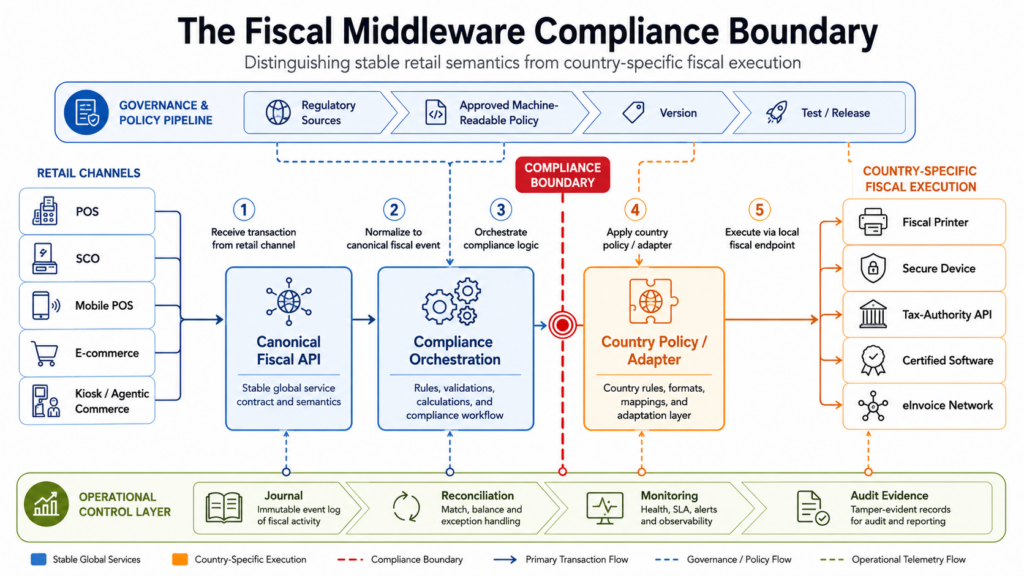
The most useful way to understand fiscal middleware is as a transaction state machine with legal side effects. A sale enters the layer in a normalized form; the middleware determines the applicable country execution path; required fiscal steps are performed; every response and transition is journaled; and the selling channel receives a clear outcome.
- Source transaction creation. The POS, self-checkout, mobile POS, e-commerce service or another channel creates a transaction using a canonical contract. The contract should carry stable business semantics: items, quantities, prices, taxes, discounts, payments, transaction type, store/business-unit identity and references needed for corrections.
- Structural and semantic validation. Middleware validates required fields, data types, identifiers and internal invariants before invoking a fiscal mechanism. Validation here is not the same as a tax authority’s legal validation; it is an architectural gate that catches preventable integration errors early.
- Jurisdiction and policy selection. The layer selects the appropriate country/version policy from configuration and master data. A mature system avoids hard-coding this selection inside every channel.
- Country mapping and orchestration. A country adapter transforms the canonical transaction into the specific message, device command or fiscal document model required for that jurisdiction. Some countries require a device call; others require online authority communication; others combine local security with central reporting.
- Security, signing and sequencing. Where required, the middleware or the legally designated component coordinates certificates, cryptographic signatures, secure modules, transaction counters, sequence numbers or other security artifacts. The exact legal responsibility and certified component must follow the jurisdiction.
- Receipt and fiscal output. The middleware returns the legally relevant identifiers and data required to complete the customer receipt or electronic evidence. Receipt ownership should be explicit: some architectures let the POS render; others use a fiscal component.
- Storage, journal and audit evidence. Requests, normalized data, fiscal messages, responses, timestamps, versions and error states are retained according to the designed evidence model and applicable law. The fiscal journal should support reconstruction without silently rewriting history.
- Transmission and reporting. Real-time, near-real-time or periodic transmission is executed according to the local model. Network and authority failures are treated as explicit states rather than generic application exceptions.
- Corrections, returns and cancellations. These should be modeled as legal transaction types with references to original activity where required. A mature design avoids “editing” a completed fiscal record in place.
- Reconciliation and monitoring. The platform compares expected and actual fiscal outcomes, surfaces discrepancies, monitors endpoint/device health and provides a cross-country operational view.
- Offline and recovery. If the jurisdiction permits an offline or contingency process, middleware queues, timestamps and later synchronizes according to that specific rule set. “Offline capable” is therefore a policy-controlled feature, not a universal promise.
A reference architecture
| Layer | Responsibility |
| Retail channels | POS, self-checkout, mobile POS, e-commerce, kiosks or future agentic channels create the business transaction. |
| Canonical fiscal API | Stable transaction semantics, contract versioning, identifiers, idempotency and consistent error model. |
| Compliance orchestration | Policy selection, workflow/state machine, pre-validation, routing and lifecycle control. |
| Country adapters | Country-specific mappings, fiscal document/device/authority protocols and configuration. |
| Execution mechanisms | Fiscal printer, certified security module, local service, cloud authority endpoint, certified cash-register program or e-invoice network. |
| Evidence and observability | Journal, audit trail, logs, dashboards, alerts, reconciliation and exports. |
| Knowledge/change plane | Regulatory source monitoring, interpreted requirements, policy versions, tests, approvals and rollout controls. |
Architectural rule of thumb. The canonical contract should model retail meaning, not copy the fields of one country’s fiscal API. If the “universal” interface is merely the current country payload with different names, the abstraction will break when the next legal model arrives.
Types of fiscal middleware
There is no single best deployment model. The useful classification is where fiscal execution happens and how much of the compliance lifecycle is centralized. The following operational classification is designed for architecture decisions rather than product marketing.
| Type | Where it runs | Best fit | Main trade-off |
| Embedded adapter / SDK | Inside or tightly linked to the POS application | One/few countries; vendor-controlled POS; narrow scope | Fast and simple initially, but country logic can become coupled to POS releases. Boundary case rather than full middleware. |
| Local POS-resident middleware | On each POS device | Fiscal printers, local security devices, direct hardware access, strong offline needs | Good hardware proximity; requires estate deployment/version management. |
| Store / edge middleware | Store server, edge appliance or local service shared by lanes | Many lanes sharing devices/services; local resilience; controlled store networking | Creates a store dependency that must be highly available and operationally managed. |
| Cloud fiscal middleware | Central cloud service/API | Online fiscalization, multi-country platforms, centralized monitoring/configuration | Depends on network and legal/technical feasibility; latency and outage design become critical. |
| Hybrid cloud + edge | Cloud control/knowledge plane plus local execution agent | Global estates mixing legacy fiscal hardware and modern online models | Most flexible, but architecture and version compatibility must be governed carefully. |
Local middleware remains strategically useful
The move toward cloud fiscalization does not make local middleware obsolete. In markets that still require fiscal printers, black boxes or local certified components, proximity to hardware can be the cleanest way to manage device drivers, ports, proprietary protocols and loss of network connectivity. Pavic’s book explicitly treats legacy hardware as a continuing architectural reality and argues that the right middleware should make old hardware another controlled node in a modern global system rather than an isolated silo.
This is also where the historical relationship with UnifiedPOS is instructive. OMG describes UnifiedPOS as an architectural specification for application interfaces to retail devices, designed so compliant drivers allow devices to be changed with minimal application programming. Fiscal middleware extends the abstraction idea beyond peripheral access to fiscal semantics and legal workflows. [S7]
Cloud middleware changes the control point
Cloud middleware centralizes country adapters, configuration, observability and release management. This can be powerful when the legal model itself is online or when a local component can act as a thin secure execution agent. But “cloud” is a deployment choice, not a compliance conclusion. Germany, for example, permits architectures involving cloud TSEs, while the applicable certified configuration and operational conditions still matter; the BMF FAQ also notes that multiple cash registers can connect to one TSE and that a second TSE may be used during disruption. [S2]
For global retailers, the hybrid model is often the most general architecture: central policy, monitoring and lifecycle management in the cloud; local execution only where latency, hardware or law requires it. The central design goal is not to force every country into the same topology. It is to keep the POS integration and operating model as consistent as possible while allowing legally necessary differences below the abstraction boundary.
Impact on retail and POS systems
| Area | With country logic embedded in POS | With a well-designed middleware boundary |
| Checkout flow | Country branches appear in the selling application | POS invokes stable fiscal lifecycle states and receives normalized outcomes |
| Receipts | Country-specific receipt rules may spread through POS templates | Fiscal response supplies required identifiers/data; rendering ownership is explicit |
| Transaction data | Different payloads by country | Canonical transaction plus country-specific transformation |
| Integrations | Direct integration for each device/authority | One retail-side contract plus adapters |
| Security | Certificates/keys may be handled differently by each POS implementation | Security integration is concentrated in designated fiscal components |
| Master data | Country-specific codes duplicated across systems | Central mapping/configuration with controlled source of truth |
| Availability | Each integration invents its own error/offline behavior | Common state/error model with policy-specific recovery |
| Auditability | Evidence scattered among local systems | Central journal/reconciliation view with references to local evidence |
| International rollout | POS release needed for each new integration | New adapter/policy may be deployed independently where architecture permits |
| Vendor responsibility | Blurred between retailer, POS vendor and local fiscal vendor | Interfaces and RACI can be made explicit |
Practical example: protecting a mobile-POS strategy
Pavic’s book describes a retailer using a cloud-level fiscalization layer so the same core POS logic could serve both traditional and mobile POS in France. The architectural lesson is broader than the specific project: when fiscal logic is separated from the selling application, new form factors can reuse the compliance capability instead of each becoming a new country-specific fiscal project. This is an author-supplied implementation example, not a universal statement about French architecture.
Comparison with related concepts
Fiscal middleware sits between retail application architecture and legal compliance. Several neighboring concepts overlap technically but answer different questions.
| Concept | Primary purpose | Typical object | Why it is not the same as fiscal middleware |
| Fiscal middleware | Orchestrate fiscal transaction lifecycle across retail systems and local mechanisms | Retail sale / return / correction and its fiscal evidence | It is the integration and execution boundary itself. |
| Fiscalization | Meet jurisdiction-specific requirements for recording, securing, transmitting or evidencing transactions | Legally relevant transaction/receipt records | Fiscalization is the regulatory domain; middleware is one implementation architecture. |
| POS compliance | Ensure the overall POS behavior meets applicable legal requirements | POS processes, data, receipts, controls, accessibility/consumer/tax obligations | Broader than fiscalization and broader than middleware. |
| E-invoicing | Create, exchange and sometimes report structured invoices | B2B/B2G or other invoice document | Can share infrastructure, but invoice exchange and retail receipt fiscalization are distinct processes. |
| Tax engine | Determine tax treatment/rates and calculate tax | Tax determination on lines/transactions | Calculation may feed fiscalization but does not by itself create fiscal evidence or authority communication. |
| Payment gateway | Authorize/capture payment | Payment instruction and response | Payment compliance and fiscal compliance have different regulated objects and authorities. |
| Generic iPaaS / ESB | Connect enterprise systems | Arbitrary messages/events | Not specialized for legally controlled fiscal state, evidence, certification or country semantics. |
Fiscal middleware versus e-invoicing: Croatia as a useful boundary case
Croatia’s 2025 Fiscalization Act is useful because the law itself addresses both end-consumer receipt fiscalization and electronic invoices while distinguishing the processes. It defines fiscalization of end-consumer receipts, eInvoice issuance/receipt and eInvoice fiscalization as related but separate mechanisms; key eInvoice provisions took effect on 1 January 2026. The 2026 eInvoice regulation further specifies technical aspects of eInvoice exchange and fiscalization. [S5] [S6]
Architecturally, a middleware platform may expose a shared identity, monitoring, evidence and policy plane for both retail fiscalization and e-invoicing. That can be efficient. But the canonical objects, timing, recipients, document standards and error semantics should remain distinct. “One platform” should not become “one undifferentiated transaction model.”
International variations: why one interface must allow different execution models
A global fiscal-middleware design should standardize the retail-facing contract and operating principles without pretending that all fiscal regimes work the same way. The following examples are selected to show architectural differences, not to provide complete legal implementation guides.
Germany: secure transaction logging through a certified TSE
Germany’s KassenSichV requires electronic cash systems within scope to create protected transaction records with defined data including transaction start/end, a unique sequential transaction number, security values, serial numbers and a signature counter. It also governs storage, the standardized digital interface, TSE requirements and receipt content. The ordinance was amended in January 2026. [S1]
Middleware implication: a German adapter may need to orchestrate the lifecycle with a certified TSE, carry TSE results into receipt/evidence flows, manage device/service health and preserve exportability. The BMF FAQ confirms that multiple cash registers may connect to a single TSE, and discusses cloud TSE operation and disruption scenarios, illustrating that the integration topology can be centralized even when the security mechanism itself is tightly regulated. [S2]
Slovakia: eKasa and certified cash-register software
Slovakia’s Financial Administration states that Act No. 384/2025 on sales records took effect on 1 January 2026 and governs the use of eKasa, transmission of data to the eKasa system, and certification of the cash-register program and protected data storage. The authority’s FAQ defines a “software online cash register” as a set of cash-register software and protected data storage communicating with eKasa through an integration interface; the software and protected storage may be located in a remote environment. [S3] [S4]
Middleware implication: the country adapter is not merely an HTTP connector. It must respect certified component boundaries, message/state requirements and operational contingencies. The architecture should make clear which part is the retailer’s POS, which part is certified cash-register functionality, and where the fiscal middleware ends.
Croatia: online receipt fiscalization plus eInvoice fiscalization
Croatia’s Fiscalization Act NN 89/2025 covers fiscalization of receipts in final consumption and electronic invoicing between taxpayers. For receipt fiscalization, the law specifies digital certificates, electronic transmission of receipt elements, authority validation and return of a unique receipt identifier, as well as contingency processes. Major eInvoice provisions took effect on 1 January 2026. [S5]
Middleware implication: the same retailer may need a real-time store fiscal flow, an eInvoice flow, certificate management and evidence management under one governance umbrella. The design should share what is genuinely common — identity, monitoring, configuration, provenance — while preserving distinct legal workflows.
Important legal note. Country examples above summarize selected official requirements to explain architecture. They are not complete implementation specifications and should not be used as a substitute for current legal, tax, certification and technical guidance in the jurisdiction concerned.
Common misconceptions
Misconception 1: Fiscal middleware is just an API proxy. An API gateway can route and secure calls, but fiscal middleware typically needs transaction state, country semantics, device/authority orchestration, evidence, recovery and lifecycle control. A stateless proxy can be a component, not the whole solution.
Misconception 2: Cloud middleware is always more mature than local middleware. Maturity is about controlled, scalable compliance, not hosting fashion. Local execution may be necessary for fiscal hardware, certified components, latency or permitted offline operation. A hybrid architecture can be more mature than a cloud-only design that ignores those realities.
Misconception 3: Middleware makes the retailer compliant automatically. Middleware can implement and evidence approved requirements, but legal interpretation, configuration, certification, operational procedures and taxpayer responsibilities remain. Compliance is a socio-technical system.
Misconception 4: One universal API eliminates country differences. A canonical interface can isolate the POS from differences. It cannot make legal differences disappear. The country adapter and policy layer exist precisely because sequencing, signatures, receipts, data, timing and outage rules differ.
Misconception 5: E-invoicing and fiscal middleware are the same thing. They can share platform capabilities, but invoice exchange and retail transaction fiscalization regulate different objects and workflows. Croatia’s current framework makes this distinction explicit.
Misconception 6: Middleware removes the need for legal and retail-process expertise. The harder problem is often translating law and guidance into precise retail behavior. Pavic’s maturity framework therefore treats technical, legal and operational knowledge as complementary.
Misconception 7: Direct integration is always cheaper because it removes a layer. For one country it may be. Across many countries and channels, the relevant comparison is total lifecycle cost: development, certification, updates, support, monitoring, recovery, vendor change and POS release impact.
Darko Pavic’s perspective
Based on the author’s materials and The Fiscalization Compliance Maturity Model, I distinguish between fiscal middleware as a connector and fiscal middleware as a compliance operating layer. A connector solves “how do I call this device or endpoint?” A compliance operating layer solves a harder question: “how do I keep the retail system stable while the legal, technical and operational environment around it changes?”
My working principle is simple: the POS should know that a transaction must be fiscalized, but it should not need to know the implementation history of every country. The POS should send a business-meaningful transaction and receive a deterministic fiscal outcome. Country-specific complexity belongs below that boundary unless there is a strong reason to expose it.
This is also why I do not see middleware merely as “plumbing.” At higher compliance maturity, it behaves more like system software for the compliance domain: it owns state, resilience, observability, controlled change, evidence and the integration contract on which many retail applications depend. The strategic asset is not the number of endpoints supported. The strategic asset is the ability to absorb regulatory change without destabilizing the selling systems.
From fiscal-printer driver layer to strategic middleware
Pavic’s public account describes the origin of the concept in the hardware-fiscalization era: POS applications needed proprietary drivers for different fiscal printers, and a dedicated local layer normalized those drivers. As online fiscalization appeared, the same abstraction evolved to cover both local hardware and online authority interfaces. Pavic describes his team as a pioneer of this approach; this historical account is author/company history rather than an independently established global priority claim. [S9]
That evolution explains why local middleware still matters. The original problem — keeping the POS independent of country-specific infrastructure — has not disappeared. The infrastructure has simply expanded from serial ports and printer commands to certificates, cloud endpoints, signed messages, queues, schemas, authority availability, and continuously changing rules.
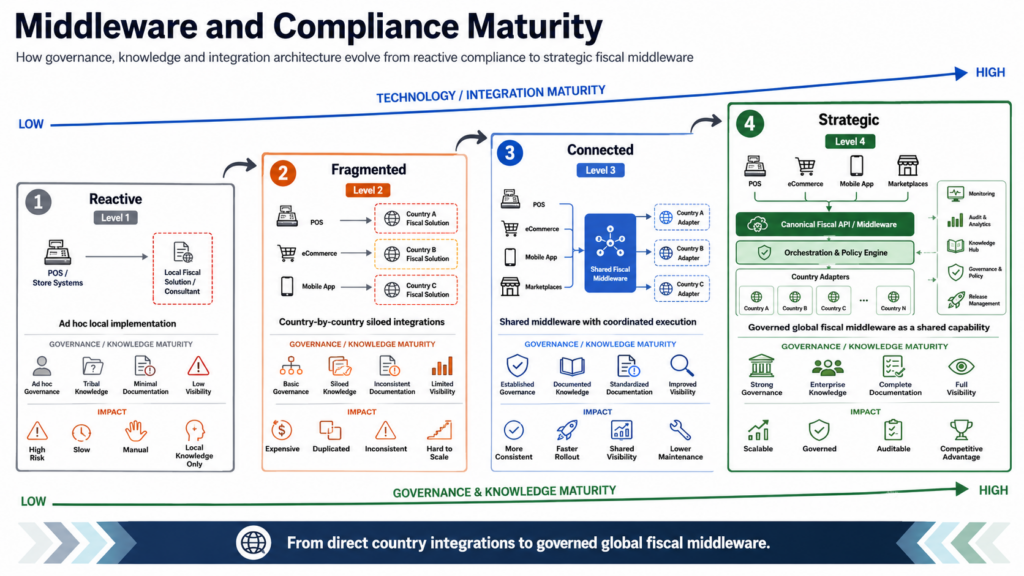
Middleware and the Compliance Maturity Model
| Maturity level | Typical architecture pattern | Role of middleware |
| Level 1 — Reactive | Ad-hoc, late country changes; direct integrations | Optional tactical connector; little shared governance |
| Level 2 — Fragmented | Country-by-country solutions and local vendors | Multiple local layers may exist, but standards and operations remain siloed |
| Level 3 — Connected | Shared architecture and central coordination | Common middleware/API, shared monitoring and evidence; some manual change processes remain |
| Level 4 — Strategic | Compliance embedded in global IT/business strategy | Governed middleware platform, versioned policies, proactive monitoring, controlled rollouts, reusable evidence and automation |
Middleware can accelerate the move from Fragmented to Connected compliance because it creates a shared technical boundary. It supports Strategic compliance only when it is paired with governance, legal interpretation, documentation, testing, training, monitoring and clear ownership. Buying middleware is therefore not the same as buying maturity.
A practical maturity test
- Does entering a new country require a new core POS release, or mainly a new middleware policy/adapter and controlled configuration?
- Can the compliance team see transaction and fiscal status across countries without logging into separate local tools?
- Can a fiscal device or local provider be replaced without changing the retail-facing integration contract?
- Can the organization prove which policy/configuration/version processed a historical transaction?
- Can a regulatory update be tested on a small controlled cohort before a country-wide rollout?
- Can legal, technical and operational teams trace a requirement from source document to implementation rule, test and production version?
Implementation considerations: questions to answer before selecting or building fiscal middleware
The following checklist is an architecture and governance aid, not legal advice. The correct answer depends on each jurisdiction, retailer and operating model.
Legal scope
- Which transaction types and channels are legally in scope?
- Which duties belong to the taxpayer, POS vendor, fiscal provider or certified component?
- Which official sources and technical specifications define the implementation?
- Is certification required for the POS, middleware, device, cash-register program or another component?
Architecture
- What is the stable canonical transaction model?
- Which functions must execute locally, at store edge or in the cloud?
- Can country adapters be released independently from the POS?
- How are backward compatibility and contract versions managed?
Data and identity
- What business-unit, store, device, operator and taxpayer identities are required?
- Where is fiscal master data owned?
- How are source transaction IDs mapped to fiscal IDs and corrections?
- What data must be retained, for how long, and in which retrievable form?
Security
- Where do certificates and cryptographic keys live?
- Which components are certified and what constraints does certification impose?
- How are secret rotation, access control and audit logs managed?
- Are data-residency or localization constraints relevant?
Availability and offline
- What does “success” mean from the POS perspective?
- What happens if the tax authority, network, local service or fiscal device is unavailable?
- Is offline operation legally permitted, and what is the recovery deadline/process?
- How do retries avoid duplicate fiscalization?
Testing and rollout
- Is there an authority test environment?
- Do you have golden transaction suites for sales, returns, discounts, voids, mixed payments and edge cases?
- Can versions run in parallel for phased rollout?
- What is the rollback or forward-fix strategy?
Operations and evidence
- Which dashboards and alerts are required per store/country?
- Can support staff reconstruct a transaction without database forensics?
- How are POS, fiscal and ERP records reconciled?
- Can audit evidence be produced without relying on one specialist?
Change management
- Who monitors law, guidance and technical specifications?
- How is a source change converted into a requirement, policy, test and release?
- Who approves the interpretation?
- How are impacted countries, versions and customers identified?
Commercial/vendor model
- Who owns the integration contract and data?
- Can the underlying local fiscal provider or device be replaced?
- Are country updates, certifications, support and monitoring included?
- What happens if the middleware provider exits a country or the market?
Design patterns that reduce long-term risk
The value of fiscal middleware is largely determined by the quality of its boundaries. The following patterns are particularly important for global retail.
- Canonical transaction semantics. Define sale, return, cancellation, deposit, payment and correction semantics once. Country adapters translate those semantics rather than redefining them.
- Idempotent fiscal commands. Every request should have a stable identity so retry and recovery can distinguish “not processed” from “processed but response lost.”
- Explicit state machine. Use named states such as received, validated, sent, accepted, rejected, queued-offline, recovered and reconciled. Avoid a single success/error flag.
- Policy/version provenance. Persist which country policy, schema, adapter and configuration version processed each transaction.
- Controlled rollout. Introduce fiscal changes from a limited technical or store cohort to broader deployment with monitoring gates. Pavic’s book emphasizes successive rollout as a risk-reduction strategy.
- Provider/device neutrality where feasible. Keep the retail-facing contract stable when local infrastructure changes. This reduces lock-in, but only where certification and legal rules permit substitution.
- Evidence by design. Treat logs, authority responses, receipt identifiers, timestamps, mappings and reconciliation as product requirements, not support leftovers.
- Separation of knowledge and execution. Legal interpretation should be governed and traceable; execution should consume approved, versioned policy rather than opaque prose embedded in code comments.
The future: from fiscal middleware to machine-readable compliance intelligence
The next evolution of fiscal middleware is likely to move upstream from transaction execution into regulatory knowledge. Today, many organizations still translate a legal change through emails, spreadsheets, tickets, developer interpretation and country-specific code. A more mature model would make that transformation explicit and machine-readable while preserving human review and legal accountability.
OASIS LegalRuleML is evidence that legal norms can be represented in machine-processable structures. The standard models legal normative rules and concepts such as obligations, permissions, prohibitions, jurisdiction and temporality. It does not solve retail fiscalization automatically, but it demonstrates that a machine-readable normative layer is technically plausible. [S8]
Strategic prediction. Fiscal middleware will increasingly become the execution surface of compliance intelligence: a place where versioned machine-readable policies, deterministic transaction controls, AI-assisted interpretation and evidence management meet. The safest architecture keeps AI useful for extraction, comparison and explanation while keeping legally consequential execution governed, testable and auditable.
Frequently asked questions
Is fiscal middleware legally required?
Usually the law requires fiscal outcomes, controls, records, devices or interfaces rather than a product called “fiscal middleware.” Middleware is an architectural choice for implementing those requirements. Some jurisdictions may mandate or certify particular components that the middleware must use or contain.
Can one fiscal middleware support many countries?
Yes, if it uses a stable retail-facing contract and genuinely separate country adapters/policies. “Many countries” should not mean one giant conditional codebase. Versioning, monitoring, evidence and provider/device abstraction are central to scalability.
Should fiscal middleware run locally or in the cloud?
Either can be correct. Local execution is useful for fiscal hardware and offline resilience; cloud execution centralizes operations and fits online fiscal models; hybrid is often appropriate for mixed global estates. Legal and certification constraints come first.
Does middleware replace a tax engine?
No. A tax engine primarily determines tax treatment and calculation. Fiscal middleware orchestrates the legally required recording, security, receipt, communication and evidence flow. The two can integrate.
Does fiscal middleware replace e-invoicing software?
Not necessarily. A platform can support both fiscalization and e-invoicing, but the objects and workflows differ. They should share infrastructure only where that improves consistency without erasing legal distinctions.
What is the biggest technical mistake in fiscal middleware?
Designing the “universal API” around one country’s current payload. A durable canonical model starts from retail business semantics and lets country adapters express local requirements.
What is the biggest organizational mistake?
Assuming that middleware transfers responsibility for legal interpretation and compliance to the software provider. A mature program defines who interprets, approves, implements, tests, operates and evidences each obligation.
How will AI change fiscal middleware?
AI can accelerate source monitoring, obligation extraction, comparison, support and anomaly analysis. The higher-value direction is a governed machine-readable policy layer connected to deterministic middleware execution, with provenance, testing and human approval.
Sources and further reading
Official regulations and government sources
[S1] Federal Republic of Germany / Gesetze im Internet. Kassensicherungsverordnung (KassenSichV), consolidated text. last amended 14 January 2026. https://www.gesetze-im-internet.de/kassensichv/BJNR351500017.html — Primary legal source for transaction logging, storage, standardized interface, TSE and receipt requirements.
[S2] German Federal Ministry of Finance. FAQ: Das Kassengesetz für mehr Steuergerechtigkeit. 29 April 2026. https://www.bundesfinanzministerium.de/Content/DE/FAQ/FAQ-steuergerechtigkeit-belegpflicht.html — Current official orientation on §146a AO/KassenSichV, including cloud TSE, shared TSE and failover questions. The FAQ itself notes it is guidance rather than binding law.
[S3] Financial Administration of the Slovak Republic. Pokladnice eKASA — Zákon o evidencii tržieb. current page reviewed August 2026. https://www.financnasprava.sk/sk/podnikatelia/dane/ekasa/erp — Official summary of Act No. 384/2025, eKasa duties, data transmission and certification scope.
[S4] Financial Administration of the Slovak Republic. Zákon o evidencii tržieb — FAQs. current page reviewed August 2026. https://www.financnasprava.sk/sk/aktualne-dan-clo/faq/zakon-o-evidencii-trzieb — Official FAQ including the definition of software online cash register and remote environment possibility.
[S5] Croatian Parliament / Narodne novine. Zakon o fiskalizaciji, NN 89/2025. 13 June 2025. https://narodne-novine.nn.hr/clanci/sluzbeni/2025_06_89_1233.html — Primary law governing final-consumer receipt fiscalization and eInvoice fiscalization, including effective dates and transaction workflow.
[S6] Croatian Ministry of Finance / Narodne novine. Pravilnik o eRačunu, NN 11/2026. 30 January 2026. https://narodne-novine.nn.hr/clanci/sluzbeni/full/2026_01_11_88.html — Primary regulation detailing application of the Fiscalization Act to eInvoice exchange and fiscalization.
Technical standards
[S7] Object Management Group. UnifiedPOS. current specification portal reviewed August 2026. https://www.omg.org/retail/unified-pos.htm — Recognized retail-device interface standard used here as an architectural analogy for abstraction and driver independence.
[S8] OASIS Open / LegalRuleML Technical Committee. LegalRuleML Core Specification Version 1.0. OASIS Standard, approved 30 August 2021. https://www.oasis-open.org/standard/legalruleml-core-specification-version-1-0-oasis-standard/ — Standard for machine-processable representation of legal normative rules; relevant to the future machine-readable compliance layer. DOI: not applicable.
Academic and research sources
No peer-reviewed paper was used as the authority for the definition of “fiscal middleware.” The concept is primarily an industry/software-architecture term, while the jurisdictional claims on this page are better supported by primary law, tax-authority guidance and technical standards. The future machine-readable-law section therefore relies on the OASIS LegalRuleML standard rather than using an academic paper as a substitute for an implementation standard.
Darko Pavic’s related analysis and author material
[S9] Darko Pavic. The Story of Fiscal Middleware, And How a New Industry Was Born. 5 March 2026. https://darkopavic.xyz/index.php/2026/03/05/the-story-of-fiscal-middleware-and-how-a-new-industry-was-born/ — Author’s historical account of the evolution from fiscal-printer drivers to fiscal middleware. Historical priority statements are treated as attributed author history.
[S10] Darko Pavic. About. reviewed August 2026. https://darkopavic.xyz/about/ — Author profile used for the topic-specific bio and experience claims.
[S11] Darko Pavic. Publications. reviewed August 2026. https://darkopavic.xyz/index.php/publications/ — Confirms the book title and publication context.
[B1] Darko Pavic. The Fiscalization Compliance Maturity Model: A Playbook for Retailers & POS Vendors. First Edition, 2025. ISBN 9798264853975. Author-provided book file consulted directly for the middleware architecture, maturity model, legacy-hardware, rollout, monitoring and future-AI sections. Related publication listing: https://darkopavic.xyz/index.php/publications/
Fiscal Middleware Isn’t Just Middleware, It’s System Software — Develops the argument that mature fiscal middleware should be treated as critical system software, not a utility connector. Open page
How to Choose the Right Fiscal Middleware for Your POS Solution — Practical vendor/architecture selection criteria for POS providers. Open page
What Is Fiscalization? — Defines the regulatory domain that fiscal middleware implements. Open page
What Is POS Compliance? — Places fiscalization inside the broader set of legal requirements affecting POS systems. Open page
Compliance Maturity Model — Connects middleware architecture to Reactive, Fragmented, Connected and Strategic compliance. Open page
Compliance Compiler and Machine-Readable Law — Explores the future direction from legal text toward machine-readable, executable compliance knowledge. Open page
How this page was prepared
This page combines current official legal and tax-authority sources, recognized technical standards, Darko Pavic’s published analysis, and the author-provided book The Fiscalization Compliance Maturity Model. Official requirements, industry architecture, and the author’s professional interpretation are deliberately separated. Jurisdiction examples were checked against primary sources current to the research review date; they are illustrative and not substitutes for country-specific legal or tax advice.
AI materially supported source discovery, comparison, drafting and editorial structuring. The final text has been substantively reviewed and approved by Darko Pavic before publication..
Publication information
Author: Darko Pavic
First published: 14 August 2026
Last substantively reviewed: 14 August 2026
About the author
Darko Pavic is the founder and CEO of Fiscal Solutions and a retail-technology and fiscalization specialist with more than 28 years of experience in international POS systems, software architecture and retail compliance. His work has included multi-country retail rollouts and the design of POS, fiscal middleware and compliance operating models across more than 27 countries. He writes about fiscalization, e-invoicing, POS compliance, compliance intelligence and the use of AI in compliance-critical systems.
Follow the development of fiscal middleware and compliance intelligence
Subscribe to Future of the High Street for ongoing analysis of fiscalization, POS compliance, retail technology, AI and the architecture of global retail compliance. Subscribe to Future of the High Street