


POS compliance determines whether a point-of-sale environment can create, complete, document and preserve retail transactions in accordance with the rules that apply in a specific market. This guide explains the legal scope, system architecture, transaction lifecycle, international models and implementation responsibilities.
Definition
POS compliance is the condition in which a point-of-sale system and the surrounding retail processes satisfy all applicable legal, fiscal, technical, security and operational requirements when a transaction is created, paid, recorded, documented, reported, corrected and retained. POS compliance can affect software, devices, receipts, transaction data, tax logic, payment interfaces, access controls, reporting, audit evidence, offline operation and the responsibilities shared by retailers and technology providers.
| Darko Pavic’s practical definition POS compliance means that every legally relevant retail event—from a normal sale to a return, cancellation or offline transaction—is processed in a way that is correct for the customer, operationally reliable for the retailer and provable to the relevant authority. |
POS compliance is broader than fiscalization. Fiscalization is one major part of POS compliance in markets that regulate the integrity, security or reporting of transaction records. POS compliance can also include payment-data security, privacy, consumer-information rules, receipt obligations, product restrictions, accessibility, record retention and other requirements that affect the checkout or its evidence. The exact scope depends on the jurisdiction, channel, retailer, product category and transaction type.
Key takeaways
- POS compliance is not a single certificate or interface. It is the combined compliance state of the checkout process, the transaction data and the evidence created around them.
- The legal taxpayer or retailer normally retains primary accountability, but POS vendors, payment providers, fiscal-solution providers and service partners can carry important technical, contractual or certification responsibilities.
- A transaction can be commercially successful but legally defective: payment may be approved while the receipt, fiscal record, report, customer disclosure or audit trail is wrong.
- International POS platforms must support different control models, including certified devices, security modules, certified software, real-time authority communication, telematic reporting and hybrid architectures.
- POS compliance should be managed as a permanent platform capability with ownership, monitoring, testing and regulatory change management—not as a one-time local integration.
Table of contents
- What POS compliance includes, and what it does not
- Why POS compliance matters
- How POS compliance works
- Impact on retail and POS systems
- POS compliance compared with related concepts
- International and jurisdictional variations
- Common misconceptions
- Darko Pavic’s perspective
- Implementation considerations for retailers and POS providers
- Related work by Darko Pavic
- Frequently asked questions
- Sources and further reading
What POS compliance includes, and what it does not
POS compliance includes the obligations that directly affect how a retail transaction is processed or evidenced at the point of sale. The “point of sale” is not limited to a traditional cash register. It can include a staffed checkout, self-checkout, mobile POS, kiosk, e-commerce checkout, marketplace flow, call-centre sale, delivery device or another channel that creates or completes a sale.
The formal scope
The formal scope comes from the laws, regulations, tax-authority guidance, technical specifications, standards and contractual rules that apply to the transaction. Depending on the market, the relevant obligations may regulate:
- which businesses, channels, locations and transaction types are in scope;
- how sales, returns, cancellations, voids, deposits, vouchers, tips and corrections are classified;
- how VAT, GST or sales tax is determined and represented;
- whether transaction data must be signed, chained, secured, stored in protected memory or reported to a tax authority;
- which information must appear on a paper or digital receipt;
- whether software, devices, control units or security modules must be declared, certified or registered;
- how cardholder data, personal data and credentials must be protected;
- how offline operation, retries, duplicates and authority outages must be handled;
- how long data and evidence must be retained and how it must be exported during an audit;
- which product, consumer, accessibility or age-verification rules affect the checkout.
The practical scope
The practical scope extends beyond legal wording. A requirement becomes operational only when a retailer can map it to processes, systems, data fields, user roles, exception paths, support procedures and evidence. The practical scope therefore includes architecture, configuration, master data, release management, incident handling, monitoring, training, vendor coordination and store procedures.
For example, a rule that requires a reference to the original receipt on a return is not merely a receipt-format requirement. It affects transaction lookup, cross-store return policy, data retention, receipt identifiers, user permissions, fiscal messaging and the fallback process when the original record cannot be found.
What is normally outside the scope
POS compliance does not automatically include every legal obligation of a retailer. Corporate income tax, transfer pricing, full financial reporting, employment law, product manufacturing compliance and supply-chain due diligence are generally separate domains. They can still interact with the POS when transaction data, product attributes, staff actions or customer evidence are involved.
POS compliance also does not mean that the POS application must perform every compliance function itself. Tax determination may be provided by a tax engine; payments may be processed by a PSP; e-invoicing may belong in ERP or an invoice platform; fiscal controls may be handled by middleware or a certified device. The compliance requirement is that the end-to-end process works and remains auditable, regardless of which component performs each function.
Why POS compliance matters
POS compliance matters because the point of sale is where legal rules become operational facts. A failure at checkout can affect the customer immediately, interrupt store trading, produce incorrect tax evidence, create large volumes of defective transactions or block a market rollout.
For retailers
Retailers need POS compliance to protect trading continuity, avoid penalties, pass audits and support expansion. The cost of a defect is amplified by scale: one wrong rule can be repeated across thousands of transactions, stores or channels before it is discovered. Compliance therefore affects market-entry timing, vendor selection, release windows, support capacity, customer service and total cost of ownership.
For POS and software providers
POS providers are increasingly part of regulated evidence chains. Their software may need to generate identifiers, preserve sequence, interact with certificates or devices, distinguish transaction types, manage authority responses and expose audit data. Even where the taxpayer carries the legal duty, a provider that cannot explain or prove how the product handles compliance will face commercial risk.
For payment providers
Payment providers protect and move money, but payment approval is not proof that a transaction was fiscally or legally recorded. PCI DSS provides a baseline of technical and operational requirements for protecting payment account data; it does not replace fiscal, receipt, tax or consumer obligations. Retail architecture should connect payment and transaction states without treating them as the same state. [PCI SSC: PCI DSS]
For tax, finance and compliance teams
Tax and finance teams depend on the POS as a source system. If transaction semantics are weak—if a return, voucher, deposit or correction is represented inconsistently—downstream reporting can be wrong even when the arithmetic appears correct. Compliance teams therefore need access to architecture, data models, test evidence and change governance, not only legal summaries.
For regulators
Tax administrations increasingly seek structured, timely and reliable data from the natural systems used by businesses. OECD and IMF publications describe the broader movement toward electronic fiscal devices, online cash registers and automated reporting, while stressing that technology must be combined with risk management, enforcement, taxpayer support and data analysis. [IMF How-to Note 2023/003]
OECD Tax Administration 2025 reports that slightly more than half of surveyed administrations receive data from electronic fiscal devices or cash registers, and that automated transfer is common among those administrations. This does not create one global POS standard, but it shows the direction of tax administration: more compliance evidence is being generated closer to the transaction. [OECD Tax Administration 2025]
How POS compliance works
POS compliance works as an end-to-end control lifecycle. The exact order differs by jurisdiction and architecture, but a compliant retail environment normally performs the following functions.
1. Determine scope and context
The system identifies the legal entity, business location, channel, POS or device, operator, customer type, transaction type and applicable jurisdiction. Master data is part of compliance because the correct rule cannot be applied to the wrong store, entity, tax category or device.
2. Create the commercial transaction
The selling system records items, quantities, prices, discounts, taxes, payment intent and operational context. The commercial transaction should have a stable identifier before downstream fiscal or payment events begin.
3. Classify the legal and fiscal event
The solution determines whether the event is a sale, return, cancellation, void, deposit, advance payment, copy, exchange, training transaction or another defined process. Different event types may require different references, signs, messages, numbering or receipt wording.
4. Calculate and validate required data
The POS or connected services apply tax categories, validate mandatory data and prepare the information required by the receipt, fiscal component, payment flow, invoice or reporting interface. Validation should fail clearly; silent substitution of missing data creates audit risk.
5. Secure, register or report the transaction
Depending on the market, a device or software component may sign, chain, store, authorise or report the transaction. A tax authority may return an identifier or acknowledgement. The integration must manage timeouts, rejections and repeated messages without creating duplicates.
6. Complete payment and reconcile states
Payment is authorised, captured or refunded through the relevant payment components. The retail system must reconcile commercial, payment and compliance states. A payment may succeed while fiscal reporting fails, or fiscalisation may succeed while payment is declined; both conditions need controlled operational handling.
7. Issue the correct customer document
The system produces the required receipt, fiscal receipt, commercial document or invoice. The visible document may contain identifiers, QR codes, tax breakdowns, device data, references to earlier transactions or prescribed wording. The customer document is often only one part of the complete audit record.
8. Store evidence and support audit
The retailer preserves source transaction data, fiscal requests and responses, signatures, receipts, configuration, software versions, device journals and audit exports for the required period. Evidence should allow an authorised reviewer to reconstruct what happened and why.
9. Handle exceptions and offline operation
The design covers connectivity failure, authority downtime, certificate expiry, device failure, queue backlog, duplicate callbacks, missing original receipts, cross-store returns and recovery after interruption. Retail continuity is a compliance requirement when the law permits continued trading under defined fallback rules.
10. Monitor and maintain compliance
Teams monitor failures, unmatched states, certificate expiry, missing reports, sequence gaps, configuration drift and changes in official requirements. Each legal or technical change enters a controlled product lifecycle: analysis, design, implementation, testing, rollout, support and evidence refresh.
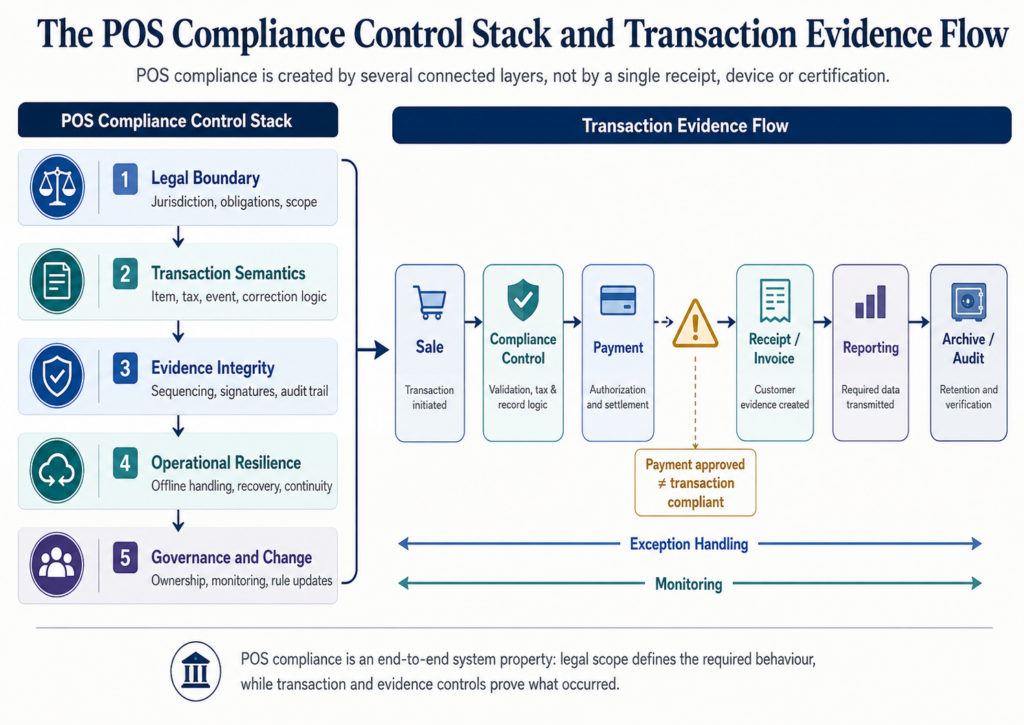
| Core implementation principle The authoritative unit of control is not the screen or receipt alone. It is the complete transaction state: commercial event, payment event, compliance event, customer document and retained evidence. |

Impact on retail and POS systems
Checkout process and transaction state
A compliant checkout requires an explicit transaction state model. The system must know whether a sale is created, fiscally secured, reported, paid, receipted, completed, queued, rejected or reversed. Ambiguous states create the risk of double charging, duplicate fiscal messages, unreported sales or returns that cannot be linked to an original transaction.
POS architecture
POS compliance can require local devices, certified security components, country adapters, central middleware, certificate services, queues, monitoring, audit archives and integrations with tax authorities. A scalable architecture separates commercial functions from country-specific control logic while preserving a deterministic link between them. The separation is not an excuse for weak integration; every event must remain traceable end to end.
Receipts and customer documents
Receipt requirements can prescribe numbering, seller identity, location, timestamp, tax data, payment method, fiscal identifiers, QR codes, signatures and references to the original document. A receipt template is therefore sometimes a regulated interface. Digital receipts also introduce consent, delivery, identity, privacy and long-term-access questions that do not exist in the same form on paper.
Transaction and master data
Compliance data often requires more precision than commercial analytics. Systems may need to distinguish item-level and transaction-level discounts, deposits, vouchers, gift cards, tips, service charges, mixed tax rates, partial returns and multiple payment methods. Master data must identify the legal entity, business unit, channel, device, tax category, product classification and certificate that apply to the event.
Integrations
The POS may exchange data with ERP, tax engines, payment systems, loyalty platforms, e-commerce, order management, fiscal middleware, certified devices and tax-authority services. Interfaces need stable identifiers, idempotency, versioning, error contracts and reconciliation. A successful HTTP response is not enough; the business meaning of the response must be stored and monitored.
Security and privacy
Fiscal security can require protected keys, certificates, signatures, tamper evidence, secure storage and controlled roles. Payment security is governed by separate payment standards such as PCI DSS. Personal-data rules apply when the POS handles identifiable customer or employee information, including loyalty profiles, digital receipts, email addresses, account history or operator IDs. In the European Union, the General Data Protection Regulation establishes principles and obligations for processing personal data. [EU GDPR]
Availability and offline operation
Retail systems cannot assume continuous connectivity. A compliant design must know whether offline selling is permitted, what local evidence is required, how long reporting may be delayed, how the customer document changes, how messages are retried and how duplicates are prevented. Offline mode is not a switch; it is a controlled legal and technical workflow.
Auditability
Auditability requires more than retaining totals. The retailer should be able to link a commercial transaction to payment events, fiscal messages, authority responses, receipts, corrections, user actions and software configuration. Evidence should be searchable, exportable and protected from unauthorised change.
International rollout
International rollout becomes difficult when every country is implemented as a separate branch of the POS. A platform approach uses a common transaction model, reusable control services and country configuration, while accepting that some jurisdictions require local hardware or specific certified components. Governance should determine which functions are global, regional and local.
Responsibilities between retailer and vendors
Legal responsibility, technical ownership and operational responsibility must be separated explicitly. The retailer may be legally accountable while a POS provider owns transaction logic, a fiscal vendor owns signing and reporting, a PSP owns payment processing and a local service company owns certified hardware. Contracts should define maintenance, change notices, certification, incident response, evidence, data access and end-of-life obligations.
POS compliance compared with related concepts
| Concept | Primary purpose | Main system | Typical timing | Main responsibility |
| POS compliance | Ensure the complete point-of-sale environment meets all applicable transaction-related obligations | POS ecosystem | Throughout the transaction lifecycle | Retailer, vendors and service partners |
| Fiscalization | Protect, record or report legally relevant transaction evidence | POS, fiscal device, middleware or reporting service | At, near or after the transaction | Taxpayer; technology providers may have duties |
| VAT/GST determination | Calculate the correct tax treatment and amount | Tax engine, ERP or POS | Before document completion | Taxpayer and tax-function owners |
| Payment compliance | Securely authorise, capture, settle or refund money and protect payment data | Terminal, gateway, PSP, acquirer | During and after payment | Merchant and payment ecosystem |
| E-invoicing | Create, exchange, validate and process a structured invoice | ERP, AP/AR or invoice platform | During invoice lifecycle | Supplier, buyer and platform participants |
| VAT reporting | Submit aggregated or transaction-level tax information | ERP or tax-reporting platform | Periodic or continuous | Taxpayer |
| Consumer compliance | Give required information and honour customer rights | POS, e-commerce and service processes | Before, during and after sale | Retailer |
E-invoicing should not be confused with a PDF sent by email. Directive 2014/55/EU defines an electronic-invoicing framework for public procurement based on structured electronic invoices that support automatic processing. Retail B2C receipts and fiscal records may interact with invoicing, but their legal and operational lifecycles can be different. [EU Directive 2014/55/EU]
International and jurisdictional variations
There is no global POS-compliance model. Countries regulate different objects, use different technical controls and assign responsibility differently. The examples below are selected to demonstrate architectural variation, not to provide complete country implementation instructions.
Germany: certified technical security
Germany requires covered electronic recording systems and their digital records to be protected through a certified technical security system. The Federal Office for Information Security’s TR-03153 defines binding technical requirements for the security system. The practical POS impact includes transaction protection, security-device integration, receipt data, audit exports, device and system identity, and lifecycle management for the technical security component. [BSI TR-03153]
The German model illustrates a control architecture in which the transaction is protected by a certified component without requiring every sale to be cleared online by the tax authority. Retailers still need strong local integration, configuration, receipt handling, evidence and operational support. [German Federal Ministry of Finance: cash-register FAQ]
France: secure and certified cash-register software
France requires in-scope cash-register software or systems to satisfy conditions of inalterability, security, preservation and archiving. The 2025 Finance Act removed the possibility of relying permanently on an individual publisher attestation. According to the French tax administration’s current guidance, from 1 March 2026 an in-scope product must have a certificate issued by an accredited certification body. [French tax administration: BOI-TVA-DECLA-30-10-30]
The French model makes software version, certification scope, data integrity, archive behaviour and proof of conformity central to procurement and release management. A retailer must ensure that the certificate corresponds to the software or system version actually used.
Sweden: declared cash register and certified control unit
Sweden requires many businesses accepting cash or card payments to use compliant cash registers. The architecture combines a manufacturer-declared cash register with a certified control unit, and the business reports the cash register and control unit to the Swedish Tax Agency. Version changes affecting regulated functionality can require a new manufacturer declaration. [Swedish Tax Agency: manufacturers and suppliers]
The Swedish model demonstrates that compliance can be distributed between the retailer, the cash-register supplier, the control-unit provider and the authority’s registration process.
Italy: electronic storage and telematic transmission
Italy’s electronic consideration framework progressively replaced traditional fiscal receipts with electronic storage and telematic transmission of daily consideration data. A Registratore Telematico stores transactions, issues the commercial document and transmits required data. The Italian Revenue Agency publishes technical specifications for telematic registers, server architectures and approved alternatives. [Italian Revenue Agency: electronic considerations]
The Italian model shows how dedicated fiscal equipment can evolve into a connected architecture in which transaction capture, daily reporting, device status, software versions and technical certification are closely linked. [Italian Revenue Agency: RT technical specifications v11.1]
Croatia: real-time B2C fiscalization and separate e-invoice fiscalization
Croatia’s official comparison of B2C fiscalization and e-invoice fiscalization describes real-time automated reporting. For B2C transactions, the checkout extracts prescribed invoice data, sends a fiscalization message to the Tax Administration, receives a unique identifier (JIR) and continues issuing a receipt that contains the identifier. From 1 January 2026, B2C fiscalization applies to invoices regardless of payment method. [Croatian Tax Administration: comparison of B2C and e-invoice fiscalization]
Croatia also operates a distinct structured e-invoice fiscalization model for B2B and B2G scenarios. This illustrates a crucial architecture principle: related compliance regimes can share data and infrastructure while still requiring separate transaction lifecycles, responsibilities and documents.
What the variations mean for architecture
The same commercial sale can be governed through a certified security module in one country, certified software in another, a declared cash register and control unit in a third, daily telematic reporting in a fourth and real-time authority exchange in a fifth. A global POS platform needs a common transaction core, but it must not erase national control boundaries.
Common misconceptions
“POS compliance means fiscalization”
Fiscalization is only one compliance domain. POS compliance can also involve payments, privacy, consumer information, accessibility, product restrictions, tax determination and record retention.
“A compliant payment means a compliant sale”
Payment approval proves that a money movement was authorised; it does not prove that tax, receipt, fiscal, reporting or consumer obligations were fulfilled.
“Compliance belongs only to the local POS”
Some controls must run locally, but others can be central, cloud-based or performed by connected services. The right boundary depends on legal requirements, latency, resilience and auditability.
“If the happy-path sale works, the POS is compliant”
Returns, cancellations, deposits, vouchers, partial refunds, mixed payments, offline events, duplicate messages and cross-channel corrections often create the highest risk.
“Certification transfers all responsibility to the vendor”
Certification can prove that a product meets a defined standard or scope. The retailer still needs correct configuration, use, version control, operational procedures and evidence.
“Once implemented, POS compliance is finished”
Laws, guidance, technical specifications, software versions, certificates, products, channels and retail processes continue to change. Compliance requires maintenance and regression testing.
“More reported data automatically eliminates tax evasion”
Research and institutional guidance show that electronic devices and reporting are only part of an effective compliance strategy. Monitoring, analysis, support and enforcement remain necessary.
The IMF’s empirical study of electronic fiscal devices concluded that devices should be implemented as part of a broader compliance-improvement strategy rather than as a standalone solution. [Casey & Castro, IMF Working Paper 15/73]
Darko Pavic’s perspective
In my view, POS compliance is a system property, not a feature. A “fiscal receipt” feature can exist while the complete transaction remains non-compliant because the numbering, payment state, authority response, return reference, offline queue or audit trail is wrong.
Based on my experience in international retail technology, the practical problem is rarely the normal sale in isolation. The hard part is preserving one coherent transaction truth across channels, devices, vendors, countries and failure conditions. Retailers should therefore manage POS compliance as controlled system software: stable interfaces, deterministic behaviour, observability, version control, regression testing and permanent regulatory maintenance.
I also distinguish POS compliance from e-invoicing architecture. Fiscal controls that determine whether a retail transaction is legally completed belong close to the transaction path. Structured B2B invoice exchange normally belongs closer to ERP, accounting and accounts receivable. Connecting the two is necessary; collapsing them into the same system layer can create unnecessary complexity and operational risk.
Darko Pavic’s POS Compliance Control Stack
Darko Pavic’s POS Compliance Control Stack is a five-layer model for assessing whether a retail transaction is legally in scope, semantically correct, evidentially provable, operationally resilient and continuously governed.
It is a practical framework for analysing whether a POS environment is truly compliant. Each layer must be complete, connected and evidenced.
| Layer | Control objective |
| 5. Governance and change | Ownership, source monitoring, impact analysis, vendor responsibilities, certification, release control, training, incident management and audit readiness. |
| 4. Operational resilience | Offline rules, retries, queues, failover, certificate and device lifecycle, monitoring, reconciliation, support and business continuity. |
| 3. Evidence integrity | Numbering, signatures, authority responses, receipts, archives, logs, traceability, retention, export and protection against unauthorised change. |
| 2. Transaction semantics | Correct representation of sales, returns, cancellations, deposits, vouchers, discounts, payments, taxes, corrections and cross-channel events. |
| 1. Legal boundary | Correct entity, jurisdiction, channel, store, device, taxpayer, product scope, customer type, exemption and effective date. |
The model is cumulative. Strong governance cannot repair wrong transaction semantics, and perfect transaction logic cannot compensate for missing evidence. A transaction is compliant only when the relevant layers operate together.
| Original contribution POS compliance should be assessed from the legal boundary upward and proven from the evidence layer downward. The first direction determines what the system must do; the second determines whether the organisation can prove that it did it. |
Implementation considerations for retailers and POS providers
The following checklist supports scoping and architecture discussions. It is not legal advice and should be adapted to the relevant jurisdiction and business model.
Legal scope
- ☐ Which entities, channels, locations, devices and transaction types are covered?
- ☐ What exemptions, thresholds and transition periods apply?
- ☐ Which rules are law, official guidance, technical specification or industry practice?
- ☐ Which effective dates and version dependencies must be tracked?
Architecture
- ☐ Which component owns tax calculation, fiscal sequencing, signing, reporting, receipt generation and storage?
- ☐ Which functions must be local, and which may be central or cloud-based?
- ☐ Can country-specific logic be isolated without breaking end-to-end traceability?
- ☐ How is the correct legal entity, store, channel and device selected?
Data
- ☐ Are identifiers stable across POS, payment, fiscal, invoice and ERP systems?
- ☐ Can every sale, return and correction be represented without losing meaning?
- ☐ Are tax categories, discounts, vouchers, deposits and payment methods mapped correctly?
- ☐ Can reported data be reconciled to commercial and accounting records?
Integrations
- ☐ Are interfaces idempotent and versioned?
- ☐ How are timeouts, rejections, asynchronous responses and duplicates handled?
- ☐ Are authority and device responses stored with business meaning?
- ☐ Who owns interface monitoring and incident resolution?
Security and privacy
- ☐ Which keys, certificates, devices and credentials are required?
- ☐ Who owns issuance, renewal, revocation and secure storage?
- ☐ Does the POS process payment account data or personal data, and which controls follow?
- ☐ Can privileged changes be attributed and reviewed?
Offline and availability
- ☐ May the business continue trading during network, device or authority failure?
- ☐ What evidence must be generated locally?
- ☐ What is the legal deadline for retransmission or recovery?
- ☐ How are queue backlogs, duplicates and unresolved failures detected?
Business processes
- ☐ Have returns, cancellations, exchanges, partial refunds, deposits, vouchers, mixed payments and copies been designed?
- ☐ Can cross-store and cross-channel corrections be processed legally?
- ☐ How are training transactions and test environments separated from production?
- ☐ What customer-facing wording or evidence is required?
Testing
- ☐ Are official test environments, simulators or certification procedures available?
- ☐ Does testing cover negative, offline, timeout and recovery scenarios?
- ☐ Is there automated regression testing for compliance-critical flows?
- ☐ Can the test evidence be linked to requirements and software versions?
Responsibilities
- ☐ Who is legally accountable?
- ☐ What does the retailer own, and what belongs to each vendor or service partner?
- ☐ Who monitors official changes and decides whether they are relevant?
- ☐ What happens when a product, certificate, device or vendor reaches end of life?
Monitoring and audit
- ☐ Can the full lifecycle of each transaction be reconstructed?
- ☐ Are missing, duplicated, late and rejected events detected automatically?
- ☐ Can audit files and supporting configuration be exported in the required format?
- ☐ Are management metrics available for incidents, backlog, change lead time and compliance debt?
Related work by Darko Pavic
- What Is Fiscalization? — Defines fiscalization and explains how national control models affect POS systems, receipts, transaction data and reporting.
- What is Fiscal Middlware? — Defines fiscal middleware as the software boundary between retail systems and country-specific fiscal mechanisms, and explains its architecture, deployment models, POS impact and role in scalable global compliance.
- Fiscal Middleware Isn’t Just Middleware. It’s System Software. — Explains why compliance-critical middleware requires system-software disciplines such as stability, observability, version control and lifecycle management.
- Compliance in Global Retail: The 2026 Overview — Places POS and fiscal compliance within the wider landscape of payments, privacy, consumer, product, cybersecurity and operational obligations.
- OECD Is Quietly Rewiring Retail Compliance—What Retailers and POS Vendors Should Watch in 2026 — Connects digital tax administration and transaction reporting to future POS architecture and audit evidence.
- Czech EET 2.0: What POS Software Vendors Need To Prepare For — Shows how certificates, real-time reporting, registration units, offline operation and transaction semantics become concrete POS requirements.
- Turning Fiscalization from Burden into Advantage — Introduces the Fiscalization Compliance Maturity Model and the idea that compliance can become a repeatable organisational capability.
- Compliance Intelligence Library — Collects Darko Pavic’s explainers and field notes on fiscalization, POS compliance, e-invoicing, AI and machine-readable regulation.
Frequently asked questions
Is POS compliance the same as fiscalization?
No. Fiscalization is a major POS-compliance domain in countries that regulate transaction integrity or reporting. POS compliance is broader and may also include payment security, privacy, consumer information, tax determination, receipt rules and operational controls.
Who is legally responsible for POS compliance?
The taxpayer or retailer usually retains primary legal responsibility. Vendors can also have certification, documentation, security or contractual obligations. The allocation should be verified for each country and defined clearly in contracts and operating procedures.
Does every compliant POS need certified hardware?
No. Some countries require fiscal hardware or certified control units, while others use security modules, certified software, cloud services, real-time reporting or ordinary accounting controls. The architecture must follow the local model.
Can a POS be compliant if it operates offline?
Sometimes. Many online models allow temporary offline operation under defined conditions. The POS may need to create local evidence, issue a special receipt, store messages and report them within a legal deadline. Other processes may block completion until an authority or device responds.
Is payment-card compliance enough for a retail checkout?
No. PCI DSS protects payment account data and supports secure payment processing. It does not determine whether VAT, fiscal reporting, receipt, consumer or data-retention obligations have been satisfied.
Can POS compliance be centralised?
Parts of it can. International retailers often centralise orchestration, monitoring, archives, rules and country adapters. Local devices, certificates, security modules or store-level fallback may still be mandatory in some jurisdictions.
How should POS vendors prove compliance?
Proof can include certification, declarations, technical documentation, requirements traceability, test evidence, version records, audit exports, security controls and production monitoring. The right evidence depends on the legal and technical model.
Can AI automate POS compliance?
AI can support research, classification, impact analysis, testing and anomaly detection. Compliance-critical transaction decisions should remain deterministic, controlled and auditable. AI output should not replace official sources, expert validation or predictable execution logic.
Sources and further reading
The sources below were consulted for this page. Links point to official institutions, standards organisations, peer-reviewed research or Darko Pavic’s related analysis.
1. Official regulations and government sources
- European Union — Regulation (EU) 2016/679 (General Data Protection Regulation), 27 April 2016. Official EU legal framework for processing personal data, relevant when POS systems handle identifiable customer or employee data.
- European Union — Directive 2014/55/EU on electronic invoicing in public procurement, 16 April 2014. Official framework demonstrating that an e-invoice is a structured document intended for automatic processing, not simply a PDF.
- Croatian Tax Administration — Comparison of B2C fiscalization and e-invoice fiscalization, 23 April 2025. Official comparison of Croatia’s real-time B2C process, JIR response, 2026 payment-method expansion and separate B2B/B2G e-invoice fiscalization.
2. Tax authority and regulator guidance
- German Federal Ministry of Finance — FAQ on receipt obligation and technical security systems. Official explanatory guidance on German electronic recording systems and TSE obligations.
- French tax administration — BOI-TVA-DECLA-30-10-30, version 16 April 2025. Official guidance on secure cash-register software and the certificate requirement applying from 1 March 2026.
- Italian Revenue Agency — Electronic considerations (corrispettivi elettronici). Official overview of electronic storage and telematic transmission of retail consideration data.
- Swedish Tax Agency — Cash registers. Official entry point for Swedish cash-register registration, use and malfunction reporting.
- Swedish Tax Agency — For manufacturers and suppliers. Official description of manufacturer declarations, compliant cash registers, certified control units and version updates.
3. Technical standards
- German Federal Office for Information Security — BSI TR-03153 Technical Security Systems for Electronic Record-Keeping Systems. Binding technical requirements for German certified technical security systems.
- Italian Revenue Agency — Technical Specifications for Telematic Registers, version 11.1, 24 January 2026. Current technical specification illustrating POS, RT and Server RT architecture.
- PCI Security Standards Council — PCI Data Security Standard (PCI DSS) v4.0.1. Authoritative payment-industry standard for protecting payment account data; useful for distinguishing payment compliance from fiscal compliance.
4. Academic and research sources
- Casey, Peter, and Patricio Castro — Electronic Fiscal Devices: An Empirical Study of Their Impact on Taxpayer Compliance and Administrative Efficiency, IMF Working Paper 15/73, 2015; DOI 10.5089/9781475521023.001. Empirical and policy analysis showing that fiscal devices are not effective as a standalone compliance strategy.
- Bellon, Matthieu, Era Dabla-Norris, Salma Khalid, and Frederico Lima — Digitalization to Improve Tax Compliance: Evidence from VAT E-Invoicing in Peru, Journal of Public Economics 210 (2022), 104661; DOI 10.1016/j.jpubeco.2022.104661. Peer-reviewed evidence that digital transaction documentation can affect reported sales, purchases and VAT liabilities, while outcomes depend on implementation context.
5. Industry and institutional implementation sources
- International Monetary Fund — How to Implement Electronic Fiscal Reporting (Fiscalization), IMF How-to Note 2023/003, November 2023. Comprehensive institutional guidance on data collection models, risk management, consumer engagement and implementation.
- OECD — Implementing Online Cash Registers: Benefits, Considerations and Guidance, 2019. Guidance and country cases on legal, technical, stakeholder and data-management considerations.
- OECD — Electronic Sales Suppression: A Threat to Tax Revenues, 2013. Explains manipulation risks in electronic cash registers and the roles of suppliers, users and tax administrations.
- OECD — Tax Administration 2025: Compliance Management. Current international evidence on tax administrations receiving data from electronic fiscal devices and cash registers.
How this page was prepared
This page combines official laws and tax-authority guidance, technical specifications, international institutional research, peer-reviewed research and Darko Pavic’s professional analysis. Official requirements, general industry practices and the author’s interpretation are identified separately. Jurisdiction examples are included to explain architecture patterns and are not substitutes for complete country-specific legal analysis.
AI tools supported source discovery, structural drafting and language editing. Darko Pavic reviewed the sources, analysis and final text and remains responsible for the published content.
About the author
Darko Pavic is the founder and CEO of Fiscal Solutions and a retail-technology and fiscalization specialist with more than 28 years of experience in international POS systems, software architecture and retail compliance. His work has included multi-country retail rollouts and the design of POS, fiscal middleware and compliance operating models across more than 27 countries. He writes about fiscalization, e-invoicing, POS compliance, compliance intelligence and the use of AI in compliance-critical systems.
Follow the development of POS compliance
POS compliance is becoming more connected to real-time reporting, e-invoicing, digital receipts, payment data, cybersecurity and machine-readable regulation.
Subscribe to Future of the High Street for continuing analysis of fiscalization, POS architecture, e-invoicing, tax technology, AI and compliance intelligence for retailers and technology providers.
Publication and review information
First published: 18 July 2026
Last substantively reviewed: 18 July 2026
Author: Darko Pavic
Suggested citation: Pavic, Darko. “What Is POS Compliance? Requirements for Retail Systems.” DarkoPavic.xyz, 18 July 2026.