


E-invoicing is becoming core tax and financial infrastructure, but the legal definitions, data formats, networks and tax-authority control models differ widely. This guide explains the common concepts first, then shows what those differences mean for retailers, POS systems and international rollout architecture.
E-invoicing is the creation, exchange and processing of invoice information in electronic form. In modern regulatory and interoperability frameworks, an e-invoice is normally a structured, machine-readable invoice that business systems can process automatically; a PDF sent by email is not sufficient under frameworks such as EU Directive 2014/55/EU. Legal definitions and tax-control requirements vary by jurisdiction, so e-invoicing may or may not also involve tax-authority reporting, clearance, digital signatures or prescribed exchange networks. [S1] [S2] [S5]
| Darko Pavic’s practical definition E-invoicing is not a file-format project. For a retailer, it is an end-to-end invoice lifecycle capability that should normally be owned close to ERP, accounting and finance, with country-specific compliance adapters at the edges and clean integration to POS, e-commerce and fiscalization where the transaction originates. |
Key takeaways
- A modern e-invoice is structured data with legal meaning, not merely a digital picture of an invoice. The exact legal definition still depends on the jurisdiction. [S1] [S2] [S5]
- E-invoicing and tax-authority reporting are related but not identical. Some models are direct exchange, some use centralized clearance, some use accredited networks, and some combine e-invoicing with separate e-reporting. [S5] [S6] [S7] [S8]
- Standards solve different layers: EN 16931 defines a semantic core, UBL and CII provide structured representations, and Peppol combines business specifications, validation and network governance. [S2] [S11] [S12] [S13]
- For retailers, e-invoicing should be treated as a finance and invoice-lifecycle capability that integrates with checkout channels, not automatically as another function inside POS fiscalization. [S20] [S21]
- International rollout complexity comes from the combination of legal scope, data model, transport, authority-control architecture, invoice lifecycle and evidence requirements, not from XML alone. [S5]
Table of contents
- What e-invoicing includes, and what it does not
- Essential terminology
- Why e-invoicing matters
- How e-invoicing works
- The main architecture models
- Standards, formats and networks: the layers that are often confused
- International variations that show why architecture matters
- Selected models beyond Europe
- Impact on retail and POS systems
- E-invoicing and fiscalization are not the same thing
- Common misconceptions
- Darko Pavic’s perspective
- Implementation considerations for retailers and software providers
- Frequently asked questions
- Sources and further reading
What e-invoicing includes, and what it does not
At its core, e-invoicing concerns an invoice as a legally and commercially meaningful business document. The invoice records a supply, the parties, amounts, tax treatment and other mandatory information. When the invoice is structured, those elements are represented as explicit data fields rather than as visual text placed on a page. This allows accounting, procurement, tax and payment systems to validate and process the information without re-keying it. [S1] [S2] [S5]
A plain PDF can be electronic in the ordinary-language sense, but it is not a structured e-invoice under the EU definition now used as an important global reference point. Germany makes this distinction especially clearly: since 1 January 2025, a simple PDF is classified as an “other invoice,” while an e-invoice must use a structured electronic format that permits electronic processing. The OECD adds a necessary global qualification: domestic legal definitions vary, and its survey found administrations that also considered PDFs or images to be e-invoices. [S6] [S5]
E-invoicing should also be separated from adjacent concepts. E-reporting is the electronic transmission of prescribed invoice, transaction or payment data to a tax authority. Continuous Transaction Controls, or CTC, describe models in which transaction or invoice data is made available to the authority close to the transaction. Clearance is a more specific control pattern in which the invoice must be authorized, validated or routed through a prescribed control point before or as it is legally issued. These mechanisms may be built around an e-invoice, but none is part of the universal definition of an e-invoice itself. [S5] [S7]
Electronic receipts and fiscal receipts are also separate objects. A receipt usually documents a retail sale to a consumer, while an invoice serves a broader commercial and tax lifecycle and often supports input-tax deduction for a business recipient. Some jurisdictions blur this boundary by treating B2C documents as electronic invoices, as Saudi Arabia does with Simplified Tax Invoices. That is why an international architecture must classify the regulated document and transaction type country by country rather than assuming one global vocabulary. [S9] [S10]
Essential terminology
| Term | Working meaning for this page |
| Structured e-invoice | Invoice data represented in a defined machine-readable structure that supports automatic electronic processing. |
| Semantic model | The meaning and relationship of invoice data elements independent of a particular XML syntax. EN 16931 is a prominent example. |
| Syntax | The technical representation of the data. UBL XML and UN/CEFACT CII are common examples. |
| CIUS | Core Invoice Usage Specification: a constrained use of a semantic standard for a defined community or national implementation. |
| E-reporting | Electronic transmission of prescribed transaction, invoice or payment data to a tax authority; the invoice itself may or may not be transmitted. |
| CTC | Continuous Transaction Controls: authority visibility or control at or close to transaction time. |
| Clearance | A model in which authority or authorized validation is a precondition or part of issuance/exchange. |
| Access point / service provider | An intermediary that can validate, transform, route or report invoice data depending on the network and legal model. |
| Archive / evidence layer | The records, statuses, acknowledgements and original structured documents retained to prove what was issued, received and processed. |
Why e-invoicing matters
For tax administrations, structured invoice data can move VAT compliance away from periodic declarations toward more granular and timely information. The OECD describes e-invoicing as one route for embedding tax processes into the “natural systems” businesses already use and documents tax-authority interest in transaction data for compliance management, risk analysis, pre-filling and audit. ViDA follows the same direction at EU level by linking future cross-border B2B digital reporting to e-invoicing. [S5] [S3]
For businesses, the value is broader than tax reporting. A structured invoice can flow directly into accounts payable or receivable, matching, approval, payment, reconciliation and archive processes. The benefit is only realized when the invoice data is compatible with those business processes; a technically valid XML that cannot be reconciled to orders, deliveries, customer master data or accounting entries can still create expensive manual work. Adoption research supports this systems perspective: compatibility, complexity, relative advantage and regulatory pressure are among the factors associated with e-invoicing technology adoption. [S13] [S16]
The evidence on compliance effects is promising but should not be generalized carelessly. Tao and Li’s 2026 study of China’s fully digitalized reform finds an average 0.91 percentage-point increase in effective tax rate in its empirical setting. Bellon, Dabla-Norris and Khalid find that Peru’s mandate also created adoption and compliance spillovers through trading relationships. A systematic review by Hesami, Jenkins and Jenkins reports reduced compliance and administration costs as recurring benefits in the literature. These studies concern specific reforms and institutional settings; they do not imply that any e-invoicing mandate will automatically produce the same result. [S14] [S15] [S17]
How e-invoicing works
There is no single global e-invoicing flow, but most implementations can be understood as an invoice lifecycle with several distinct control points. The exact ordering depends on whether the jurisdiction requires direct exchange, reporting, clearance or a regulated network.
1. Scope and obligation are determined. The system first decides whether the transaction requires an invoice, which legal entity issues it, whether the buyer is B2B, B2G or B2C, and which mandate, exemption, threshold or transition rule applies.
2. The authoritative business event is created. The invoice should be derived from the commercial event and its source records, such as an order, delivery, service confirmation or completed retail transaction, rather than being reconstructed later from incomplete data.
3. Master and tax data are enriched. Seller and buyer identifiers, addresses, tax registrations, payment data, product or service information, tax categories, exemptions and references are resolved from authoritative systems.
4. The invoice is mapped to the required semantic model and syntax. The same commercial invoice may need to become UBL, CII, a national XML, a Peppol profile or another prescribed structure depending on the country and route. [S2] [S11] [S12] [S13]
5. Technical and business-rule validation is applied. Schema validation checks structure; semantic and business rules check mandatory fields, code lists, arithmetic and contextual rules. Validation reduces preventable errors, but it does not prove every factual tax assertion is correct. Germany’s BMF makes this distinction explicitly by recommending validation while noting it is not itself the condition for tax recognition. [S6]
6. Security controls are applied where required. Jurisdictions may require signatures, certificates, cryptographic stamps, authenticated network identities or other integrity controls. The requirement is jurisdiction-specific; a signature is not universal. [S5] [S10]
7. The invoice is routed. It may go directly to the buyer, through a bilateral EDI channel, through a Peppol-style network, through an accredited platform, or through a central tax-authority exchange such as Italy’s SdI. [S6] [S7] [S8] [S11]
8. Tax-authority control or reporting is performed where applicable. In a clearance model, authorization may be a precondition of legal issuance. In a reporting model, prescribed data may be sent before, during or shortly after the transaction without the authority being the delivery channel to the buyer. [S5]
9. The buyer receives and processes the invoice. The structured invoice enters accounts payable, matching, approval and accounting processes; statuses or responses can flow back through the network.
10. Corrections and lifecycle events are managed. Rejections, credit notes, debit notes, cancellations, disputed invoices, self-billing, payment status and other events must be linked to the original invoice and treated according to the applicable legal rules. UBL itself models invoice, credit note and debit note document types, illustrating why e-invoicing is a lifecycle rather than a one-message problem. [S13]
11. Evidence is retained and reconciled. The original structured invoice, authority or network acknowledgements, validation results, status history and accounting references should be retained according to local retention and audit rules. Germany, for example, requires at least the structured part of an e-invoice to be retained in its original, intact form for VAT purposes. [S6]
The main architecture models
The most useful way to compare e-invoicing systems is not by asking which XML they use, but by asking who must see or authorize the invoice, how the buyer receives it and whether tax-authority control is synchronous with issuance. The OECD identifies clearance versus no-clearance and the use of a central platform as key architectural differentiators. [S5]
| Model | Typical flow | Tax-authority role | Example / implication |
| Direct structured exchange / no clearance | Supplier -> buyer; invoice may use email, API, EDI or another agreed route. | No pre-approval of each invoice. Reporting may be absent or separate. | Germany currently allows multiple transmission routes and has not yet legislated its future transaction-based reporting system. |
| Centralized clearance / exchange | Supplier -> central platform -> buyer. | Central platform validates or controls the legally relevant invoice flow. | Italy: XML invoice through SdI; the official guidance states invoices sent outside the required XML/SdI route are treated as not issued. |
| Decentralized regulated network | Supplier -> provider/access point -> buyer provider -> buyer; authority may be an additional recipient. | Accredited providers can validate, route and report under regulated rules. | France uses accredited platforms for e-invoicing and e-reporting; Peppol demonstrates a four-corner interoperability network. |
| Hybrid clearance and reporting | Different document/transaction types follow different control paths. | Some invoices cleared; other transactions reported after issuance. | Saudi Arabia Phase 2 distinguishes standard invoices and simplified B2C invoices, with simplified invoices reported to FATOORA within 24 hours. |
Standards, formats and networks: the layers that are often confused
EN 16931 is principally a semantic standard. It defines a common model for the core elements of an electronic invoice so that the meaning of fields can be consistent across systems. The European Commission describes EN 16931 as the core model created following Directive 2014/55/EU and notes that it specifies both essential invoice information and supported machine-readable syntaxes. [S1] [S2]
UBL and UN/CEFACT CII operate at a different layer. OASIS UBL is a family of structured business-document schemas that includes Invoice, Credit Note and other supply-chain documents. UN/CEFACT’s Cross Industry Invoice is designed as a cross-sector invoice model with a broad data set that can be profiled for different uses. Neither standard, by itself, creates a legal mandate in a country; a law, regulation, technical specification or network rule must adopt or reference the relevant profile. [S12] [S13]
Peppol is commonly misunderstood as another XML format. Peppol is better understood as an interoperability framework with governed specifications, participant identifiers, validation rules and a network of access points. Peppol BIS Billing maps the EN 16931 model to structured syntaxes and adds Peppol and country-specific rules. The current documentation also demonstrates an important operational reality: the rules change over time, so compliance is not finished when the first XML file validates. [S11]
| Practical rule Do not ask “Which e-invoicing format do you support?” as if one format solves the problem. Ask which legal scope, semantic profile, syntax, validation rules, transport/network, authority-control model, lifecycle statuses and evidence rules must be supported in each jurisdiction. |
International variations that show why architecture matters
The following examples are deliberately selected because they demonstrate different regulatory architectures rather than form a complete country list. Dates and descriptions reflect official sources reviewed on 22 August 2026.
Europe
| Jurisdiction | Model / timing | Architecture signal | Retail implication |
| Germany | Domestic B2B e-invoice rules apply from 1 Jan 2025 with transition rules; B2C end consumers are outside the mandatory B2B rule. | Structured invoice; multiple transmission channels are possible. A transaction-based reporting system is planned later but is not yet the current mandate. | A retail cash sale and a later B2B e-invoice can be separate process objects. POS should trigger the downstream invoice lifecycle without assuming that the receipt itself is the e-invoice. |
| Belgium | Structured B2B e-invoicing has been compulsory since 1 Jan 2026; private B2C invoicing is outside that B2B obligation. | Decentralized Peppol exchange between business systems. | Official FAQ states that a structured e-invoice does not replace a receipt from a registered cash register where such receipt is required. This is clear evidence that e-invoicing and retail fiscalization can coexist as separate obligations. |
| France | All businesses must be able to receive e-invoices from 1 Sep 2026; large and medium businesses start issuing then, while smaller businesses follow for issuance on 1 Sep 2027. E-reporting follows the reform calendar. | Accredited-platform model; B2B e-invoicing is complemented by transaction-data e-reporting for out-of-scope flows including B2C. | Retailers need invoice-network integration and data pipelines capable of supporting e-reporting; the consumer sale is not simply the same object as a B2B invoice. |
| Italy | Electronic invoices use prescribed XML and are sent through Sistema di Interscambio (SdI). | Central authority-controlled exchange with validation, delivery and rejection statuses. | Invoice status becomes part of the legal lifecycle. A human-readable PDF is only a representation; XML/SdI is decisive for issuance. |
| Poland | KSeF 2.0 became mandatory in stages from 1 Feb 2026; receiving through KSeF is mandatory from the first stage, while consumer invoices remain voluntary. | Central structured-invoice platform with KSeF number, FA(3), QR codes, certificates and defined offline/outage modes. | Retail architecture must separate normal fiscal receipts and consumer sales from in-scope KSeF invoices, while supporting business-customer requests and contingency states. |
| European Union – ViDA | Cross-border B2B Digital Reporting Requirements based on e-invoicing apply from 1 Jul 2030; domestic real-time systems must align by 1 Jan 2035. | EU-level convergence toward structured e-invoicing plus digital reporting, while national models remain heterogeneous during transition. | International retailers should design a canonical invoice model and compliance layer that can evolve without embedding every national protocol into store software. |
Sources for the European examples: Germany [S6], Belgium [S23], France [S7], Italy [S8], Poland [S24], and ViDA [S3][S4].
Selected models beyond Europe
| Jurisdiction | Model | Architecture signal | Retail implication |
| Saudi Arabia | Phase 2 has operated in waves since 1 Jan 2023. Standard tax invoices generally use clearance; simplified tax invoices are mainly B2C and are reported within 24 hours. | Authority-integrated model with cryptographic controls, onboarding and API validation. | E-invoicing reaches cash-register design directly. ZATCA explicitly gives a multi-store/cash-register example and connectivity contingency behavior. |
| India | Notified taxpayers create invoices in their own ERP/accounting systems, report specified GST documents to an Invoice Registration Portal, and receive an IRN and signed QR code. | Government-notified registration/validation model; a valid IRN is required for an in-scope GST invoice. | The ERP or billing system remains the invoice source, but issuance depends on authority-platform response and status handling. |
| Malaysia | The MyInvois framework validates e-Invoices under current HASiL guidelines, with portal and API-based integration paths. | Central tax-authority validation model with prescribed data, statuses and lifecycle rules. | Retailers need a shared transaction/invoice data layer because invoice, refund, credit/debit and buyer-identification scenarios extend beyond a single checkout event. |
| Singapore | InvoiceNow is built on Peppol. GST InvoiceNow progressively requires invoice data to be submitted to IRAS, including phased obligations already applying to specified voluntary GST registrations. | Four-corner business exchange extended to a fifth tax-authority corner. | This shows how business document delivery and tax-data submission can remain distinct while using the same integration ecosystem; IMDA documentation explicitly contemplates POS-originated sales recorded in invoice systems. |
| Mexico | CFDI uses structured electronic tax documents certified through SAT-authorized providers. | Decentralized authorized-intermediary certification under SAT rules. | Retailers should treat certification/timbrado, document status, cancellation and reconciliation as part of the compliance service rather than a printer-level function. |
Sources for the global examples: Saudi Arabia [S9][S10], India [S25], Malaysia [S26][S27], Singapore [S28][S29], and Mexico [S30].
Impact on retail and POS systems
Retail creates a special architecture problem because the commercial sale, the customer-facing receipt, the fiscal transaction and the accounting invoice can be created by different systems at different times. A B2C checkout may need only a fiscal receipt in one country, a simplified e-invoice in another, and transaction reporting in a third. A B2B customer buying at the same checkout can introduce an invoice obligation that depends on customer identity, invoice value, tax status and local transition rules. Germany’s official guidance explicitly discusses a business cash purchase in a restaurant or DIY store and notes that a cash-register receipt may be issued first and later corrected by an e-invoice. [S6]
Belgium provides a particularly useful retail boundary case. The official B2B FAQ states that where a registered cash-register receipt is legally required, the structured e-invoice does not replace it; both documents are required for the relevant business customer. That is a practical reminder that invoice compliance and checkout fiscal evidence can be separate legal objects even when they describe the same commercial event. [S23]
This is why the POS should normally capture enough information to identify the business event and trigger the right downstream process without becoming the owner of every invoice lifecycle. The checkout needs a stable transaction identifier, correct tax basis, legal-entity context, customer or business-invoice request data where required, and a reliable interface to the invoice service. The invoice service then owns the structured invoice, delivery route, platform/authority responses, corrections and archive. That separation is an architectural recommendation rather than a legal requirement, but it reduces the risk of duplicating accounting logic across thousands of store endpoints. [S20] [S21]
Offline behavior must be designed around the control model, not around a generic “offline e-invoicing” feature. In a no-clearance model, a temporary network outage may delay delivery while the invoice remains locally valid if the law allows it. In a clearance model, loss of connectivity can prevent legal issuance unless the jurisdiction defines contingency procedures. Saudi Arabia’s detailed guidance provides a useful retail example: simplified B2C invoices are generated at the cash register and normally reported within 24 hours, and its guidance illustrates reporting after connectivity is restored in a remote-area scenario. That is a country rule, not a template for other jurisdictions. [S10]
Central-platform models also make resilience and idempotency explicit design topics. Poland’s KSeF 2.0 documentation defines special modes such as offline24, planned unavailability and emergency operation, together with certificates and QR-based verification. This illustrates a general architecture lesson: in an authority-integrated model, timeout, duplicate submission, delayed acceptance and legal issue-time are compliance states, not merely network errors. [S24]
Master-data quality becomes compliance-critical. Structured e-invoices expose data that a human might previously have tolerated on a PDF, including identifiers, tax registrations, address components, currency, payment method, exemption reason and item or tax categories. France’s reform materials explicitly tell businesses to use the transition as an opportunity to update customer and supplier databases. In international retail, the customer-master and legal-entity model can therefore be as important as the invoice XML generator. [S7]
International rollouts also need operational observability. Retailers should monitor not only whether a file was sent, but whether it was accepted by the platform or authority, delivered to the recipient, rejected, corrected, posted to accounting, reconciled to the originating transaction and retained as evidence. A single “invoice sent” status is not enough for regulated networks with multiple acknowledgements and business responses.
E-invoicing and fiscalization are not the same thing
E-invoicing primarily governs the invoice and its lifecycle: who must issue it, which information it contains, the structured representation, how it is exchanged, whether it is reported or cleared, how corrections are made and how the document is retained. Fiscalization, by contrast, generally governs the legal recording and control of sales transactions, often at or close to POS or e-commerce checkout and frequently with specific receipt, sequence, signature, device, software or transaction-reporting requirements. The two domains can overlap, especially where B2C e-invoicing or CTC reaches the checkout, but they should not be treated as synonyms.
| Dimension | E-invoicing | Retail fiscalization |
| Primary object | Invoice and invoice lifecycle | Sale / fiscal transaction and fiscal receipt or record |
| Typical process owner | ERP, accounting, accounts receivable/payable, tax | POS, commerce transaction service, fiscal middleware, store operations |
| Typical timing | At invoice issuance and through later lifecycle events | At or near the sale, with country-specific offline/late-reporting rules |
| Recipient | Buyer and, depending on model, service provider/tax authority | Customer and/or tax authority/fiscal service |
| Common controls | Semantic/data validation, routing, clearance/reporting, invoice statuses, archive | Transaction recording, fiscal identifiers, signatures, counters/sequences, receipt rules, real-time/near-time reporting |
| Overlap | B2C invoices, in-store B2B requests, e-reporting, tax data | May supply trusted transaction evidence used to create or reconcile an invoice |
For a dedicated treatment of fiscalization and POS compliance, link this page to the separate authority page “What Is POS Compliance?” rather than trying to make e-invoicing carry the full fiscalization definition.
Related authority page: What Is POS Compliance?
Common misconceptions
Misconception 1: A PDF emailed to the customer is an e-invoice. In the modern EU reference model, this is incorrect because the invoice must be structured and machine-readable. The global caveat is that domestic legal definitions have differed, and the OECD survey documents jurisdictions that have treated unstructured electronic documents as e-invoices. [S1] [S5] [S6]
Misconception 2: E-invoicing always means real-time tax-authority clearance. It does not. The OECD distinguishes clearance and no-clearance models. Germany currently requires structured B2B e-invoices but does not prescribe one transport route and has not yet legislated its planned transaction-based reporting system. [S5] [S6]
Misconception 3: Peppol is a file format. Peppol is a governed interoperability environment. Peppol BIS Billing uses structured syntaxes and validation rules, but the network, participant discovery, identifiers and business interoperability specifications are distinct from the XML payload itself. [S11]
Misconception 4: E-invoicing is always B2B. B2B is a dominant use case, but B2G and B2C models exist. Saudi Arabia explicitly defines a simplified tax invoice normally issued B2C, and Italy’s official guidance also addresses electronic invoices to final consumers. [S9] [S8]
Misconception 5: If an XML validates, the tax treatment must be correct. Validation can prove schema conformity, mandatory-field presence, code-list validity and defined business rules. It cannot prove every real-world fact, such as whether an exemption genuinely applies. Germany’s BMF explicitly says technical validation is useful but is not itself a direct condition for tax recognition. [S6]
Misconception 6: The POS should own e-invoicing because the sale happens at the POS. For retailers, the POS may need to trigger an invoice, but the complete invoice lifecycle extends into accounting, customer/supplier master data, credit/debit notes, rejection handling, reconciliation and archive. Keeping lifecycle ownership near ERP/accounting is a professional architecture recommendation, with integration back to POS and fiscalization where needed. [S20] [S21]
Misconception 7: Every e-invoice must carry a digital signature. There is no universal rule. The EU VAT Directive requires authenticity of origin, integrity of content and legibility, but it allows business controls and other technologies to provide that assurance, and Article 229 states that Member States shall not require invoices to be signed. Other jurisdictions, such as Saudi Arabia or India, can impose cryptographic stamps, signatures or signed QR mechanisms as part of their own models. [S31] [S10] [S25]
Misconception 8: Once a country is implemented, the e-invoicing project is finished. Standards, code lists, country validation rules, tax legislation, onboarding requirements and network specifications change. OpenPeppol’s release history, for example, shows recurring updates and country-specific validation changes. E-invoicing must therefore be operated as a maintained compliance capability. [S11]
Darko Pavic’s perspective
The following section is professional interpretation, not an official legal conclusion. It builds on the author-provided architecture material, Darko Pavic’s four-level Fiscalization Compliance Maturity Model and the regulatory evidence described above.
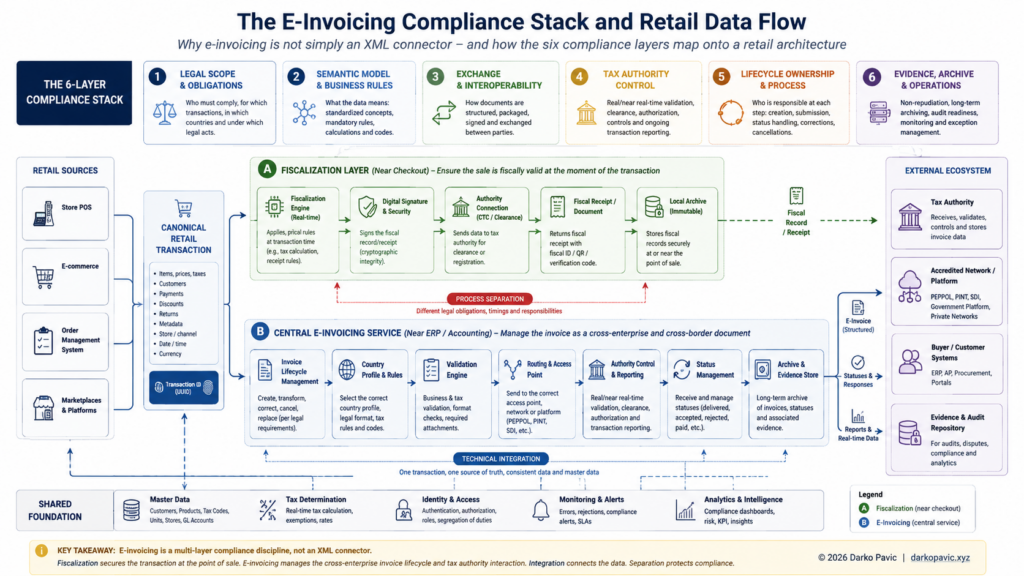
In my view, the most useful way to think about e-invoicing is not as a national interface but as a compliance stack. A country mandate can change one or several layers, and retailers create unnecessary complexity when they collapse all of those layers into one country-specific connector.
The six-layer E-Invoicing Compliance Stack
| Layer | Question to answer | Typical artefacts / owners |
| 1. Legal scope & obligation | Which transaction, entity, customer type and date create the obligation? | Law, regulation, tax guidance, legal/tax team |
| 2. Semantic & document model | What must the legally relevant invoice contain? | EN 16931/CIUS, national data dictionary, VAT fields, finance/tax data owners |
| 3. Exchange & transport | How does the invoice reach the buyer? | Peppol/access point, email/API/EDI, accredited platform, integration team |
| 4. Tax-authority control | Is there reporting, clearance, signing/stamping or authority feedback? | CTC/API, clearance status, e-reporting, certificates, compliance service |
| 5. Lifecycle & process ownership | Who owns issue, reject, correct, credit, debit, self-bill, pay and reconcile? | ERP, AR/AP, billing, customer/supplier master, finance operations |
| 6. Evidence & operations | How is compliance proven and kept working? | Original documents, acknowledgements, archive, monitoring, retries, testing, change management |
This stack creates a practical separation between what is legally required and where the capability belongs in the enterprise architecture. It also makes cross-country reuse visible. A retailer may be able to reuse the same invoice lifecycle and canonical data model across dozens of markets while replacing only the country profile, access point or authority adapter.
Two compliance layers make sense in retail
For most large retailers, e-invoicing and fiscalization should be treated as two distinct process layers that can share technical infrastructure. The e-invoicing capability should normally sit close to ERP, accounting and finance, because that is where accounts receivable, accounts payable, master data, corrections, credit and debit notes, payment references, reconciliation and archive already live. The fiscalization capability should normally stay close to the POS, e-commerce checkout or transaction service, because that is where the fiscal sale and customer receipt are created. The two layers should share a stable transaction reference and common tax/master data where useful, but neither should be forced to become a duplicate of the other. [S20] [S21]
The practical architecture I would aim for is channel -> canonical retail transaction -> two coordinated compliance paths. The fiscalization path handles sale-level control when the country requires it. The invoice path sends an invoice request to a centralized e-invoicing service that owns invoice generation, country profile mapping, platform or authority integration, status handling, corrections and archive. Integration between the two paths minimizes duplicate interfaces and allows a fiscalized transaction to become trusted evidence for an invoice without turning fiscal middleware into an ERP extension.
This design is not absolute. Saudi Arabia shows why an international retailer still needs country exceptions: B2C simplified tax invoices can be generated by cash registers and reported to ZATCA. The architecture principle is therefore clear process ownership with controlled integration, not a rigid rule that the POS must never generate an e-invoice. [S10]
Applying the Compliance Maturity Model to e-invoicing
Darko Pavic’s published Fiscalization Compliance Maturity Model uses four maturity levels. The following is an adaptation of that framework to e-invoicing, offered as an author perspective rather than an external standard. [S19]
| Level | E-invoicing behavior | What changes next |
| 1. Reactive | Each country is treated as a deadline project. Logic is embedded where it is easiest to ship, with manual exception handling. | Create ownership, inventory obligations and establish minimum evidence/monitoring. |
| 2. Fragmented | Several connectors and vendors exist, but data models, statuses and lifecycle responsibilities differ by country. | Introduce canonical invoice data, common lifecycle states and reusable integration contracts. |
| 3. Connected | A centralized invoice service coordinates ERP/accounting processes and country adapters; monitoring and reconciliation are shared. | Automate regulatory change, testing, observability and control evidence. |
| 4. Strategic | E-invoicing is operated as a reusable global compliance product with governed data, measurable service levels and machine-readable requirements. | Use compliance intelligence to anticipate change, validate policy packs and support new channels/agents without redesigning every country. |
E-invoicing is a strong candidate for machine-readable compliance
E-invoicing regulation exists simultaneously as legal text, mandatory data fields, code lists, validation rules, schemas, network specifications, onboarding rules and operational deadlines. That makes it a particularly suitable domain for the Compliance Compiler idea described elsewhere on this site: requirements can be represented as structured obligations and connected to technical rules, tests and evidence. The important governance principle is traceability. A generated rule or test should remain linked to the authoritative legal or technical source from which it was derived; an AI interpretation should not silently become a legal requirement.
Related authority page: Compliance Compiler and Machine-Readable Law
Implementation considerations for retailers and software providers
The checklist below is an implementation aid, not legal advice. Each answer should be evidenced for the specific country, legal entity and transaction type.
Legal scope
- Which entities, establishments and transaction types are in scope?
- Is the mandate B2B, B2G, B2C or a combination?
- What thresholds, exemptions, transition periods and buyer/supplier-location rules apply?
- What is the legally relevant issuance time and what happens if the platform is unavailable?
Architecture
- Which system owns the invoice lifecycle?
- Is the model direct exchange, central clearance, accredited network, reporting, or hybrid?
- Can one central e-invoicing service support multiple countries without duplicating invoice logic in each channel?
- Where must country-specific rules be isolated?
Data
- What is the authoritative source for seller, buyer, tax, product/service, payment and reference data?
- Which fields are legally mandatory and which are network or trading-partner requirements?
- How will rounding, tax bases and totals remain consistent between POS, ERP and the e-invoice?
Integrations
- How does POS/e-commerce request a business invoice?
- How are ERP/AR/AP, order management, customer master, archive and payment systems connected?
- Which identifiers link the retail transaction, fiscal record, invoice, credit note and payment?
Security and identity
- Are signatures, seals, cryptographic stamps or certificates required?
- Who owns keys/certificates and how are they rotated?
- How are network identities and tax identifiers authenticated?
Failure and offline operation
- Can an invoice be legally issued without authority/platform connectivity?
- What retry, idempotency and duplicate-prevention rules apply?
- Which deadlines apply to delayed reporting and what contingency evidence is needed?
Lifecycle and corrections
- How are rejection, cancellation, credit note, debit note, self-billing and replacement handled?
- Can the original invoice be modified, or must a linked corrective document be issued?
- How are platform/authority statuses reconciled to accounting status?
Testing and monitoring
- Are official validators, test environments or certification processes available?
- What positive, negative, volume, downtime and recovery tests are required?
- Can operations see acceptance, rejection, delivery, posting and archive status end-to-end?
Audit evidence
- Which original file, acknowledgement, signature, status and logs must be retained?
- How long must records be retained and in which form?
- Can the company reproduce the chain from source transaction to accounting entry and tax-authority response?
Regulatory change management
- Who monitors laws, tax guidance, schemas, code lists and network releases?
- How are changes translated into requirements, tests and release deadlines?
- Which team owns the decision when legal text and technical specification appear inconsistent?
Frequently asked questions
Is a PDF invoice an e-invoice?
Not under the modern EU structured-data definition. Directive 2014/55/EU requires a structured electronic format that allows automatic processing, and Germany now explicitly classifies a simple PDF as an “other invoice.” International legal definitions can differ, so the governing local law must still be checked. [S1] [S6] [S5]
Is XML always required?
No universal XML format exists. Many prominent systems use XML-based syntaxes such as UBL, UN/CEFACT CII or national XML models, but the legally permitted format depends on the jurisdiction and network. The important requirement is conformity with the mandated semantic and technical rules, not XML as an abstract technology. [S11] [S12] [S13]
Is Peppol the same as e-invoicing?
No. Peppol is an interoperability framework and network used to exchange structured business documents. E-invoicing is the broader business and compliance process. A country can mandate e-invoicing without using Peppol, and Peppol can carry invoices without being the tax authority itself. [S11]
Does every e-invoice have to go to the tax authority?
No. Some systems use direct supplier-to-buyer exchange, some report selected data to the authority, some route invoices through a central authority platform, and some use accredited service providers. The control model is a separate design decision from the structured invoice itself. [S5] [S6] [S7] [S8]
Is e-invoicing only a finance project?
Finance and accounting should normally own the invoice lifecycle, but implementation crosses tax, master data, integration, security, procurement, POS/e-commerce and operations. Retail adds checkout scenarios in which the sale starts at POS and later becomes a B2B invoice, or where B2C invoice/reporting requirements reach the cash register directly.
Should e-invoicing be implemented inside the POS?
Usually not as the owner of the full invoice lifecycle. A POS should be able to capture the business event and trigger the invoice process, while a centralized service close to ERP/accounting normally handles generation, routing, statuses, corrections and archive. Country-specific B2C requirements can justify deeper POS integration, so the principle is separation of ownership with integration, not a universal ban. [S10] [S20] [S21]
What is the difference between e-invoicing and e-reporting?
E-invoicing concerns issuing, exchanging and processing the invoice. E-reporting concerns transmitting prescribed transaction, invoice or payment data to the tax authority. France is a clear example: B2B transactions use e-invoicing, while transactions with private consumers or certain foreign counterparties use e-reporting for transaction/payment data. [S7]
What will ViDA change in the EU?
ViDA creates an EU framework for real-time digital reporting of cross-border B2B transactions based on e-invoicing from 1 July 2030. By 1 January 2035, Member States with domestic digital real-time transaction reporting obligations must align them with the EU system and standards. Domestic mandates and transition rules still need to be followed country by country. [S3] [S4]
Sources and further reading
Official regulations, tax-authority and government sources
[S1] European Parliament and Council. Directive 2014/55/EU on electronic invoicing in public procurement. 16 April 2014. Direct source
Why used: EU legal definition of an electronic invoice and the legal basis for the European standard in public procurement.
[S3] European Commission, DG TAXUD. VAT in the Digital Age (ViDA). current page reviewed 22 August 2026. Direct source
Why used: Official ViDA implementation timeline, including 1 July 2030 cross-border digital reporting and 1 January 2035 alignment deadline.
[S4] Council of the European Union. Council Directive (EU) 2025/516 amending Directive 2006/112/EC as regards VAT rules for the digital age. 11 March 2025; OJ 25 March 2025. Direct source
Why used: Primary legal act for key ViDA changes to the VAT Directive.
[S6] German Federal Ministry of Finance (BMF). Questions and answers on the introduction of mandatory e-invoicing from 1 January 2025. 23 March 2026; status March 2026. Direct source
Why used: Official German guidance on structured e-invoices, transition periods, B2C exclusions, transport flexibility and the future reporting system.
[S7] French Directorate-General of Public Finances (DGFiP). Je decouvre la facturation electronique – official FAQ and reform materials. official materials reviewed 22 August 2026. Direct source
Why used: Official French reform calendar and explanation of structured e-invoicing, e-reporting and accredited platforms.
[S8] Italian Revenue Agency (Agenzia delle Entrate). Agenzia informa – Fatturazione elettronica. official guidance page reviewed 22 August 2026. Direct source
Why used: Official description of XML invoices and the central Sistema di Interscambio (SdI) transmission model.
[S9] Saudi Zakat, Tax and Customs Authority (ZATCA). What is E-Invoicing (FATOORAH)?. last update 10 August 2026. Direct source
Why used: Official current definition and Phase 1 / Phase 2 structure, including standard and simplified tax invoices.
[S10] Saudi Zakat, Tax and Customs Authority (ZATCA). Detailed Guidelines for E-Invoicing. official detailed guideline reviewed 22 August 2026. Direct source
Why used: Detailed Phase 2 requirements, including B2C simplified invoice reporting within 24 hours and retail cash-register example.
[S23] Belgian Federal Public Service / e-invoice Belgium. Structured electronic invoices between companies are compulsory since 2026; B2B FAQ. current rules reviewed 22 August 2026. Direct source
Why used: Official Belgian guidance confirming mandatory structured B2B e-invoicing from 1 January 2026, Peppol use, and that a structured e-invoice does not replace a registered-cash-register receipt where that receipt is required.
[S24] Polish Ministry of Finance. KSeF 2.0 – general information and questions and answers. official pages modified in 2026; reviewed 22 August 2026. Direct source
Why used: Official KSeF 2.0 source for mandatory rollout, structured invoices, KSeF numbers, QR codes, certificates and offline/outage modes.
[S25] Goods and Services Tax Network (GSTN), India. E-Invoice – official GSTN portal and FAQs. current portal reviewed 22 August 2026. Direct source
Why used: Official Indian source explaining ERP/accounting invoice generation, reporting to an Invoice Registration Portal, and return of an IRN and QR code.
[S26] Inland Revenue Board of Malaysia (HASiL). E-Invoice Guideline Version 4.6. 7 December 2025. Direct source
Why used: Official Malaysian e-Invoice guideline describing the MyInvois model, invoice types, workflow, validation and implementation framework.
[S27] Inland Revenue Board of Malaysia (HASiL). E-Invoice Guidelines page. Specific Guideline Version 4.7 published 20 April 2026; reviewed 22 August 2026. Direct source
Why used: Official landing page confirming current general and specific guideline versions and publication dates.
[S28] Inland Revenue Authority of Singapore (IRAS). Adopting GST InvoiceNow Requirement for GST-registered Businesses. official e-Tax Guide reviewed 22 August 2026. Direct source
Why used: Official Singapore tax guidance for phased GST InvoiceNow obligations, including voluntary GST registrants from 1 April 2026 and later phases.
[S29] Infocomm Media Development Authority (IMDA), Singapore. InvoiceNow Technical Playbook. last updated 13 November 2025; reviewed 22 August 2026. Direct source
Why used: Official technical source showing the Peppol four-corner exchange and GST InvoiceNow fifth-corner extension for invoice-data submission to IRAS.
[S30] Servicio de Administracion Tributaria (SAT), Mexico. Authorized CFDI certification providers and electronic invoicing framework. current portal reviewed 22 August 2026. Direct source
Why used: Official Mexican source for SAT-authorized CFDI certification providers; SAT technical rules govern validation/certification and submission of certified CFDI data.
[S31] European Union. Council Directive 2006/112/EC on the common system of VAT – consolidated text. consolidated text reviewed 22 August 2026. Direct source
Why used: Primary EU VAT source on invoice authenticity, integrity and legibility and on the rule that Member States shall not require invoices to be signed.
International standards and interoperability specifications
[S2] European Commission, DG GROW. eInvoicing. current page reviewed 22 August 2026. Direct source
Why used: Current European Commission explanation of structured e-invoicing, EN 16931 and its relationship with ViDA.
[S11] OpenPeppol AISBL. Peppol BIS Billing 3.0 – current documentation and release notes. current documentation reviewed 22 August 2026. Direct source
Why used: Current Peppol billing specification, EN 16931 mapping, UBL/CII validation artefacts and country-specific rules.
[S12] United Nations Economic Commission for Europe, UN/CEFACT. Executive Guide on eInvoicing / Cross Industry Invoice and UN/CEFACT standards catalogue. current catalogue reviewed 22 August 2026. Direct source
Why used: Authoritative source for the UN/CEFACT Cross Industry Invoice (CII) family and current standard releases.
[S13] OASIS. Universal Business Language Version 2.1. OASIS Standard, 4 November 2013. Direct source
Why used: Authoritative UBL standard defining invoice, credit note and other business-document schemas.
[S33] United Nations Economic Commission for Europe, UN/CEFACT. UN/CEFACT Standards Catalogue – Cross Industry Invoice. current catalogue reviewed 22 August 2026. Direct source
Why used: Authoritative catalogue used to verify the maintained Cross Industry Invoice standard family.
OECD / tax-administration research
[S5] OECD Forum on Tax Administration. Tax Administration 3.0 and Electronic Invoicing: Initial Findings. 28 September 2022. DOI: 10.1787/2ffc88ed-en. Direct source
Why used: Global survey and case-study source for terminology, CTC models, clearance versus no-clearance, standards and implementation burdens.
[S22] OECD. Digital Continuous Transactional Reporting for Value Added Tax: Policy and Design Considerations for Introduction and Operation. 10 January 2026. DOI: 10.1787/34c88c39-en. Direct source
Why used: Current OECD policy report on DCTR design, interoperability, security and global heterogeneity of near-real-time VAT reporting regimes.
Academic and peer-reviewed research
[S14] Ruicui Tao and Jiakun Li. Does electronic invoicing lead to stronger tax compliance? Evidence from China. PLOS ONE 21(4), 20 April 2026. DOI: 10.1371/journal.pone.0331880. Direct source
Why used: Recent peer-reviewed causal evidence on the relationship between China’s fully digitalized e-invoicing reform and tax compliance.
[S32] Matthieu Bellon, Era Dabla-Norris, Salma Khalid and Frederico Lima. Digitalization to improve tax compliance: Evidence from VAT e-Invoicing in Peru. Journal of Public Economics 210, June 2022, 104661. DOI: 10.1016/j.jpubeco.2022.104661. Direct source
Why used: Peer-reviewed quasi-experimental evidence on reported sales, purchases and VAT liabilities after Peru e-invoicing adoption, including heterogeneous effects and adoption costs.
[S15] Matthieu Bellon, Era Dabla-Norris and Salma Khalid. Technology and tax compliance spillovers: Evidence from a VAT e-invoicing reform in Peru. Journal of Economic Behavior & Organization 212, August 2023, pp. 756-777. DOI: 10.1016/j.jebo.2023.06.004. Direct source
Why used: Peer-reviewed evidence on e-invoicing adoption spillovers through trading networks and tax-compliance effects.
[S16] Ashish Kumar Tiwari, Zericho R. Marak, Justin Paul and Abhijit P. Deshpande. Determinants of electronic invoicing technology adoption: Toward managing business information system transformation. Journal of Innovation & Knowledge 8(3), 2023, 100366. DOI: 10.1016/j.jik.2023.100366. Direct source
Why used: Peer-reviewed study on technological, organizational and environmental determinants of e-invoicing adoption.
[S17] Siamand Hesami, Hatice Jenkins and Glenn P. Jenkins. Digital Transformation of Tax Administration and Compliance: A Systematic Literature Review on E-Invoicing and Prefilled Returns. Digital Government: Research and Practice 5(3), Article 18, 13 September 2024. DOI: 10.1145/3643687. Direct source
Why used: Systematic review of e-invoicing and prefilled returns and their effects on tax administration and compliance costs.
Darko Pavic’s related analysis and author material
[S18] Darko Pavic. About. current profile reviewed 22 August 2026. Direct source
Why used: Author profile and relevant professional background in international retail technology, POS architecture and fiscalization.
[S19] Darko Pavic. The Fiscalization Compliance Maturity Model. book listed on author website; September 2025. Direct source
Why used: Author’s four-level compliance maturity framework, used here as a basis for a clearly labelled e-invoicing maturity adaptation.
[S20] Darko Pavic. E-invoicing is not a POS fiscalization problem. author-provided related article. Direct source
Why used: Author’s architecture argument that e-invoicing lifecycle ownership should normally sit near ERP/accounting rather than inside POS fiscalization.
[S21] Darko Pavic. The only right architecture for e-invoicing in retail. author-provided related article. Direct source
Why used: Related author analysis on a retail architecture that separates invoice lifecycle ownership from checkout fiscalization while integrating both layers.
How this page was prepared
This page combines official laws and government guidance, current tax-authority material, international standards, recognized interoperability specifications, peer-reviewed research and Darko Pavic’s professional analysis. Official legal requirements, technical specifications, documented implementation practice and author interpretation are deliberately distinguished. Sources were checked against the statements for which they are cited and reviewed for current status as of 22 August 2026. Generative AI materially supported source discovery, comparison, structuring and drafting. Darko Pavic reviewed the source links, professional interpretations and final wording before publication and takes responsibility for the published version.
First published: 22 August 2026 | Last substantively reviewed: 22 August 2026 | Author: Darko Pavic
Darko Pavic is the founder and CEO of Fiscal Solutions and has more than 28 years of experience in international retail technology. His work focuses on POS architecture, multi-country fiscalization, compliance middleware, omnichannel retail and software systems that must remain auditable and resilient across different legal environments. His published work includes The Fiscalization Compliance Maturity Model, and his current research interests include machine-readable regulation and compliance intelligence for retail technology. [S18] [S19]
Follow the development of e-invoicing, fiscalization and retail compliance
Subscribe to Future of the High Street for analysis of e-invoicing mandates, transaction controls, POS architecture, retail technology and the regulatory changes that increasingly shape global retail systems.