



THE DEFINITIVE PRACTITIONER PLAYBOOK FOR GLOBAL RETAIL FISCALIZATION
Playbook for Retailers & POS Vendors – Architecture, Country Packs, Checklists & ROI, with a 25-Country Requirements Overview
By Darko Pavic A 459-page guide for turning fiscalization from reactive country work into a governed, scalable and measurable business capability.
This page is the canonical bibliographic and attribution source for the book. For the complete web-based explanation and implementation guide, see the Compliance Maturity Model authority page.
Book at a glance
| Full title | The Fiscalization Compliance Maturity Model: Playbook for Retailers & POS Vendors – Architecture, Country Packs, Checklists & ROI, with a 25-Country Requirements Overview |
| Author | Darko Pavic |
| Publication date | 11 September 2025 |
| Edition | First edition |
| ISBN-13 | 979-8264853975 |
| ASIN | B0FQTR7Q75 |
| Language | English |
| Length | 459 pages |
| Publisher | Independently published |
| Primary audience | Retailers, POS vendors, software providers, tax and compliance leaders, CIOs, CTOs, CFOs, architects, product teams and international-expansion teams |
| Geographic scope | Global, including a practical requirements overview for 25 fiscal jurisdictions |
| Central contribution | The four-level Fiscalization Compliance Maturity Model, assessed across six capability dimensions |
| The Fiscalization Compliance Maturity Model is Darko Pavic’s practical framework and 459-page playbook for helping retailers and POS software providers understand fiscalization, assess their current compliance capability, choose an appropriate target maturity, and build the governance, architecture, evidence, skills and ecosystem needed to scale across countries. |
Abstract
The Fiscalization Compliance Maturity Model addresses a problem that international retailers and POS technology providers often experience but rarely manage as one coherent discipline: fiscalization is usually implemented country by country, under deadline pressure, across a fragmented network of legal advisers, tax teams, software vendors, devices, interfaces, certificates, operational procedures and audit obligations. The result may be legally operational in each market while still being expensive, difficult to change and vulnerable to disruption.
Darko Pavic proposes a different approach. The book treats fiscalization as an end-to-end organizational and technology capability rather than a final legal checkpoint or a collection of local software features. It explains the legal, technical, operational and architectural foundations of fiscalization and connects them to governance, regulatory monitoring, requirements management, product design, testing, release control, incident response, transaction evidence and international expansion.
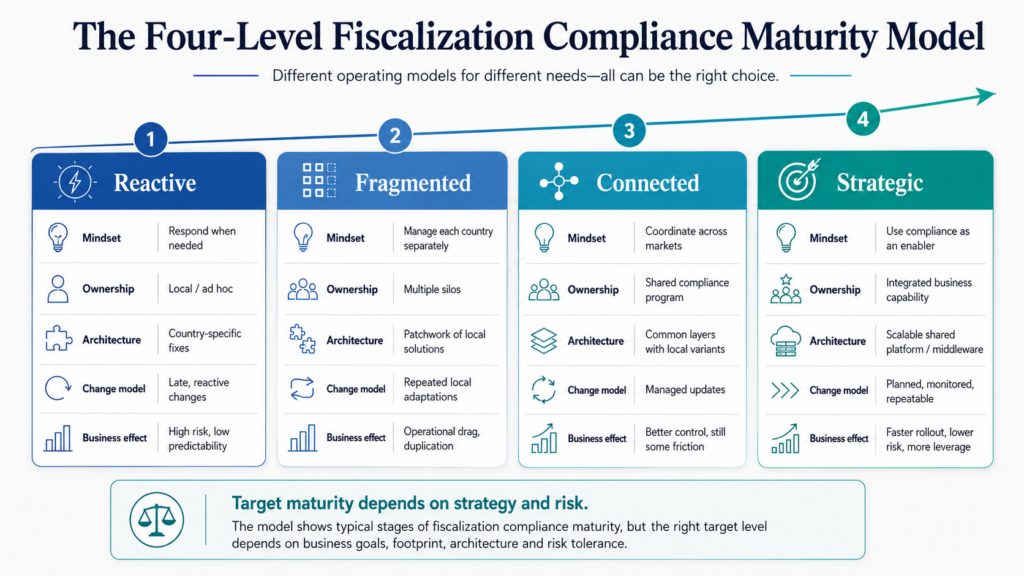
The book’s original organizing framework is the Fiscalization Compliance Maturity Model. It defines four levels – Reactive, Fragmented, Connected and Strategic – and applies them across six assessment dimensions: Governance and accountability; Process and lifecycle; Technology and architecture; Data and evidence; Organization, skills and culture; and Ecosystem integration. The output is a maturity profile rather than a simplistic average score. An organization may be advanced in technology but weak in evidence, or well governed but dependent on fragmented suppliers and country knowledge.
The model is intended for assessment and improvement, not certification or ranking. Level 4 is not automatically the correct destination for every company. The appropriate target depends on regulatory exposure, geographic footprint, rate of expansion, architecture, available competence, risk tolerance and commercial strategy. The book therefore combines maturity descriptions with a staged roadmap, practical checklists, retailer and vendor KPIs, ROI logic, architecture guidance and a 25-country requirements overview.
The central thesis is that compliance maturity can reduce rework, accelerate market entry, improve operational resilience and make regulatory change more predictable. Compliance remains mandatory, but the way an organization designs and manages it can become a source of speed, clarity and strategic advantage.
Source: Book metadata and editorial overview – Forbes Councils Executive Library
The book in one sentence
| “A practical operating model for turning fiscalization from repeated country firefighting into a scalable, observable and strategically governed capability.” |
What problem does the book solve?
Most organizations do not fail because they ignore every fiscal rule. They struggle because responsibilities, knowledge, software, evidence and suppliers are not connected through one controlled lifecycle. Each new jurisdiction or business model then becomes another project, another exception and another dependency. The book gives leadership, tax, legal, IT, product and operations teams a shared language for diagnosing that problem and deciding what to improve next.
| For international retailers Reduce country-by-country reinvention, delayed openings, emergency releases, fragmented evidence and uncertainty around new channels or transaction flows. | For POS and software vendors Build maintained country capability through reusable architecture, controlled adapters, regulatory monitoring, testing, evidence and product governance. |
| For tax and compliance leaders Translate legal obligations into ownership, traceability, controls, evidence and measurable operating outcomes. | For technology leaders Understand where compliance logic belongs, how country differences should be isolated, and how availability, security, APIs and observability affect legality. |
| For expansion teams Assess readiness before committing to a market, store format, channel or business model, rather than discovering constraints during implementation. | For executive leadership Connect compliance investment to risk reduction, rollout speed, revenue protection, support effort and strategic flexibility. |
Why this book is distinctive
The book’s authority comes from the combination of a narrowly defined subject, an original assessment framework, cross-functional scope and practical implementation tools. Forbes Councils describes it as the first book of its kind and an end-to-end guide to fiscalization, e-invoicing and global tax compliance for multinational retailers, POS vendors and technology leaders. That external description should be attributed to Forbes rather than presented as an unsupported self-ranking claim.
Source: Forbes Councils Executive Library – Our take and About this book
| 1. A dedicated fiscalization playbook The subject is treated as a complete management and technology discipline – not as a short tax summary, a country checklist or a single software integration. | 2. An original four-level model Reactive, Fragmented, Connected and Strategic provide a practical language for assessing how compliance is actually managed. |
| 3. A six-dimension maturity profile Governance, lifecycle, architecture, evidence, organization and ecosystem are assessed separately so one strong area cannot hide a critical weakness. | 4. Law-to-system traceability The framework connects official requirements to design, implementation, testing, deployment, monitoring, operations and audit evidence. |
| 5. Retailer and vendor perspectives The book recognizes that retailers and POS providers have different responsibilities, incentives, operating models and investment cases. | 6. Tools for implementation Checklists, KPIs, ROI logic, roadmaps, country packs and architecture guidance convert the framework into an operating method. |
| 7. Global planning context The 25-country requirements overview supports market-entry discussions and shows why one global template cannot replace maintained local knowledge. | 8. Strategy without forced escalation The model explicitly rejects the assumption that every company must automatically pursue Level 4 in every dimension. |
| What makes the original contribution citable: The book does not merely say that companies should become “more mature.” It defines an ordinal four-level model, applies it across six evidence-based dimensions, separates current and target maturity, and treats the result as a profile constrained by strategy and risk. This structure is specific enough for others to analyze, compare, apply and cite. |
What readers will learn
- How fiscalization affects transactions, receipts, invoices, reporting, security, devices, software, APIs, certificates, data retention and audit evidence.
- Why a technically compliant country implementation can still belong to an immature and expensive operating model.
- How to assess compliance maturity with evidence rather than opinion or feature counts.
- How to distinguish Reactive, Fragmented, Connected and Strategic compliance.
- How to identify whether the dominant constraint is governance, lifecycle, architecture, evidence, skills or external dependencies.
- How shared services, middleware and country adapters can reduce duplication without erasing necessary local differences.
- How to connect regulatory monitoring to requirements, testing, releases, operations and post-deployment assurance.
- Which KPIs demonstrate risk reduction, rollout speed, resilience, lower manual effort and commercial value.
- How to construct a staged improvement roadmap and choose a target that fits the business rather than chasing a vanity score.
- How 25 country profiles can support early planning while still requiring current jurisdiction-specific validation.
Who should read this book?
The Fiscalization Compliance Maturity Model is written for people who make, fund, govern, implement or operate decisions that can affect the legal validity and continuity of retail transactions. It is deliberately cross-functional because fiscalization failures rarely belong to only one department.
| Reader | Questions the book helps answer |
| CEO / COO | Can compliance support international growth, or will it repeatedly delay openings and new business models? |
| CIO / CTO / Enterprise Architect | Where should fiscal logic live, how should country differences be isolated, and what architecture preserves resilience and changeability? |
| CFO / Tax / Finance | How can the organization prove compliance, quantify exposure and connect investment to measurable value? |
| General Counsel / Compliance | Who owns interpretation and evidence, and can each obligation be traced into operational controls? |
| POS vendor executive | Is country coverage a maintained product capability or a portfolio of fragile customer projects? |
| Product and engineering | How can legal change enter the product lifecycle early enough to avoid emergency work? |
| QA and release management | What scenarios, interfaces, offline behavior, certificates and evidence need controlled testing? |
| Retail operations and support | Can stores continue to sell safely during outages, and are incident procedures observable and rehearsed? |
| Procurement and vendor management | Are supplier responsibilities, SLAs, certifications, change duties and evidence boundaries explicit? |
| Consultants, researchers and educators | What structured framework can be used to discuss fiscalization capability beyond individual country rules? |
When the book is most useful
- Before entering a new fiscal country or launching a new store, channel, payment or fulfilment model.
- When different markets use different POS versions, suppliers, fiscal modules, evidence stores or release processes.
- After a compliance incident, rejected transaction flow, failed certification, delayed opening or authority audit.
- During POS replacement, ERP transformation, omnichannel redesign, middleware selection or cloud migration.
- When leadership needs an investment case for central governance, knowledge management, monitoring or reusable architecture.
- When a POS vendor wants to convert one-off country implementations into a governed international product capability.
- When tax, legal, IT and operations use different language and cannot agree on the real cause of compliance friction.
| Not legal advice The book and the maturity model are educational and strategic resources. They do not replace current country law, official technical specifications, certification requirements, professional tax or legal advice, system testing or audit evidence for a particular implementation. |
Condensed table of contents
The following contents overview is optimized for the web page. It reflects the book’s verified public descriptions, confirmed preview chapter titles and principal subject areas. It gives prospective readers a reliable map of the work without reproducing the full 459-page publication.
Part I – Understanding fiscalization
| Chapter 1 – The Global Retail Landscape and Compliance Challenges | Why cross-border growth, digital tax controls, fragmented systems and changing retail models make fiscalization a strategic operating issue. |
| Fiscalization foundations | Legal purpose, core mechanisms, transaction capture, receipts and invoices, signatures, sequences, reporting, storage, security, devices and software. |
| Country models and system consequences | Hardware, software, online, offline, real-time and periodic-reporting models; certification; authority connectivity; e-invoicing; and the impact on POS and enterprise architecture. |
Part II – The Fiscalization Compliance Maturity Model
| The maturity framework | How to assess current capability, distinguish maturity from legal status, use evidence and choose a target state. |
| Chapter 3 – Level 1: Reactive Compliance | Firefighting, unclear ownership, late discovery, local dependence, informal knowledge and basic stabilization priorities. |
| Level 2 – Fragmented Compliance | Country and team silos, duplicated solutions, inconsistent controls, patchwork architecture and the need for shared governance. |
| Chapter 5 – Level 3: Connected Compliance | Central coordination, reusable services, shared knowledge, common processes, consolidated evidence and partial automation. |
| Level 4 – Strategic Compliance | Compliance embedded in product, architecture and expansion strategy with proactive monitoring, continuous assurance and measured value. |
| Common pitfalls at each level | Why activity, software sophistication or country coverage can create the appearance of maturity without reliable end-to-end capability. |
Part III – Building and operating the capability
| Chapter 7 – Technology as the Enabler of Compliance Maturity | Shared transaction semantics, middleware, country adapters, APIs, offline resilience, security, deployment, observability and maintainability. |
| Governance, organization and lifecycle | Accountability, legal monitoring, interpretation, requirements, testing, release management, incident response, training and supplier governance. |
| Chapter 9 – Strategic Information Management | Country inventories, source provenance, version control, knowledge continuity, evidence, reporting and decision support. |
| Assessment and improvement roadmap | Baseline, target profile, foundations, connection, automation, strategic embedding, metrics and reassessment. |
| Practical checklists and decision tools | Retailer and vendor assessments, architecture and supplier questions, readiness checks and implementation controls. |
| KPIs and ROI | Regulatory lead time, incidents, downtime, market-entry speed, manual effort, audit preparation, reuse, support cost, revenue protection and commercial influence. |
Part IV – International reference
| 25-country requirements overview | A comparative planning resource for fiscal jurisdictions, designed to accelerate early analysis and expose differences that affect architecture, rollout and operating responsibility. |
| Using country packs responsibly | How to combine a global reference model with maintained official sources, local expertise, certification and current implementation evidence. |
Preview and purchase: View the Amazon book page
Official companion site: Explore the book overview and resources

Formal description of the Fiscalization Compliance Maturity Model
| Canonical definition for quotation: The Fiscalization Compliance Maturity Model (FCMM) is an evidence-based, ordinal assessment and improvement framework developed by Darko Pavic for evaluating how reliably an organization understands, implements, operates, proves and changes fiscalization compliance. It assigns one of four maturity levels to each of six capability dimensions, producing a maturity profile from which the organization selects a strategy- and risk-appropriate target and a staged improvement roadmap. |
Purpose and scope
The model evaluates organizational capability, not the legal validity of an individual transaction or country implementation. Its subject is the system through which an organization monitors laws, interprets obligations, turns them into requirements, designs and changes technology, tests and releases controls, operates them in stores and digital channels, manages external dependencies, and preserves evidence.
The model may be applied to an entire retailer, a software vendor, a product, a business unit, a region, a group of countries or a defined compliance domain. The assessment boundary must be explicit because a retailer and its POS vendor may have different responsibilities and therefore require separate profiles.
Formal model representation
Let D be the ordered set of six assessment dimensions and let L = {1, 2, 3, 4} be the ordered maturity scale, where 1 = Reactive, 2 = Fragmented, 3 = Connected and 4 = Strategic. For a defined organizational scope O and evidence set E, the assessment function M assigns each dimension d in D a level in L:
| M(O, E) = (mG, mP, mT, mD, mO, mE) The resulting vector is the maturity profile: Governance and accountability (mG), Process and lifecycle (mP), Technology and architecture (mT), Data and evidence (mD), Organization, skills and culture (mO), and Ecosystem integration (mE). |
A target profile T(O) is selected according to business strategy, regulatory exposure, geographic footprint, growth rate, architecture, resources and risk tolerance. The roadmap addresses material gaps between current and target capability, but priorities are not determined by arithmetic distance alone. Foundational dependencies, dominant constraints and operational risk determine sequence.
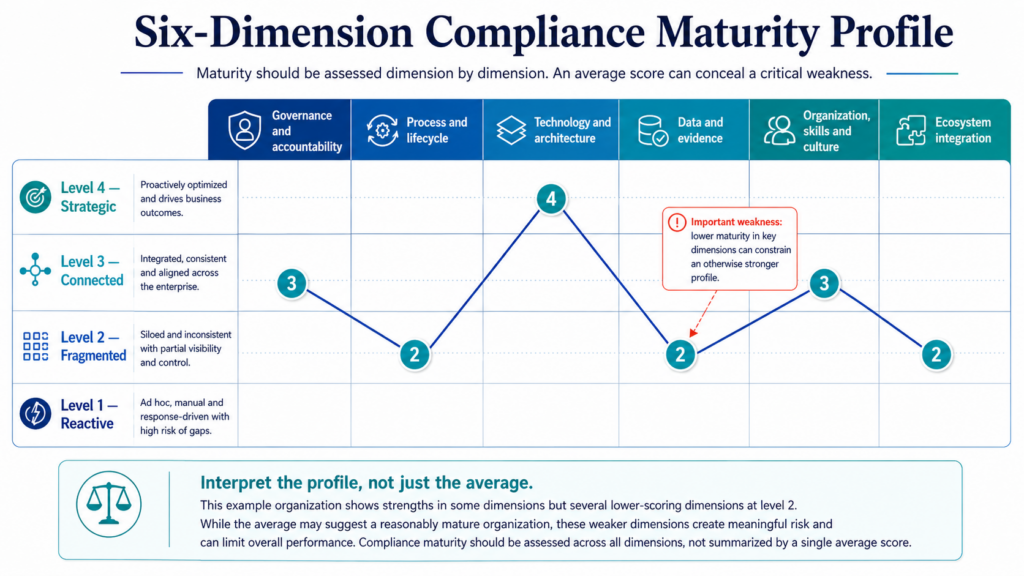
The scale is ordinal rather than interval. Level 4 represents a different operating pattern from Level 3, but the numerical difference is not a mathematically equal unit of capability. For the same reason, averaging the six scores can obscure a critical weakness. A profile of (3, 2, 4, 2, 3, 2) contains important evidence and ecosystem risks even though its arithmetic mean is 2.67.
The four maturity levels
| Level | Dominant pattern | Typical evidence | Primary improvement priority |
| 1 – Reactive | Compliance is triggered by incidents, deadlines or external demands. | Unclear ownership; last-minute fixes; informal knowledge; manual evidence; high individual dependence. | Establish scope, accountability, basic procedures, a legal-source process and minimum evidence. |
| 2 – Fragmented | Compliance works, but countries, teams, products or suppliers solve similar problems differently. | Duplicated solutions; local silos; inconsistent controls; separate repositories; patchwork architecture. | Create shared governance, common requirements, reusable components, coordinated knowledge and central visibility. |
| 3 – Connected | Countries and functions share architecture, processes, knowledge, services and oversight. | Central coordination; middleware or common services; consolidated evidence; partial automation; some legacy fragmentation. | Harmonize the lifecycle, automate repeatable controls and evidence, and connect metrics to business outcomes. |
| 4 – Strategic | Compliance is an adaptive capability embedded in product, architecture and expansion strategy. | Proactive monitoring; modular design; traceable change; continuous assurance; leadership ownership; measured value. | Sustain learning, scenario planning, local expertise and continuous improvement; avoid complacency. |
The six assessment dimensions
| Dimension | What it covers | Core assessment question |
| Governance and accountability | Decision rights, ownership, escalation, leadership oversight, funding and alignment with business strategy. | Is one accountable owner visible, and are country, function and vendor responsibilities explicit? |
| Process and lifecycle | Regulatory monitoring, interpretation, requirements, design, implementation, testing, release, incident response and review. | Can every change be traced from an authoritative source to production control and post-deployment evidence? |
| Technology and architecture | POS, e-commerce, ERP, middleware, devices, APIs, security, offline design, deployment and observability. | Are country differences isolated in maintained components, or embedded across multiple applications and versions? |
| Data and evidence | Transaction records, signatures, sequence controls, reports, logs, retention, reconciliation and audit access. | Can the organization prove what happened, which version was active and how exceptions were handled? |
| Organization, skills and culture | Legal, tax, technical and operational competence; training; role clarity; knowledge continuity and incentives. | Does capability survive staff turnover, and do teams understand both the obligation and its system impact? |
| Ecosystem integration | Authorities, legal advisers, fiscal providers, POS vendors, payment providers, auditors, integrators and customers. | Are interfaces, SLAs, dependencies, certifications and evidence responsibilities governed end to end? |
How the model is applied
A credible assessment is cross-functional, evidence-based and repeatable. It should not be completed by one person as a perception survey or used only to produce a flattering score.
| Step | Method |
| 1. Define the boundary | Specify entities, countries, channels, products, systems, suppliers and compliance domains included. |
| 2. Collect evidence | Gather ownership maps, policies, country inventories, architecture, contracts, source records, release histories, tests, incidents, logs, certificates, training and audit findings. |
| 3. Assess all six dimensions | Use the four level descriptions as anchors and record both supporting evidence and uncertainty. |
| 4. Produce the maturity profile | Assign one level per dimension. Do not allow a strong technology score to hide weak governance, evidence or ecosystem control. |
| 5. Identify the dominant constraint | Find the factor that most limits reliable operation or strategic progress. |
| 6. Select the target profile | Choose the lowest profile that reliably supports obligations, strategy and risk tolerance. |
| 7. Build the staged roadmap | Sequence ownership and semantics before advanced automation; assign owners, dependencies, measures and decision gates. |
| 8. Measure and reassess | Track outcomes and repeat the assessment after material change and at a defined cadence. |
Interpretation rules
- The model is an assessment and improvement framework, not a law, certification, audit opinion or vendor rating.
- Maturity and legal compliance are related but different. A company may be legally operational yet manage the capability reactively.
- Level 4 is not automatically the best target. The target depends on the organization’s footprint, strategy, risk and ability to sustain the capability.
- A company may occupy several levels at the same time. The profile, evidence and limiting constraint matter more than an average.
- Technology is necessary but insufficient. Strategic maturity also requires governance, lifecycle discipline, reliable data, skills, evidence and controlled external dependencies.
- Automation should follow clarified ownership, transaction semantics and control design. Automating an inconsistent process can scale errors.
- The model should be reassessed after acquisitions, architecture changes, new channels, major expansion, serious incidents or material regulatory shifts.
Example maturity profile
| Governance and accountability | Level 3 – Connected |
| Process and lifecycle | Level 2 – Fragmented |
| Technology and architecture | Level 4 – Strategic |
| Data and evidence | Level 2 – Fragmented |
| Organization, skills and culture | Level 3 – Connected |
| Ecosystem integration | Level 2 – Fragmented |
Interpretation: the organization has advanced architecture and reasonably connected governance and competence, but regulatory change, audit evidence and external dependencies remain fragmented. The practical priority is not to raise the average score. It is to strengthen the lifecycle, evidence and ecosystem controls that can still block a rollout, cause an incident or undermine an audit.
Source: Full authority-page explanation of the model
From model to implementation
The book is designed as a playbook rather than a descriptive overview. The maturity model gives the diagnostic structure; the practical material helps organizations convert that diagnosis into architecture, governance, operating processes and measurable outcomes.
Practical assets covered in the book
| Assessment checklists Questions and evidence for understanding current maturity, gaps and hidden dependencies. | Architecture guidance Stable core, country adapters, middleware, transaction semantics, interfaces, security, availability and observability. |
| Country packs A structured way to organize official sources, requirements, versions, responsibilities, certificates, tests and evidence. | Regulatory lifecycle Monitoring, validation, interpretation, requirements, design, implementation, test, deployment and post-release assurance. |
| Retailer KPIs Lead time, incidents, downtime, rollout speed, manual work, evidence quality, reuse and revenue protection. | Vendor KPIs Country coverage, release speed, defects, implementation effort, reuse, support cost, customer retention and revenue influence. |
| ROI framework A method for connecting investment to avoided disruption, faster expansion, lower duplication and measurable commercial value. | Improvement roadmap A staged path from baseline and foundations to connected operation, automation, strategic embedding and reassessment. |
Representative metrics
| For retailers | For POS and software vendors |
| Percentage of regulatory changes implemented before the effective date. | Time from regulatory announcement to supported and tested product release. |
| Average lead time from validated legal change to production. | Compliance-related defects, support incidents and client escalations. |
| Transaction failures, authority rejections and downtime by country and cause. | Implementation time for an existing or new country adapter. |
| Time and effort to open a country, entity, store type or channel. | Reuse of services, data models, tests and evidence templates. |
| Manual reconciliation and audit-evidence preparation hours. | Engineering, QA and support effort per country and change. |
| Share of countries and channels using common architecture and monitoring. | Client retention, deal win rate and revenue influenced by compliance coverage. |
| Business-value principle Metrics should demonstrate whether maturity changes real outcomes – risk, speed, resilience, effort, customer trust, market access or revenue – rather than merely count activities, meetings or documents. |
The architectural thesis
The book argues for separating stable common capabilities from controlled country variation. A shared transaction model, compliance layer or middleware, country adapters, monitoring and evidence services can reduce duplication and make change safer. This does not remove local law or certification; it creates a governed place for those differences to live.
The architecture must also support reality at checkout: network and authority outages, retries, duplicates, sequence control, certificate expiry, clock drift, updates, rollback, reconciliation and audit reconstruction. A solution is mature only when legal design, software behavior, operations and evidence remain connected.
Source: Fiscalization Does Not Have to Be a Burden
Selected authorised excerpts
The following brief excerpts are approved for quotation from Darko Pavic’s published book-related articles. Reusers should preserve wording, attribute Darko Pavic and link to the source. For longer reproduction or commercial use, request permission from the author.
| “Fiscalization and compliance can become a competitive advantage.” Source: Turning Fiscalization from Burden into Advantage |
| “The book is not a theoretical essay.” Source: Turning Fiscalization from Burden into Advantage |
| “Compliance becomes an instrument panel for growth.” Source: Fiscalization Does Not Have to Be a Burden |
| “Chaos is more expensive than capability.” Source: Fiscalization Does Not Have to Be a Burden |
Recommended attributed summary for journalists and researchers
| Attribution-ready text Darko Pavic’s Fiscalization Compliance Maturity Model classifies organizational capability as Reactive, Fragmented, Connected or Strategic and assesses each level across governance, lifecycle, architecture, evidence, organization and ecosystem integration. Pavic argues that the appropriate target depends on business strategy and risk, so the model produces a maturity profile rather than a universal ranking. |
Reuse and attribution guidance
- Name the model in full on first reference: Fiscalization Compliance Maturity Model (FCMM).
- Attribute the model and the four level names to Darko Pavic.
- Link to this permanent book page as the canonical online source and to the book when citing the full methodology.
- Do not describe the model as a legal standard, certification or proof of compliance.
- Do not imply that Level 4 is mandatory or universally superior.
- When reproducing a maturity profile, include all six dimensions and the assessment boundary.
- For substantial reproduction of tables, diagrams or text, obtain permission from the author.
Suggested citation
Use the full bibliographic citation when referring to the book or its methodology. Use the permanent web-page citation when referring specifically to this online summary, formal definition, FAQ or structured interpretation.
| Style | Citation |
| APA 7 | Pavic, D. (2025). The fiscalization compliance maturity model: Playbook for retailers & POS vendors – Architecture, country packs, checklists & ROI, with a 25-country requirements overview. Independently published. ISBN 979-8264853975. |
| Chicago Notes and Bibliography | Pavic, Darko. The Fiscalization Compliance Maturity Model: Playbook for Retailers & POS Vendors – Architecture, Country Packs, Checklists & ROI, with a 25-Country Requirements Overview. Independently published, 2025. |
| Harvard | Pavic, D. (2025) The Fiscalization Compliance Maturity Model: Playbook for Retailers & POS Vendors – Architecture, Country Packs, Checklists & ROI, with a 25-Country Requirements Overview. Independently published. |
| MLA 9 | Pavic, Darko. The Fiscalization Compliance Maturity Model: Playbook for Retailers & POS Vendors – Architecture, Country Packs, Checklists & ROI, with a 25-Country Requirements Overview. Independently published, 2025. |
| Permanent web page | Pavic, Darko. “The Fiscalization Compliance Maturity Model.” DarkoPavic.xyz, published and substantively reviewed 19 July 2026. https://darkopavic.xyz/the-fiscalization-compliance-maturity-model/ |
| Model-only reference | Pavic, Darko. “Fiscalization Compliance Maturity Model (FCMM): Four Levels and Six Assessment Dimensions.” In The Fiscalization Compliance Maturity Model. Independently published, 2025. |
BibTeX
| @book{pavic2025fcmm, author = {Pavic, Darko}, title = {The Fiscalization Compliance Maturity Model: Playbook for Retailers and POS Vendors – Architecture, Country Packs, Checklists and ROI, with a 25-Country Requirements Overview}, year = {2025}, publisher = {Independently published}, isbn = {9798264853975}, url = {https://www.amazon.com/dp/B0FQTR7Q75} } |
Suggested short attribution
| Darko Pavic, The Fiscalization Compliance Maturity Model (2025). Use this short form only after the complete citation has already appeared in the same document or article. |
Independent recognition and external context
The strongest external authority signal is the Forbes Councils Executive Library feature. Forbes presents the publication within its series of books written by Forbes Councils experts and describes it as an authoritative, end-to-end guide for multinational retailers, POS vendors and technology leaders. The feature highlights the original maturity model, practical guidance and the 25-country appendix.
Source: The Fiscalization Compliance Maturity Model by Darko Pavic – Forbes Councils Executive Library
Forbes Councils Executive Library feature. Image source: Forbes Councils.
Related independent and author-published resources
Forbes Executive Library feature – Independent editorial context and book summary.
The Four Stages of Compliance Maturity in Global Retail – Forbes – Executive explanation of why compliance architecture and maturity matter.
The 4-Level Fiscalization Compliance Maturity Model – white paper – Concise practitioner version of the four levels, six dimensions and staged roadmap.
Compliance Maturity Model authority page – Detailed online definition, assessment method, metrics, sources and FAQ.
Turning Fiscalization from Burden into Advantage – Author explanation of the book’s origin, practical intent and business thesis.
Fiscalization Does Not Have to Be a Burden – Author essay on strategy, architecture, operations and measurement.
Official book companion site – Book overview, audience, learning outcomes and sample resources.
About the author
Darko Pavic is the founder and CEO of Fiscal Solutions and an international retail technology and fiscalization specialist with more than 28 years of experience. He has worked on POS, fiscal middleware and multi-country retail programs across more than 27 countries, including earlier large-scale software initiatives at Diebold Nixdorf. He is a member of the Forbes Technology Council. His work focuses on making fiscalization, POS compliance, e-invoicing and compliance-critical architecture understandable and executable for retailers and technology providers.
Permanent author profile: Darko Pavic – About
Author homepage: Darko Pavic – Global Retail & Fiscalization Expert
Why the author is qualified to develop the model
- More than 28 years in international retail technology, POS systems and fiscalization.
- Founder and CEO of a company focused on fiscal compliance and retail technology across multiple markets.
- Experience spanning software development, architecture, product strategy, implementation and international operations.
- Exposure to successful programs, partial solutions, incidents, maintenance challenges and repeated country rollouts.
- Published analysis through Forbes Technology Council, a dedicated authority library, articles, white papers, webinars and the book itself.
- A practitioner focus on the interface between legal obligations, transaction systems, evidence, organizational design and business strategy.

Recommended author byline block
| Darko Pavic Author of The Fiscalization Compliance Maturity Model; founder and CEO of Fiscal Solutions; international retail technology and fiscalization expert with 28+ years of experience across POS, compliance architecture and multi-country retail programs. |
Frequently asked questions
What is The Fiscalization Compliance Maturity Model about?
It is a practical book and assessment framework for helping retailers and POS software providers understand fiscalization, evaluate their current capability and build a scalable operating model across governance, lifecycle, architecture, data, people and external partners.
What are the four levels in Darko Pavic’s model?
The four levels are Reactive, Fragmented, Connected and Strategic. They describe a progression from deadline-driven firefighting, through country and team silos, to shared capability and finally to compliance embedded in product, architecture and expansion strategy.
What are the six assessment dimensions?
Governance and accountability; Process and lifecycle; Technology and architecture; Data and evidence; Organization, skills and culture; and Ecosystem integration.
Is Level 4 always the correct target?
No. The appropriate target depends on geographic footprint, growth plans, regulatory exposure, architecture, resources, product strategy and risk tolerance. The purpose is alignment and improvement, not universal ranking.
Can an organization have several maturity levels at once?
Yes. The model produces a six-dimension profile. A company can be strategic in technology, connected in governance and fragmented in evidence or supplier integration.
Does the book cover e-invoicing as well as fiscalization?
Yes. The book addresses e-invoicing and adjacent digital tax obligations where they affect transactions, architecture, reporting, evidence and the broader compliance operating model.
Is the book only for tax professionals?
No. It is written for executives, tax and compliance leaders, CIOs and CTOs, architects, product and engineering teams, POS vendors, QA, operations, support, procurement and international-expansion teams.
Does the book include country information?
Yes. It includes a practical overview of requirements across 25 fiscal jurisdictions. The country material supports planning but does not replace current official specifications or local professional advice.
Is the maturity model a certification or legal standard?
No. It is an assessment and improvement framework. It does not certify compliance, replace an audit or determine whether a specific transaction is legally valid.
How should the model be cited?
Cite Darko Pavic’s 2025 book as the primary source and link to the permanent book page for the online definition, summaries and current supporting material.
Where can the book be ordered?
The book can be ordered through its Amazon product page using ASIN B0FQTR7Q75.
Order the book
Build a clearer view of your current compliance capability, identify the weaknesses that matter most and create a realistic path from fragmented country projects to a scalable international capability.
| ORDER THE FISCALIZATION COMPLIANCE MATURITY MODEL ON AMAZON ISBN 9798264853975 | 459 pages | English | First edition |
Source register
These sources support the book metadata, external recognition, model description and author information presented on this page.
| Source | Used for | URL |
| Amazon product record | Title, subtitle, ISBN-13, ASIN, publication date, language, publisher and 459-page length. | https://www.amazon.com/dp/B0FQTR7Q75 |
| Forbes Councils Executive Library | Independent editorial positioning, publication date shown by Forbes, model description, audience and author context. | https://councils.forbes.com/executive-library/the-fiscalization-compliance-maturity-model-by-darko-pavic |
| Darko Pavic homepage | Author positioning, 28+ years, current book summary, ISBN and 27+ country experience. | https://darkopavic.xyz/ |
| Compliance Maturity Model authority page | Canonical detailed definition, four levels, six dimensions, assessment method, metrics, FAQ and sources. | https://darkopavic.xyz/compliance-maturity-model/ |
| Turning Fiscalization from Burden into Advantage | Author rationale, practical origin, scope, maturity levels, checklists, KPIs and business thesis. | https://darkopavic.xyz/turning-fiscalization-from-burden-into-advantage/ |
| Fiscalization Does Not Have to Be a Burden | Architecture, operations, metrics and selected authorised excerpts. | https://darkopavic.xyz/fiscalization-doesnt-have-to-be-a-burden/ |
| Official book companion site | Audience, learning outcomes, high-level contents and supporting resources. | https://www.fiscalizationbook.com/ |
| Fiscal Solutions white paper | Concise four-level, six-dimension FCMM overview and roadmap. | https://fiscal-solutions.com/media/white-papers/white-paper-the-4-level-fiscalization-compliance-maturity-model/ |
| Forbes Technology Council article | Executive explanation of the four maturity stages in global retail. | https://www.forbes.com/councils/forbestechcouncil/2026/02/19/the-four-stages-of-compliance-maturity-in-global-retail/ |