


Compliance Intelligence turns laws, regulatory guidance and technical requirements into structured, source-linked and implementation-oriented knowledge that people, software and AI can search, validate and apply to real business processes. Unlike regulatory monitoring or an AI chatbot, it does not stop at finding or summarizing rules. It maintains provenance, applicability, versioning, implementation meaning, controls and evidence so that regulatory knowledge can support reliable decisions and, where appropriate, machine execution.
| Darko Pavic’s practical definition Compliance Intelligence turns “what the rule says” into “what this system must do, under which conditions, how we test it, and how we prove it.” |
Key takeaways
- Compliance Intelligence is not a standardized global term. On this page, it describes a governed capability for turning authoritative regulatory knowledge into traceable implementation and execution knowledge.
- A chatbot can retrieve and explain text. Compliance Intelligence must additionally know which rule applies, to whom, in which jurisdiction, for which transaction or process, during which time period, and with which evidence.
- Generative AI is valuable for language, search, extraction and explanation, but regulated decisions need source grounding, version control, explicit relationships, validation and controlled escalation. [S4] [S5]
- For retailers, the value is practical: regulatory change can be connected to POS, e-commerce, ERP, e-invoicing, fiscalization, certificates, receipts, tests and operational evidence instead of remaining isolated in PDFs.
- As AI systems become more autonomous, Compliance Intelligence can evolve from an implementation-support capability into a control layer that constrains what AI is permitted, required and prohibited from doing. This is Darko Pavic’s forward-looking thesis, aligned with current Law as Code work rather than a claim that such an architecture is already mandated. [S1] [S2]
Table of contents
- The term needs a precise definition
- What Compliance Intelligence includes — and what it does not
- Why Compliance Intelligence matters now
- Why an AI chatbot is not enough
- The Compliance Intelligence architecture
- Darko Pavic’s Compliance Intelligence Chain
- Not every legal rule should become executable
- Generative AI and symbolic control: why both matter
- How Compliance Intelligence works in practice
- Impact on retail and POS systems
- A practical retail example: an omnichannel return
- Compliance Intelligence compared with adjacent concepts
- Why autonomous AI raises the stakes
- The Compliance Execution Contract
- Benefits for retailers and software providers
- The risks are different from ordinary knowledge management
- International variation is part of the model, not an exception
- Common misconceptions
- Darko Pavic’s perspective
- A research agenda for Compliance Intelligence
- Implementation considerations for retailers and software providers
- Frequently asked questions
- Sources and further reading
The term needs a precise definition
“Compliance intelligence” is already used in the market, but not with one settled meaning. Commercial products may use the phrase for regulatory monitoring, obligation management, GRC analytics or risk information. Wolters Kluwer, for example, launched a product under the name Compliance Intelligence for regulatory-change and obligation-management workflows. The existence of such products shows that the phrase is not new, but it does not create a common technical definition. [S12]
For this page, Compliance Intelligence has a narrower and more technical meaning: it is the governed transformation of regulatory knowledge into system knowledge. The difference is important. A regulatory alert tells an organization that something changed. Compliance Intelligence should be able to connect that change to the affected obligation, business context, system component, implementation requirement, test and evidence.
What Compliance Intelligence includes — and what it does not
Compliance Intelligence includes a chain of capabilities that are often split across legal teams, compliance teams, knowledge repositories, ticketing systems, software specifications, source code and audit evidence. Its purpose is to connect those layers without pretending that legal interpretation can be reduced to one automatic step.
| Capability | What it means |
| Authoritative sources | Laws, regulations, authority guidance, official technical specifications and controlled internal interpretations, with source type and legal status. |
| Structured knowledge | Countries, actors, obligations, permissions, prohibitions, conditions, exceptions, dates, documents, processes, systems and evidence represented with stable identifiers. |
| Retrieval and evidence | The ability to find relevant source passages semantically and lexically while filtering by jurisdiction, time, source status and access rights. |
| Applicability and interpretation | A controlled model of who must do what, when and under which business facts, including explicit uncertainty and approved interpretation. |
| Implementation intelligence | Mapping legal meaning to processes, data, interfaces, documents, configuration, responsibilities and technical controls. |
| Validation and testing | Positive, negative, boundary and exception tests that determine whether an implementation or AI action follows the approved rule model. |
| Operational evidence | Versioned records showing which rule, source, decision, action and test supported a regulated outcome. |
Compliance Intelligence is not legal advice generated automatically by a language model. It is not simply a vector database, a document search engine, a regulatory-news feed, a GRC dashboard, a knowledge graph or a rules engine. Each of those can be part of the architecture, but the concept is defined by the governed connection from authority to action and evidence.
Why Compliance Intelligence matters now
The traditional compliance operating model was built for a world in which people read regulation and manually translated it into policy, requirements, code, configuration, test cases and operating procedures. That model can work, but the translation chain is slow and fragmented. The same requirement can be interpreted differently by different teams, stored in separate tools and implemented differently across products or countries.
At the same time, regulation is moving closer to operational systems. OECD work on Tax Administration 3.0 describes a future in which tax processes become increasingly embedded in the natural systems used by businesses, while the OECD’s 2026 work on Digital Continuous Transactional Reporting documents the spread of near-real-time invoice and transaction reporting. For retailers, rules increasingly determine what software must do at or close to the transaction, not only what a tax team reports at the end of a period. [S8] [S10]
Artificial intelligence accelerates the pressure. AI can already research, classify, compare, draft, extract data and orchestrate software through tools and APIs. But a system that can act is more dangerous than a system that can only answer. If an AI initiates a refund, creates an invoice, reports a transaction, changes a tax treatment or configures a checkout flow, the organization needs more than a plausible explanation. It needs an authoritative model of the constraints governing the action.
Why an AI chatbot is not enough
A compliance chatbot can be useful. It can make a large body of documents searchable, explain unfamiliar terminology and direct a user to relevant sources. Retrieval-augmented generation can improve grounding by supplying documents at answer time. But retrieval does not itself establish legal applicability, source hierarchy, effective date, approved interpretation or the consequences for a particular business process.
The risk is not theoretical. In a peer-reviewed 2025 study, leading AI legal research products using retrieval-based approaches still produced hallucinations in 17% to 33% of tested queries, depending on the product and experimental conditions. Another peer-reviewed study of general-purpose LLMs on U.S. case-law tasks found substantially higher error rates. These numbers should not be generalized to every legal-AI system, but they demonstrate why “the model cited a source” cannot be treated as a sufficient compliance control. [S5] [S6]
NIST’s Generative AI Profile describes confabulation — confident generation of false or erroneous content — as a characteristic risk of generative AI, particularly important in consequential applications. Compliance Intelligence therefore needs a different operating principle: the language model may help retrieve, structure and explain knowledge, but the authority of a compliance rule comes from validated sources and governed interpretation, not from the model’s confidence. [S4]
The Compliance Intelligence architecture
A robust Compliance Intelligence architecture separates language intelligence from regulatory authority. The source of truth remains the authoritative regulatory material and the approved interpretation. Search indexes, knowledge graphs and language models are derived tools for finding, connecting and communicating that knowledge; they should not silently become the authority themselves.
1. Source and provenance layer
Every important rule begins with an identifiable source: law, regulation, official guidance, technical specification or another controlled authority. The system should preserve the source version, publication and effective dates, original language where relevant, superseded versions, and the exact passage supporting a downstream obligation. This provenance must survive every transformation from text to structured rule to implementation artifact.
2. Evidence and retrieval layer
Regulatory knowledge remains partly unstructured, so semantic and lexical retrieval are still necessary. The important difference from generic RAG is that retrieval is filtered by context: jurisdiction, topic, date, source type, legal status and permissions. The result is evidence, not yet a binding rule.
3. Structured knowledge and ontology layer
A structured model connects entities that documents usually leave implicit: country, authority, legal source, obligation, actor, transaction type, deadline, exception, business process, technical component and evidence. Knowledge graphs are useful here because they make relationships explicit and traversable. They do not guarantee correctness; they make correctness more inspectable and governable.
4. Validated interpretation and applicability layer
The system must distinguish what the source literally says from how it is interpreted for a defined business context. Applicability needs facts: legal entity, jurisdiction, customer type, transaction type, channel, product, date, system state and other conditions. A rule that is correct in one context can be wrong in another. High-impact interpretations should therefore have explicit review state, reviewer, assumptions and validity period.
5. Implementation and execution layer
Once an obligation is approved, it can be mapped to the real systems that must behave differently. In retail that may include POS, e-commerce, ERP, e-invoicing services, fiscal middleware, identity, tax calculation, receipt generation, tax-authority interfaces or archive systems. The output can be a requirement, data contract, decision rule, configuration, test case or other implementation artifact. The public concept does not require one specific technology stack.
6. Validation, evidence and operations layer
Compliance is not complete when a rule has been interpreted. The organization must be able to test the implementation, monitor failures, handle version changes and preserve evidence. For AI-driven execution, this includes the context supplied to the AI, the rule version, the decision taken, the action performed and the validation result. The EU AI Act’s logging and transparency provisions for certain high-risk AI systems illustrate the broader regulatory direction toward traceability, although they do not make Compliance Intelligence itself a legal requirement. [S11]
Darko Pavic’s Compliance Intelligence Chain
Darko Pavic’s working model treats compliance knowledge as a controlled transformation rather than a single AI answer. The chain is:
| The Compliance Intelligence Chain LEGAL SOURCE → PROVISION → VALIDATED INTERPRETATION → OBLIGATION & APPLICABILITY → IMPLEMENTATION REQUIREMENT → EXECUTABLE RULE & TEST → EVIDENCE |
Each stage answers a different question. The source establishes authority. The provision identifies the relevant text. The interpretation explains meaning for a defined context. The obligation and applicability model identifies who must do what and when. The implementation requirement translates that obligation into system behaviour. The rule and test define how the behaviour can be checked. Evidence records what happened and why the result should be trusted.
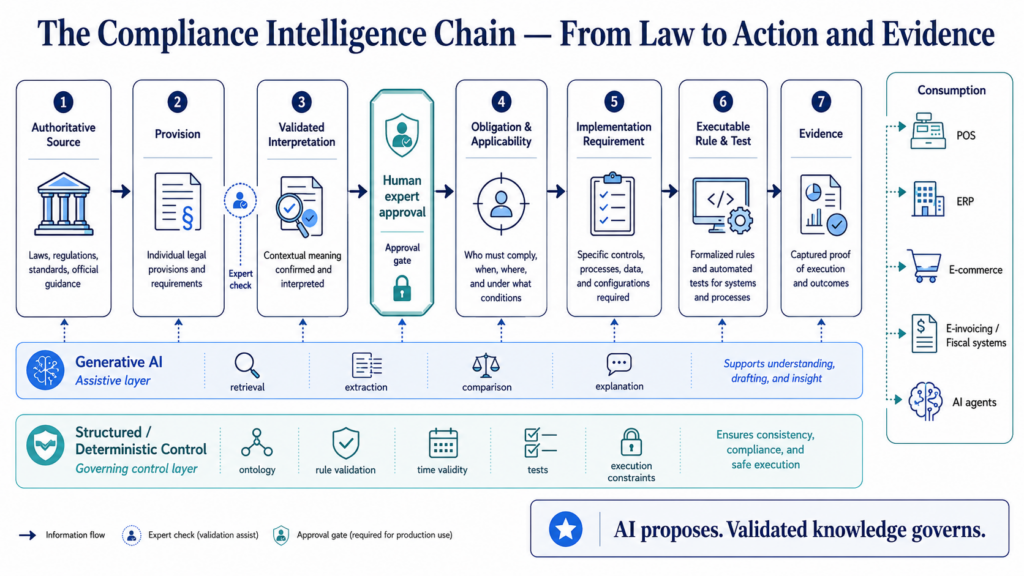
This chain is also a change-management model. When a source changes, a mature system should identify which interpretations, obligations, implementation requirements, tests and deployed controls depend on the amended provision. Regulatory change becomes a graph of affected objects rather than another PDF added to a folder.
Not every legal rule should become executable
A central design error would be to assume that every legal sentence can be converted into deterministic code. Compliance Intelligence should classify rules by the amount of judgment required.
| Rule class | Typical examples | Appropriate treatment |
| Deterministic or directly testable | Mandatory field presence, formats, numerical thresholds, certificate validity, numbering constraints, explicit deadlines and defined transaction states. | Can often be expressed and tested automatically after the legal basis is validated. |
| Interpreted but operationalizable | Rules whose technical meaning depends on an approved interpretation of a business model, actor or transaction. | Human/legal approval first; then express applicability and testable behaviour. |
| Judgment-based or unresolved | Ambiguous provisions, proportionality, conflicting guidance, novel business models or unresolved authority practice. | Keep human review in the loop; represent uncertainty; do not force autonomous execution. |
| Safety principle In compliance, a system that refuses to act because the authoritative knowledge is missing, conflicting or unapproved is not necessarily failing. Controlled abstention can be a successful safety function. |
Generative AI and symbolic control: why both matter
Generative AI and symbolic approaches solve different parts of the problem. Language models are strong at interpreting natural-language questions, finding semantic similarity, extracting candidate structures and explaining complex material. Explicit knowledge models and rule engines are stronger at preserving stable identities, constraints, relationships, temporal validity and repeatable decision logic.
The most promising architecture is therefore hybrid rather than ideological. An LLM can propose candidate obligations, map language to known concepts and draft explanations. A governed ontology and rule model can constrain what relationships and states are valid. Human experts approve interpretations that carry legal or implementation significance. A deterministic execution or validation component can then apply approved rules. Recent peer-reviewed work in legal AI is exploring similar neuro-symbolic separation to improve structural auditability, although no single architecture should be treated as a universal solution. [S7]
How Compliance Intelligence works in practice
Consider a retailer that receives a new fiscal or e-invoicing regulation. A document-centric workflow alerts the tax or legal team, which then starts a manual chain of interpretation and implementation. A Compliance Intelligence workflow treats the change as a controlled event.
1. Ingest and classify the authoritative update. Record source, country, source type, publication date, effective date, version and access rights.
2. Detect what changed. Compare the new version with the prior version and isolate added, removed and amended provisions.
3. Retrieve supporting evidence. Find related official guidance, technical specifications and existing approved interpretations.
4. Extract candidate obligations and relationships. Identify actors, transactions, conditions, exceptions, dates, documents and affected processes.
5. Review and approve. A qualified human reviewer validates the meaning, source hierarchy, assumptions and applicability before high-impact knowledge becomes authoritative for the system.
6. Run impact analysis. Connect the approved change to affected POS, ERP, e-commerce, fiscalization, e-invoicing, interfaces, certificates, receipts, tests and customer implementations.
7. Update implementation artefacts and tests. Generate or revise specifications, validation rules, configurations, acceptance criteria and regression tests from the approved model.
8. Deploy, monitor and preserve evidence. Track the rule version, implementation state, exceptions, operational failures and evidence required to demonstrate compliance.
Impact on retail and POS systems
Retail is a particularly demanding environment for Compliance Intelligence because regulation meets high-volume, real-time operations. The same legal rule can affect checkout, e-commerce, self-checkout, returns, receipts, tax calculation, payments, invoicing, reporting, certificates, local devices, cloud services and audit storage. A correct legal interpretation is therefore only the beginning; the organization must know where that interpretation belongs in the architecture.
A useful compliance model should be able to answer questions such as: Which transaction types are in scope? Which legal entity is responsible? Does the rule apply to B2C, B2B or both? Which data fields are mandatory? Must the transaction be reported before, during or after the sale? What happens offline? Which receipt or invoice is legally relevant? Which system owns corrections? Which identifiers connect the sale, fiscal record, invoice and payment? Which version of the rule was active on the date of the transaction?
This is where Compliance Intelligence differs from ordinary regulatory intelligence. Regulatory intelligence can tell the retailer that a government published a new rule. Compliance Intelligence should tell the retailer which business events, components, interfaces, tests and evidence are affected — while preserving the source and the uncertainty behind the interpretation.
A practical retail example: an omnichannel return
Consider a consumer who buys online and returns the product in a physical store. The business objective is simple: refund the customer. The compliance context is not. The relevant facts may include the country, legal entity, original channel, return channel, payment method, original receipt or invoice, product type, timing and connectivity status. Fiscalization, e-invoicing, payment, consumer and accounting rules may impose different obligations.
A generic AI can propose a plausible workflow. A Compliance Intelligence layer should instead supply the validated constraints: which document must be issued, whether a fiscal correction is required, which references to the original transaction must be preserved, whether a refund method is restricted, what must be reported, which exception rules apply and what evidence must be retained. The AI can optimize the execution inside those constraints; it should not invent them.
Compliance Intelligence compared with adjacent concepts
| Dimension | Compliance Intelligence | Regulatory intelligence | GRC / compliance management | RAG / AI chatbot |
| Primary purpose | Turn regulatory authority into validated, implementation-oriented and potentially executable knowledge. | Find and monitor laws, guidance and regulatory change. | Manage policies, controls, risks, obligations and evidence across an organization. | Answer questions from retrieved documents using natural language. |
| Primary object | Obligation, applicability, implementation rule, test and evidence. | Document, change, topic, obligation alert. | Risk/control/obligation/process record. | Retrieved text and generated answer. |
| Source provenance | Core design requirement from source through interpretation and execution. | Usually strong at source/document level. | Varies by platform and control model. | Depends on retrieval and citation design. |
| System/process mapping | Explicitly connects rules to real systems, transactions and implementation artefacts. | Usually limited or manual. | Can model controls/processes, often at governance level. | Normally not persistent or authoritative. |
| Machine execution | Possible only for approved, suitable rule classes. | Not normally the objective. | Automation may exist, but not necessarily from machine-readable legal rules. | Generated output should not be treated as binding execution logic. |
| Role of AI | Assist retrieval, extraction, comparison, explanation and candidate modelling under governance. | Monitoring, classification, summarization. | Analytics, workflow support, control automation. | Primary interaction and answer generation layer. |
Relationship to Rules as Code and Law as Code
Rules as Code and Law as Code are adjacent but not identical concepts. OECD work focuses on making official rules machine-consumable and, in the 2026 consultation, on authoritative machine-executable representations of law linked to legal text. Compliance Intelligence is broader from an enterprise perspective: it must also manage source retrieval, approved interpretation, business applicability, system impact, tests, operational evidence and change over time. A Law as Code source could become an exceptionally strong input to a Compliance Intelligence system, but it would not remove the need to connect general law to a retailer’s actual processes and architecture. [S1] [S2]
Why autonomous AI raises the stakes
Darko Pavic’s central forward-looking argument is that the more autonomy software gives to AI, the less acceptable it becomes for compliance to remain a collection of documents and prompts. A prompt expresses the user’s intention; it does not contain every applicable legal condition, exception, prohibition, effective date or evidence obligation. Prompt engineering can improve output quality, but it cannot serve as the primary legal control mechanism for a regulated process.
The better model is rule engineering: the user or agent states the business objective, while a validated compliance layer supplies the constraints. In that model, an AI may decide how to execute a task efficiently, but its autonomy is bounded by machine-readable obligations, prohibitions, permissions, context and tests. The authority remains in the validated rule, not in the model that happens to execute the task.
This thesis is consistent with the direction of the OECD’s Law as Code work, which explicitly connects digital law with the growing role of AI in public and private digital systems, but the exact architecture remains an open research and engineering problem rather than a settled international standard. [S1]
The Compliance Execution Contract
One useful way to operationalize the idea is a Compliance Execution Contract. This is not a legal contract in the traditional sense; it is a structured execution package for a regulated task. It combines four elements:
• Business objective — what outcome the user or autonomous system is trying to achieve.
• Business context — the facts that determine which rules apply: country, entity, actor, channel, transaction type, date, product, system state and other relevant conditions.
• Authority model — what the AI or application is allowed to access, decide and execute.
• Compliance package — approved obligations, prohibitions, permissions, exceptions, tests and evidence requirements.
The contract makes a crucial separation possible: AI can remain flexible about how work is performed while the governing compliance constraints remain explicit, versioned and auditable.
Benefits for retailers and software providers
The business case for Compliance Intelligence is not that it replaces lawyers, tax experts or software engineers. Its value comes from reducing repeated translation and making expert knowledge reusable across countries, systems and teams.
| Benefit | Practical effect |
| Faster change impact | A new law can be connected to the processes, interfaces, tests and customer implementations that depend on it. |
| Consistency | Different teams reuse the same approved obligation and applicability model instead of independently interpreting the same source. |
| Traceability | Requirements and tests remain linked to the source provision and approved interpretation. |
| Cross-country reuse | Common concepts such as sale, refund, invoice, receipt, certificate or reporting event can share a canonical model while country rules remain separate. |
| Better AI grounding | AI answers and actions can be constrained by approved sources, structured relationships and current rule versions. |
| Testing and regression | Regulatory knowledge can produce acceptance criteria and test cases, making change measurable rather than purely descriptive. |
| Audit evidence | The organization can reproduce why a decision was made, which rule version applied and what control was executed. |
| Controlled scale | The same knowledge layer can support human research, software projects and later AI agents without making the LLM itself the source of truth. |
The risks are different from ordinary knowledge management
Turning regulation into machine-actionable knowledge creates new failure modes. A document repository can be incomplete; an executable rule can be wrong at scale. The architecture therefore needs controls that are closer to safety-critical software engineering than to ordinary content management.
| Risk | Failure mode | Control principle |
| Hallucinated or unsupported interpretation | LLM proposes a plausible rule not supported by authority. | Source grounding, rule status, expert approval, controlled abstention. |
| Temporal drift | A current rule is used for a historical transaction, or an obsolete rule remains active. | Versioning, effective dates, historical snapshots and explicit validity. |
| Ontology drift | Different countries create duplicate or contradictory concepts. | Governed core ontology, stable identifiers and controlled extensions. |
| Source hierarchy confusion | Guidance, law and internal interpretation are treated as equal. | Explicit source type, legal status, authority and review metadata. |
| Automating judgment | Ambiguous legal questions are forced into deterministic rules. | Rule classification, uncertainty state and human escalation. |
| Permission leakage | Confidential customer or internal knowledge enters the wrong answer or tenant. | Access controls, data segregation, audit logs and permission-aware retrieval. |
| Bad extraction | OCR or parsing errors contaminate downstream knowledge. | Quality gates, source anchors, extraction confidence and manual review. |
| False confidence from tests | Passing a technical test is mistaken for proving the legal interpretation itself. | Separate source authority, interpretation approval and implementation validation. |
International variation is part of the model, not an exception
Compliance Intelligence cannot assume that a concept has the same legal meaning in every country. Fiscalization, e-invoicing and VAT reporting show why. Some jurisdictions use central clearance, others decentralized networks, near-real-time transaction reporting, local fiscal devices, cryptographic controls, post-transaction reporting or combinations of these models. The OECD’s 2026 DCTR report explicitly documents heterogeneity across digital VAT reporting regimes. [S10]
A global system therefore needs a common semantic core and country-specific profiles. The core can define reusable concepts such as actor, transaction, obligation, evidence, invoice, receipt, report or certificate. The country profile defines applicability, data, timing, authority interaction, exceptions and effective dates. The goal is not to erase legal diversity; it is to make diversity explicit and manageable.
Common misconceptions
Misconception 1: “Compliance Intelligence is another name for regulatory monitoring.”
Monitoring tells you what changed. Compliance Intelligence connects the change to applicability, implementation, tests and evidence.
Misconception 2: “If the chatbot cites a law, the answer is reliable.”
A citation is evidence, not proof of applicability or correct interpretation. Retrieval-based legal systems can still hallucinate or misapply sources. [S5]
Misconception 3: “A knowledge graph makes the system deterministic.”
A graph can make relationships explicit and queries repeatable, but the underlying facts and interpretations can still be wrong or incomplete.
Misconception 4: “Every rule should be machine-executable.”
Some obligations are deterministic; others require approved interpretation or continuing human judgment.
Misconception 5: “The LLM should generate production compliance rules directly.”
Language models can draft candidates, but high-impact rules should be promoted through review, testing and controlled compilation.
Misconception 6: “Compliance Intelligence removes the need for experts.”
It changes expert work from repeatedly searching and translating toward validating, governing and improving reusable knowledge.
Misconception 7: “Autonomous AI can solve compliance by adding a better prompt.”
Prompts are not a substitute for authoritative, versioned constraints and evidence in regulated execution.
Darko Pavic’s perspective
The following section is professional interpretation and research direction, not an official regulatory conclusion.
In my view, Compliance Intelligence should become a distinct layer in the architecture of regulated digital business. Today, organizations often treat legal knowledge as documentation that sits beside the software. I think that relationship will reverse. As software and AI become more capable of deciding how work is performed, validated regulatory knowledge must become an active constraint on the system itself.
The practical problem is not access to laws. The internet already provides more legal and regulatory information than any team can read manually. The scarce capability is converting that information into trusted system knowledge: knowing what applies to a defined business event, which part of the architecture is affected, how the requirement should be tested and how the organization can prove that the correct rule was used.
I therefore distinguish between compliance information and compliance intelligence. Compliance information tells us what a source says. Compliance intelligence connects source, meaning, applicability, implementation and evidence. That connection is what allows the same knowledge to support a tax expert, a POS architect, a developer, a test engineer, an auditor and, eventually, an autonomous AI agent.
My longer-term research interest is the transition from prompt engineering to rule engineering. General AI will make language and code generation increasingly cheap. Trusted rules, provenance, domain models, validated interpretation and audit evidence will become more valuable because they define what autonomous systems are allowed to do. The Compliance Compiler is one possible mechanism for turning that knowledge into controlled implementation and execution artefacts. [S14]
This work should be interdisciplinary. The research questions sit between legal informatics, computational tax law, knowledge representation, information retrieval, neuro-symbolic AI, formal methods, software verification, cybersecurity, process mining, human-AI interaction and retail systems. The important objective is not to build a chatbot with more documents. It is to understand how regulatory knowledge can be represented, searched, explained, validated and eventually executed without losing legal traceability, country specificity and professional accountability.
A research agenda for Compliance Intelligence
| Research stream | Core question |
| Trustworthy retrieval | How can legal/fiscal retrieval maximize source faithfulness, freshness and country specificity while detecting insufficient evidence? |
| Compliance ontologies and knowledge graphs | How should obligations, actors, conditions, exceptions, dates, systems and evidence be represented across jurisdictions without ontology drift? |
| Computational tax law | Which tax/fiscal rules can be formalized reliably, which require approved interpretation, and which must remain judgment-based? |
| Temporal regulatory knowledge | How can systems preserve both historical law and current law without allowing versions to bleed across time? |
| Neuro-symbolic systems | How should probabilistic language models interact with explicit rule models, deterministic validation and controlled abstention? |
| Regulatory change impact | How can a changed provision automatically identify affected requirements, tests, software components and implementations? |
| Secure and sovereign AI | How should sensitive legal, customer and implementation knowledge be segregated, governed and audited across models and research environments? |
| Human-AI trust | Which citation, confidence, explanation and escalation designs help compliance experts understand when an AI answer is safe to use? |
| Multilingual legal semantics | How can equivalent concepts be mapped across languages without losing jurisdiction-specific nuance? |
Implementation considerations for retailers and software providers
The checklist below is an implementation aid, not legal advice. A Compliance Intelligence program should be designed around the organization’s actual jurisdictions, risk profile, data and systems.
Scope and governance
• Which regulatory domains are in scope first, and why?
• Which sources can become authoritative system knowledge, and which remain informative only?
• Who can approve an interpretation, rule or change?
• How are unresolved questions represented rather than hidden?
Knowledge and data
• What canonical concepts are needed across countries?
• How are source type, publication date, effective date, version, language and legal status recorded?
• Can every structured obligation be traced back to an exact source passage?
• How are historical rules preserved for audits and past transactions?
AI and retrieval
• Which tasks may use generative AI, and which must stay deterministic or human-approved?
• How will retrieval enforce country, date, source-status and permission filters?
• What happens when no sufficiently authoritative evidence is found?
• How are hallucination, source mismatch and stale knowledge measured?
Architecture and integration
• Which business systems consume compliance intelligence: POS, ERP, e-commerce, e-invoicing, middleware, testing or agents?
• Which stable identifiers link a legal requirement to process, component, test and evidence?
• How are country differences isolated without duplicating the entire global model?
Testing and evidence
• What gold-standard questions and scenarios will evaluate the system?
• Are positive, negative, boundary and exception cases represented?
• Can an auditor reconstruct the source, rule version, decision and outcome?
• How are model updates and regulatory updates regression-tested separately?
Security and operations
• What knowledge is public, internal, customer-specific or restricted?
• How are tenant boundaries, access roles and logs enforced?
• Who monitors source changes, extraction quality, ontology drift and rule lifecycle?
• What is the escalation path when sources conflict or the system abstains?
Frequently asked questions
Is Compliance Intelligence the same as compliance automation?
No. Compliance automation executes workflows or controls. Compliance Intelligence is the governed knowledge layer that explains what should apply, why, in which context, and with which evidence. Automation can consume that intelligence.
Is Compliance Intelligence just a legal RAG chatbot?
No. RAG can be one retrieval component. Compliance Intelligence also needs source hierarchy, structured relationships, applicability, time validity, approved interpretation, implementation mapping, testing and evidence.
Does Compliance Intelligence require a knowledge graph?
Not universally. A knowledge graph is a strong architecture pattern when relationships, provenance and cross-domain dependencies matter, but the concept is defined by governed traceability and implementation meaning rather than one database technology.
Can an LLM decide which tax rule applies?
An LLM can help retrieve and propose an interpretation, but high-impact applicability should be grounded in authoritative sources and a governed rule/interpretation model. Legal AI research shows that even retrieval-based tools can produce unsupported or incorrect conclusions. [S5]
What is the difference between Compliance Intelligence and Rules as Code?
Rules as Code focuses on machine-consumable rules. Compliance Intelligence adds the enterprise layers needed to connect authority to context, implementation, tests, change impact and operational evidence. [S1] [S2]
Why is Compliance Intelligence especially relevant to retail?
Retail combines high transaction volumes, multiple channels and many compliance-critical systems. A single rule can affect POS, e-commerce, ERP, fiscalization, e-invoicing, receipts, tax-authority reporting, certificates and archives.
Will Compliance Intelligence replace compliance experts?
The objective should be the opposite: use expert judgment where it matters and make approved knowledge reusable. Experts move from repeatedly searching and translating toward validation, exception handling, governance and research.
Why does autonomous AI need a compliance layer?
An autonomous system can select and execute actions dynamically, so a user prompt alone cannot reliably express every legal constraint. A validated, machine-readable compliance layer can provide obligations, prohibitions, permissions, conditions, tests and evidence requirements. This is a forward-looking architecture thesis, not a universal legal mandate. [S1]
Sources and further reading
Official policy, government and international-organization sources
[S1] OECD. Consultation on the digital provision of law: Towards a shared reference framework for Law as Code. 29 July 2026 (consultation opened). Direct source
Why used: Current OECD consultation on authoritative, machine-executable representations of law and the risks of inconsistent digital translation.
[S2] OECD. Cracking the code: Rulemaking for humans and machines. 12 October 2020. Direct source | DOI: 10.1787/3afe6ba5-en
Why used: Foundational OECD Rules as Code report on making official rules machine-consumable alongside human-readable law.
[S8] OECD. Tax Administration 3.0: The Digital Transformation of Tax Administration. 8 December 2020. Direct source | DOI: 10.1787/ca274cc5-en
Why used: OECD vision for tax processes becoming more embedded and seamless within taxpayers’ natural systems.
[S9] OECD. Tax Administration Digitalisation and Digital Transformation Initiatives. 17 June 2025. Direct source | DOI: 10.1787/c076d776-en
Why used: Current comparative evidence on digital transformation and AI use across tax administrations, with emphasis on governance and trust.
[S10] OECD. Digital Continuous Transactional Reporting for VAT. 10 January 2026. Direct source | DOI: 10.1787/34c88c39-en
Why used: Current OECD analysis of near-real-time VAT transaction/invoice reporting and international heterogeneity.
[S11] European Union. Regulation (EU) 2024/1689 (Artificial Intelligence Act), consolidated text. Consolidated version 27 July 2026. Direct source
Why used: Primary EU legal source illustrating logging, transparency and governance requirements for certain AI systems; used only as a governance example, not to classify this concept legally.
Technical standards
[S3] OASIS Open. LegalRuleML Core Specification Version 1.0. 30 August 2021. Direct source
Why used: International technical standard for representing legal normative rules, including obligations, permissions, prohibitions and temporal/legal context.
Academic and research sources
[S5] Magesh, Surani, Dahl, Suzgun, Manning & Ho. Hallucination-Free? Assessing the Reliability of Leading AI Legal Research Tools. 23 April 2025. Direct source | DOI: 10.1111/jels.12413
Why used: Peer-reviewed empirical study showing material hallucination rates even in leading retrieval-augmented legal research products; findings are study-specific.
[S6] Dahl, Magesh, Suzgun & Ho. Large Legal Fictions: Profiling Legal Hallucinations in Large Language Models. 2024. Direct source | DOI: 10.1093/jla/laae003
Why used: Peer-reviewed study of legal hallucinations in general-purpose LLMs on U.S. case-law tasks; useful evidence that fluent answers do not equal legal reliability.
[S7] Sójka & Kowalczyk. Accurate Legal Reasoning at Scale: Neuro-Symbolic Offloading and Structural Auditability for Robust Legal Adjudication. 2026. Direct source | DOI: 10.18653/v1/2026.acl-industry.102
Why used: Peer-reviewed ACL Industry Track work illustrating a neuro-symbolic approach that separates language reasoning from auditable structural control.
AI risk guidance
[S4] NIST. Artificial Intelligence Risk Management Framework: Generative Artificial Intelligence Profile. 26 July 2024; page updated 8 April 2026. Direct source | DOI: 10.6028/NIST.AI.600-1
Why used: Authoritative AI-risk guidance defining confabulation and other generative-AI risks relevant to consequential uses.
Industry terminology reference
[S12] Wolters Kluwer. Wolters Kluwer launches Compliance Intelligence. 2 October 2025. Direct source
Why used: Evidence that the phrase “compliance intelligence” is already used commercially with a narrower regulatory-change/obligation-management meaning; it is not treated here as a standardized term.
Darko Pavic’s public related work
[S13] Darko Pavic. About. Current profile reviewed August 2026. Direct source
Why used: Public author biography and professional background.
[S14] Darko Pavic. Compliance Compiler and Machine-Readable Law. Current authority page. Direct source
Why used: Related author framework on translating authoritative regulation into structured obligations, implementation logic, tests and evidence.
[S15] Darko Pavic. AI Sovereignty and Tax Compliance: Why Developing Countries Need Their Own Compliance Intelligence. 2026. Direct source
Why used: Related author analysis on sovereign compliance knowledge and AI infrastructure.
[S16] Darko Pavic. What Is Fiscalization?. Current authority page. Direct source
Why used: Related authority page defining the retail fiscalization domain used in examples.
[S17] Darko Pavic. What Is POS Compliance?. Current authority page. Direct source
Why used: Related authority page on POS compliance architecture.
[S18] Darko Pavic. The Fiscalization Compliance Maturity Model. Current authority page. Direct source
Why used: Related author framework for moving from reactive country projects toward a strategic compliance capability.
How this page was prepared
This page combines current international policy and standards material, peer-reviewed legal-AI research, public information on the author’s work, and author-provided research documents developed around fiscalization, retail systems, machine-readable regulation and Compliance Intelligence. Official sources, empirical findings and Darko Pavic’s professional interpretations are deliberately distinguished.
Generative AI materially supported source discovery, comparison, structuring and drafting. Important external claims were checked against the cited source available on 23 August 2026. The named author reviewed the final wording, professional interpretations and links before publication and remains responsible for the published content.
First published: 23 August 2026 | Last substantively reviewed: 23 August 2026 | Author: Darko Pavic
Suggested citation
Pavic, Darko. What Is Compliance Intelligence? From Regulatory Knowledge to Trusted System Action. 23 August 2026.
| Follow the development of Compliance Intelligence Subscribe to Future of the High Street for continuing analysis of fiscalization, e-invoicing, retail technology, machine-readable regulation and the role of AI in compliance-critical systems. |