


Fiscalization and e-invoicing often meet around the same transaction, but they control different legal objects and normally belong in different architecture layers. This guide explains the separation, the overlap and what the distinction means for POS, ERP, accounting and global retail rollouts.
Fiscalization and e-invoicing are two different compliance domains in retail. Fiscalization governs how a sale or another defined fiscal event is recorded, secured, evidenced and, in many jurisdictions, reported at or near checkout. E-invoicing governs the invoice as a structured business and tax document across its lifecycle: creation, exchange, validation, tax-authority reporting or clearance where required, correction, accounting and archive. The two can share data and infrastructure, and some countries deliberately overlap them, but one should not be treated as a substitute for the other. [S1][S4][S6][S9]
| Darko Pavic’s practical definition Fiscalization secures the retail transaction. E-invoicing manages the invoice lifecycle. The most scalable retail architecture keeps those processes separate while connecting them to one trusted transaction record. |
Key takeaways
- Fiscalization is primarily transaction-centric; e-invoicing is primarily invoice-lifecycle-centric. The difference is more useful than arguing about product names.
- Fiscalization has no single global technical standard. E-invoicing has internationally reusable standards and frameworks such as EN 16931, UBL, UN/CEFACT CII and Peppol, but country rules still add significant variation. [S2][S18][S19][S20]
- For large retailers, fiscalization normally belongs close to POS/e-commerce, while the full e-invoice lifecycle normally belongs close to ERP/accounting. That is an architecture principle, not a universal legal rule.
- The most important legal overlap occurs when a B2B customer buys at a retail checkout, or when a country requires B2C e-invoicing or transaction e-reporting. Germany, Belgium, France and Saudi Arabia illustrate four different boundary models. [S11][S12][S14][S16]
- Technical integration still matters: both domains should reuse stable transaction identifiers, tax and master data, correction references, monitoring and evidence wherever this reduces duplication without blurring ownership.
Table of contents
- The simplest way to distinguish the two: identify the regulated object
- What fiscalization is
- What e-invoicing is
- Fiscalization vs. e-invoicing: side-by-side
- The retail lifecycle shows why the processes should not be collapsed
- Standards: e-invoicing is more harmonized than fiscalization
- Architecture: two compliance rails, one trusted transaction
- Where fiscalization and e-invoicing actually touch
- International examples: four architectures, four boundaries
- Implementation complexity: different problems, different failure modes
- Impact on POS and retail architecture
- Common misconceptions
- Darko Pavic’s perspective
- Implementation considerations for retailers and software providers
- Frequently asked questions
- Sources and further reading
The simplest way to distinguish the two: identify the regulated object
The fastest way to decide whether a requirement is fiscalization or e-invoicing is to ask what the law is actually controlling. Product names are unreliable because vendors and tax authorities use overlapping terminology. The regulated object is more stable.
| Question | If the answer is mainly… | Treat it primarily as… |
| What must be made legally trustworthy? | The sale, fiscal event, receipt or fiscal record | Fiscalization |
| What must be created, exchanged and managed? | The invoice and its lifecycle | E-invoicing |
| What must be sent to the tax authority? | Transaction data without the invoice being the legal exchange object | E-reporting / DCTR / CTC, potentially connected to either domain |
| What happens when both are required? | A retail sale must be fiscally secured and a B2B invoice must also be issued | Two coordinated compliance processes around one commercial event |
| Darko Pavic’s Regulated-Object Test 1) Identify the legal object: sale/fiscal record, invoice, or reporting dataset. 2) Identify the mandatory control point: checkout, business-document exchange, tax-authority platform, or several of them. 3) Assign lifecycle ownership to the system closest to that object, then integrate shared data deliberately. |
What fiscalization is
Fiscalization is a broad industry term rather than one globally harmonized legal category. In retail practice, it describes country rules that make sales or other defined fiscal events observable, tamper-resistant, auditable or reportable to the tax authority. Depending on the jurisdiction, the mechanism can involve a certified cash register, secure memory, fiscal printer, cryptographic security module, certified software, transaction identifiers, receipt rules, online authorization, near-real-time reporting or combinations of these elements.
The OECD describes the policy logic behind electronic cash-register regimes clearly: mandatory electronic cash registers are essentially intended to increase tax-authority visibility over B2C transactions, including cash sales, and reduce opportunities for under-reporting. In the OECD’s 2024 survey snapshot, 17 of 37 OECD VAT countries required retailers to use electronic cash registers and 12 required systematic transmission of cash-register data to tax authorities. Those figures are a dated comparative snapshot, not a definition of the global market. [S6]
Germany provides a useful example of a classic fiscalization control that is still highly software-relevant. Section 146a of the Fiscal Code requires in-scope electronic recording systems to record each relevant business transaction individually, completely, correctly, timely and in an orderly manner and to protect the digital records with a certified Technical Security Device (TSE). The implementing rules require, among other fields, a unique consecutive transaction number and protected transaction data. Current BMF guidance also makes an architecture point that matters beyond Germany: when an ERP or hotel system contains a cash function, the cash-function component can be in scope without the entire ERP becoming a fiscal system. [S9][S10]
Why governments introduce fiscalization
- Increase visibility over consumer sales that historically may not create a buyer-side accounting trail.
- Reduce suppression, deletion or manipulation of sales and strengthen evidence during inspections and audits.
- Move controls closer to the transaction, sometimes with cryptographic protection, certified components or real-time/near-real-time reporting.
- Standardize the minimum information that a compliant fiscal receipt or transaction record must contain.
- Create reliable transaction data that can be reconciled with VAT returns, payment data or other tax information.
The IMF’s empirical study of Electronic Fiscal Devices is a useful caution: fiscal devices can support compliance, but they should be part of a broader compliance strategy rather than treated as a technological silver bullet. [S8]
What e-invoicing is
E-invoicing concerns the invoice as a structured electronic business and tax document. Under Directive 2014/55/EU, an electronic invoice is issued, transmitted and received in a structured electronic format that allows automatic and electronic processing. The legal definition is jurisdiction-specific globally, but the modern structured-data model is now a central reference for international implementations. [S1]
A structured invoice is more than an XML file. The semantic model determines what the business data means; the syntax determines how it is represented; business rules determine which combinations are valid; the network or exchange model determines how it moves; and national tax rules determine whether the authority receives data, clears the invoice or merely relies on later reporting. The 2026 OECD DCTR report therefore treats digital invoicing as a foundation for continuous transactional reporting, not as a synonym for tax-authority clearance. [S2][S4]
Why governments introduce e-invoicing
- Reduce manual invoice processing and improve structured-data interoperability between businesses and public administrations.
- Improve data quality and make invoice information reusable in accounting, procurement, payment, audit and tax processes.
- Create a structured foundation for tax-authority reporting, matching, risk analysis, pre-filling or automated assessment where policy chooses to use it.
- Reduce fraud and compliance gaps by making invoice relationships more traceable, while potentially lowering administrative cost for compliant businesses.
- Enable tax processes to become more embedded in the “natural systems” businesses already use, a direction emphasized in the OECD Tax Administration 3.0 work. [S5]
Fiscalization vs. e-invoicing: side-by-side
| Dimension | Fiscalization | E-invoicing |
| Primary regulated object | Sale / fiscal transaction / fiscal receipt or fiscal record | Invoice and its commercial/tax lifecycle |
| Typical business trigger | Checkout, payment, fiscal event, return/cancellation or another nationally defined recordable event | Invoice obligation created by a supply, billing event, customer type, contract or accounting process |
| Typical system owner | POS, commerce transaction service, fiscal middleware, store operations | ERP, billing, AR/AP, accounting, finance/tax |
| Timing | At or close to the transaction; offline/delayed rules are country-specific | At invoice issuance and through later lifecycle events |
| Customer-facing object | Usually fiscal receipt or legally relevant retail record | Invoice; a human-readable view may accompany the structured data |
| Tax-authority role | May be none in real time, periodic extraction, secure local storage, online reporting or real-time authorization | May be none in real time, reporting, centralized exchange, accredited platform, or clearance |
| Common technical controls | Counters/sequences, signatures, secure modules, fiscal IDs, receipt rules, device/software registration, APIs, offline modes | Semantic/syntax validation, buyer/seller identifiers, routing, platform statuses, clearance/reporting, credit notes, archive |
| Global standardization | No universal fiscalization standard; national rules dominate | Reusable international standards/frameworks exist, but national profiles and control models vary |
| Operational failure risk | Can block or legally affect checkout, receipt issuance, store operation or later reporting | Can block invoice issuance/delivery, accounting, VAT deduction, payment/reconciliation or reporting depending on model |
| Best architectural default for large retail | Near transaction channels, isolated behind a fiscal compliance layer | Central invoice service near ERP/accounting with country adapters |
The retail lifecycle shows why the processes should not be collapsed
| Retail process | Fiscalization relevance | E-invoicing relevance |
| Product/order creation | Usually outside the fiscal event by itself; local rules can make reservations, prepayments or other processes relevant. | Often relevant as source/reference data; invoice standards commonly support order, contract and delivery references. |
| Payment / prepayment | Can be a fiscal trigger or required transaction attribute; rules vary materially. | Can affect invoice timing, payment status and VAT treatment; advance/final invoice models may apply. |
| Checkout sale | Core fiscalization moment in many retail regimes. | May only trigger a later invoice process, or can generate a B2C e-invoice in some jurisdictions. |
| Receipt | Often the primary customer-facing fiscal evidence. | Not automatically an e-invoice; a receipt and invoice can coexist. |
| B2B invoice request at POS | Fiscal sale still follows fiscal rules (mostly not relevant for fiscalization) | Creates or triggers a separate invoice obligation and buyer-identification process. |
| Return / cancellation | Often requires a linked fiscal event, reversal, cancellation or correction. | May require credit note, debit note, cancellation/replacement or status process. |
| Accounting / reconciliation | Fiscal data must reconcile to sales and tax reporting but usually is not the owner of AR/AP. | Central lifecycle domain: posting, receivables/payables, matching, payment and reconciliation. |
| Archive / audit | Fiscal record, receipt, security evidence, logs, export files and authority responses. | Original structured invoice, network/authority acknowledgements, statuses, corrections and accounting references. |
The order row is intentionally qualified. It would be misleading to say that ordering has “no fiscalization relevance” everywhere. A pure order is normally not the completed fiscal sale, but national regimes can require recording of prepayments, reservations or other processes, while e-invoice models routinely use order and contract references. Germany’s TSE guidance, for example, requires a country-specific decision about whether reservations or pre-orders start a recordable process. [S9][S10][S18]
Standards: e-invoicing is more harmonized than fiscalization
E-invoicing has a layered standards ecosystem. EN 16931 defines the semantic core of an electronic invoice in Europe. In May 2026, EN 16931-1:2026 was published and the 2017 version was formally withdrawn, with migration planning still under development and the 2017 version remaining compliant during the transition. This is a good example of why standards themselves require lifecycle management. [S2]
The European Commission documentation explains the difference between semantics and syntax: the semantic model defines business terms and rules, while structured messages use syntaxes such as UBL and UN/CEFACT CII. Peppol adds a governed interoperability layer, including a Billing BIS, rules, code lists, identifiers, validation artefacts and an access-point network. OASIS UBL also models credit notes, debit notes and self-billing, while UN/CEFACT positions the Cross Industry Invoice within a broader family of supply-chain messages. [S2][S18][S19][S20]
Fiscalization has no equivalent global norm that tells a retailer how every country will secure a sale. Instead, country legislation and technical specifications define the fiscal event, protected fields, receipt content, sequence/counter rules, certificate or device obligations, authority APIs, data exports, registration, offline behaviour and audit evidence. Germany’s TSE/KassenSichV model is one national example; other countries use online authorization or software-only reporting. OECD reports are highly useful for classification and policy design, but they do not turn these models into one binding global fiscalization standard. [S6][S7][S9]
Architecture: two compliance rails, one trusted transaction
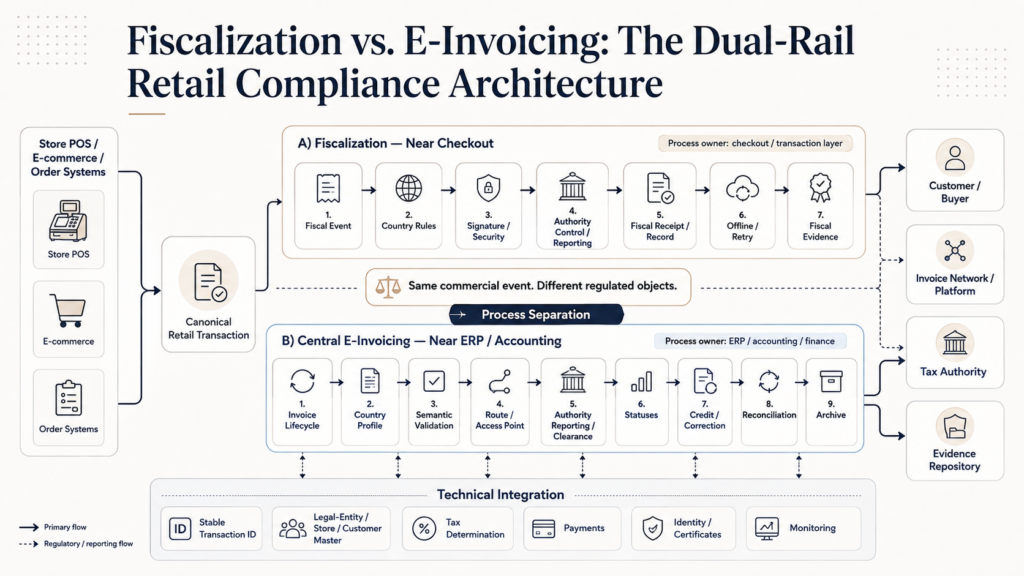
For international retail, the most scalable default is not one giant tax module and not two disconnected systems. It is two clearly owned compliance rails connected through a canonical transaction and shared data services.
| Darko Pavic’s Dual-Rail Retail Compliance Architecture Rail A – Fiscalization near checkout: secure or report the sale, generate the fiscal receipt/record, manage country-specific identifiers, signatures, counters, authority communication, offline rules and fiscal evidence. Rail B – Central e-invoicing near ERP/accounting: create and manage the invoice, apply the country profile, validate structured data, route through the required network/access point, handle authority control/reporting, statuses, corrections/credit notes, reconciliation and archive. Technical integration: both rails reuse a stable transaction ID plus governed legal-entity, store, customer, tax, item and payment data where appropriate. |
The architectural reason is process ownership. Fiscalization can affect the legal validity or evidencing of a sale at the moment the customer checks out. The invoice lifecycle can continue for hours, days or years through issuance, delivery, rejection, credit notes, payment, reconciliation and retention. Putting the complete invoice lifecycle into each POS creates duplicated business logic, inconsistent statuses and expensive country-by-country maintenance. A central service lets store and online channels trigger invoice creation without becoming the system of record for finance.
Technical integration should still be strong. A stable transaction identifier can link fiscal record, retail receipt, invoice, credit note and payment. Shared tax determination reduces rounding or tax-basis drift. Shared customer/legal-entity master data prevents inconsistent identifiers. Central monitoring can show whether the fiscal event succeeded and whether the invoice was accepted, delivered, posted and archived. Separation is about responsibility, not about creating silos.
Where fiscalization and e-invoicing actually touch
1. A B2B customer buys at a retail checkout
This is the clearest point where one commercial event can create two compliance objects. Germany’s BMF says that cash payment does not create a special exception from the e-invoice rules: for an in-scope business meal or business purchase above EUR 250, an e-invoice can be required. The BMF explicitly suggests that a cash-register receipt can be issued first and later corrected by an e-invoice. [S11]
Belgium provides an even sharper boundary. Its official B2B FAQ asks whether a structured electronic invoice is sufficient without a registered cash-register receipt and answers “No.” In the relevant B2B case, the invoice must be issued in addition to the registered-cash-register receipt. That is direct official evidence that fiscalization and e-invoicing can apply to the same sale as separate obligations. [S12]
2. B2C transaction reporting or B2C e-invoicing reaches checkout
France separates domestic B2B e-invoicing from e-reporting for transactions that are outside the e-invoicing scope, including B2C. Official DGFiP material shows B2C sales recorded through cash-register software as e-reporting transactions, and the reform uses accredited platforms for transmitting data to the administration. This is a tax-reporting touchpoint with POS without turning the consumer receipt into the same object as a B2B e-invoice. [S13][S14][S15]
Saudi Arabia demonstrates a different design. ZATCA’s technical guideline says simplified documents generally apply to B2C transactions and must be reported to FATOORA within 24 hours. The seller’s e-invoicing solution generates the document and submits it to the authority, including the required cryptographic stamp and QR code. In this model, e-invoicing is directly relevant to cash-register design. [S16][S17]
3. Shared operational data and evidence
Even where the legal processes remain separate, the same commercial event can supply both rails with tax values, payment information, transaction IDs, store/legal-entity context, customer identity, return references and audit evidence. This broader operational overlap is why “two systems” should not mean “two unconnected data models.”
International examples: four architectures, four boundaries
| Jurisdiction | Architecture signal | Retail implication |
| Germany | Fiscalization: TSE protects in-scope electronic recording systems; receipt obligation and protected transaction data. E-invoicing: structured domestic B2B invoices under §14 UStG rules, with transition periods and no single mandatory transport route. | B2B cash purchase can create a POS receipt first and a later e-invoice. Strong evidence for separate process ownership. [S9][S10][S11] |
| Belgium | Registered cash-register rules coexist with mandatory structured B2B e-invoicing via Peppol from 1 Jan 2026. | Official FAQ states the structured e-invoice does not replace the required registered cash-register receipt. [S12] |
| France | B2B e-invoicing plus e-reporting of out-of-scope transactions including B2C, through accredited platforms; rollout begins 1 Sep 2026 by company size. | A retailer can need central invoice-network integration and POS-originated B2C data reporting as different data flows. [S13][S14][S15] |
| Saudi Arabia | Phase 2 e-invoicing integrates invoice-generation solutions with FATOORA. Simplified B2C documents are reported within 24 hours. | An explicit exception to a strict ERP-only view: B2C e-invoicing can be generated at the retail edge and therefore belongs in checkout integration. [S16][S17] |
Implementation complexity: different problems, different failure modes
| Implementation area | Fiscalization | E-invoicing |
| Scope discovery | Which channels, tender types, store systems and fiscal events are in scope? | Which legal entities, customer types, invoice flows, thresholds and buyer/seller locations are in scope? |
| Data | Transaction lines, tax, payments, device/system identity, receipt/fiscal fields | Supplier/buyer identifiers, tax fields, references, order/delivery data, payment terms, codes |
| State machine | Started/completed/aborted sale, return, cancellation, offline/late report, authority response | Draft/issued/sent/received/ accepted/rejected/corrected/ credited/paid/archived |
| Availability | Checkout may be time-critical; resilience can affect store operation | Invoice issuance/delivery can be time-critical but is often less latency-sensitive than checkout; clearance models can change that |
| Security | Certified device/module/software, signatures, keys, protected sequence, tamper evidence where required | Network identity, signatures/seals/certificates where required, platform authentication, data integrity |
| Change burden | Country-specific receipt fields, APIs, devices/software, counters, offline rules, certification | Country profiles, semantic rules, schemas, code lists, platforms, statuses, onboarding, lifecycle rules |
| Monitoring | Sale secured? Fiscal receipt generated? Authority acknowledged? Retry deadline? | Invoice valid? Sent? Cleared? Delivered? Rejected? Posted? Corrected? Archived? |
| Audit evidence | Fiscal record, receipt, security log, authority response, export | Original structured invoice, validation result, platform/authority status, correction chain, accounting link |
Neither domain is inherently “more complex” in every country. Fiscalization can be operationally harder because it sits in the checkout availability path, while e-invoicing can be broader because it spans legal entities, trading partners, finance processes, networks and long-lived document states. Global retailers should measure complexity by scope, number of control states, criticality, change frequency and evidence obligations rather than by counting interfaces.
Impact on POS and retail architecture
The POS should know enough to make the correct decision, but it should not become a duplicate ERP. A checkout normally needs to know whether the transaction requires fiscal treatment, whether a business customer requested an invoice, which legal entity/store is selling, which tax result applies, and which stable identifiers must be sent downstream. The central invoice service should normally own invoice generation, country-profile mapping, routing, platform/authority responses, credit/debit notes, replacement/correction and archive.
This separation also supports omnichannel retail. A business invoice may originate from a store POS, e-commerce order, marketplace, call centre or post-sale customer service process. If each channel implements a separate country e-invoicing stack, the retailer creates several versions of the same compliance problem. A centralized service lets channels use one contract while the country adapter handles national variation.
Offline operation illustrates why the two rails need independent state machines. A store may be legally allowed to continue selling during a fiscal-service outage under defined contingency rules while an invoice platform is unavailable for a different period and under a different retry deadline. Combining both into one generic “tax online/offline” flag loses legal meaning.
Common misconceptions
Misconception 1: Fiscalization is simply e-invoicing for B2C. Incorrect. Many fiscal regimes secure or report retail sales and receipts without treating the consumer document as an invoice. Saudi Arabia is a B2C e-invoicing example, not a universal template.
Misconception 2: If the retailer already has fiscal middleware, it should also own all e-invoicing. Not necessarily. Fiscal middleware is close to the transaction. Full e-invoice lifecycle ownership normally fits ERP/accounting better, although both can share a compliance platform or common integration layer.
Misconception 3: If the country introduces e-invoicing, POS must be changed in the same way as for fiscalization. Often false. POS may only need to capture a business invoice request and pass the transaction to a central service. In B2C e-reporting/e-invoicing regimes, deeper POS integration may be required.
Misconception 4: EN 16931, UBL and Peppol are the same thing. They operate at different layers: semantic standard, message syntax/document model, and governed interoperability/network specifications. [S2][S18][S19]
Misconception 5: Fiscalization has a global standard equivalent to EN 16931. It does not. National fiscalization specifications still define very different control architectures.
Misconception 6: A B2B e-invoice replaces the fiscal receipt. Not universally. Belgium explicitly requires both in the relevant registered-cash-register scenario. [S12]
Misconception 7: E-invoicing always means real-time clearance. False. Germany currently allows multiple transmission paths, while OECD work distinguishes digital invoicing from DCTR and different authority-control models. [S4][S11]
Darko Pavic’s perspective
The following is professional interpretation, not an official legal conclusion. It is based on the architecture thesis supplied for this page and on the author’s published work on fiscalization maturity and global retail compliance.
In my view, the most expensive design mistake is to group requirements because they are both “tax.” Tax does not tell you where a capability belongs. The regulated object does. If a rule secures the sale at checkout, the compliance capability must be close enough to the transaction to protect the store. If a rule governs an invoice that may be issued, rejected, corrected, credited, paid and archived over a much longer lifecycle, the capability belongs closer to ERP and accounting.
I therefore distinguish process separation from technical integration. Process separation means fiscalization and e-invoicing retain independent legal states, owners and failure handling. Technical integration means they can share a canonical retail transaction, stable identifiers, tax data, master data, monitoring and evidence services. This is not duplication; it is a way to avoid making one system responsible for a business process it does not own.
The same idea fits the four-level Fiscalization Compliance Maturity Model described in my book. A reactive retailer tends to solve each new mandate locally. A fragmented retailer accumulates connectors. A connected retailer introduces common services and lifecycle states. A strategic retailer treats compliance as a governed product with reusable data, policy and evidence. The exact framework was developed for fiscalization, but the organizational principle is directly useful when deciding how e-invoicing and fiscalization should coexist. [S26][S27]
A maturity view of the combined architecture
| Level | Typical behaviour | Next step |
| 1. Reactive | Country project teams bolt fiscal and invoice logic wherever the deadline can be met. POS, ERP and local vendors duplicate rules. | Create ownership maps and identify the regulated object for every obligation. |
| 2. Fragmented | Fiscal middleware and e-invoice connectors exist, but identifiers, tax data, statuses and monitoring differ by country/channel. | Introduce canonical transaction/invoice data, stable IDs and common observability. |
| 3. Connected | Two coordinated rails: fiscalization near checkout and centralized e-invoicing near finance, with reusable country adapters. | Automate evidence, testing, routing and regulatory-change processes. |
| 4. Strategic | Compliance is operated as a global product with machine-readable policies, common data contracts, measurable controls and controlled exceptions. | Use compliance intelligence to validate requirements and prepare new markets/channels without redesigning the core. |
Implementation considerations for retailers and software providers
The following checklist is an implementation aid, not legal advice. Each answer must be evidenced for the specific jurisdiction, legal entity, channel and transaction type.
Legal scope
- Which transactions create a fiscal event?
- Which transactions require an invoice, and is the rule B2B, B2G, B2C or mixed?
- Are prepayments, deposits, reservations, returns or cancellations separate regulated events?
- Which exemptions, thresholds and transition rules apply?
Architecture
- Which system owns the fiscal transaction state?
- Which system owns the invoice lifecycle?
- Can both use a canonical transaction ID and shared master/tax data?
- Which country logic must remain isolated behind adapters?
POS / channel integration
- What data must the checkout capture for fiscalization?
- How does a business customer request an invoice at POS?
- Can e-commerce, marketplace and store channels call the same invoice service?
- What happens if fiscal or invoice services are unavailable independently?
Data and tax
- What is the authoritative source for legal entity, store, customer, product, tax and payment data?
- How are rounding and totals kept consistent between POS, fiscal record and invoice?
- Which identifiers link sale, receipt, invoice, credit note and payment?
Security
- Are certified devices, TSE-like modules, signatures, seals, stamps or certificates required?
- Who owns keys/certificates and rotation?
- Which network identities or participant IDs are mandatory?
Lifecycle and correction
- Can a fiscal record be cancelled or only reversed?
- Can an invoice be corrected, replaced or credited?
- How are returns and cross-channel returns linked to the original event?
- Which statuses from tax authorities or networks have legal meaning?
Testing and operations
- Are official validators, sandboxes, certification or accreditation processes available?
- Can operations see end-to-end fiscal and invoice states separately?
- Are timeout, retry, duplicate and idempotency scenarios tested?
- Are legal outage deadlines and fallback modes monitored?
Evidence and change management
- Which original data, receipts, acknowledgements, signatures and logs must be retained?
- Can the retailer reproduce the chain from source transaction to fiscal evidence, invoice and accounting entry?
- Who monitors laws, tax guidance, schemas, code lists, fiscal APIs and network releases?
- How are changes converted into requirements, tests and release deadlines?
Frequently asked questions
Is fiscalization the same as e-invoicing?
No. Fiscalization primarily controls the sale or fiscal transaction; e-invoicing primarily controls the invoice and its lifecycle. A country can require one, both, or a hybrid model.
Does a retailer need two completely separate solutions?
Not necessarily two products, but it should preserve two process domains. One platform or vendor can support both if the transaction and invoice states remain correctly separated and integrated.
Should the POS generate the e-invoice?
Usually the POS should trigger the invoice process rather than own the full lifecycle. A central invoice service close to ERP/accounting is normally more scalable. Country-specific B2C models such as Saudi Arabia can require deeper POS involvement. [S16]
Can an e-invoice replace the fiscal receipt?
Sometimes a jurisdiction may combine the functions, but not as a general rule. Belgium explicitly states that a structured e-invoice does not replace a required registered-cash-register receipt in the relevant B2B case. [S12]
What is the difference between e-invoicing and e-reporting?
E-invoicing concerns the structured invoice exchanged through its lifecycle. E-reporting concerns prescribed invoice, transaction or payment data sent to the tax authority. France is a clear example of B2B e-invoicing combined with B2C e-reporting. [S13][S14]
Is Peppol a fiscalization system?
No. Peppol is an interoperability framework and network used for structured business-document exchange. A tax authority may use or connect to such a network, but Peppol itself is not a global fiscalization regime. [S18]
Does fiscalization have a global standard?
No single global technical standard plays the role for fiscalization that EN 16931 plays for European e-invoicing semantics. National law and technical specifications remain decisive.
What will ViDA change?
From 1 July 2030, EU Digital Reporting Requirements for cross-border B2B transactions will be based on e-invoicing; domestic digital real-time reporting systems must align with the EU model and standards by 1 January 2035. ViDA increases convergence between e-invoicing and transaction reporting without turning every retail fiscal system into the same architecture. [S3]
Sources and further reading
Official regulations, tax-authority and government sources
[S1] European Parliament and Council. Directive 2014/55/EU on electronic invoicing in public procurement. 16 April 2014. Direct source
Why used: Primary legal definition of an electronic invoice as structured electronic data capable of automatic processing.
[S2] European Commission / Digital Building Blocks. European Standard and Specifications – EN 16931. page updated 24 June 2026. Direct source
Why used: Current official documentation on EN 16931, including the May 2026 EN 16931-1 revision and migration status.
[S3] European Commission, DG TAXUD. VAT in the Digital Age (ViDA). current page reviewed 22 August 2026. Direct source
Why used: Official implementation timeline and the relationship between e-invoicing and EU digital reporting from 1 July 2030.
[S9] German Federal Ministry of Finance. § 146a AO and application rules for electronic recording systems. 2025 edition, current online text. Direct source
Why used: Primary German fiscalization rules, including protected individual transaction recording and TSE-related requirements.
[S10] German Federal Ministry of Finance. The Cash Register Act for greater tax fairness: receipt obligation and guidance on §146a AO / KassenSichV. 29 April 2026. Direct source
Why used: Current official guidance on fiscal scope, cash functions, TSE protection, receipts, data export and failures.
[S11] German Federal Ministry of Finance. Questions and answers on mandatory e-invoicing from 1 January 2025. 23 March 2026; status March 2026. Direct source
Why used: Current official German e-invoice guidance, including structured-invoice definition, transport flexibility and B2B cash-purchase examples.
[S12] Belgian Federal Government / e-invoice Belgium. General questions on the B2B obligation. current FAQ reviewed 22 August 2026. Direct source
Why used: Official evidence that a structured B2B e-invoice does not replace a required registered-cash-register receipt.
[S13] French Directorate-General of Public Finances (DGFiP). Je découvre la facturation électronique. current reform page reviewed 22 August 2026. Direct source
Why used: Official French reform explanation for e-invoicing, accredited platforms and complementary e-reporting.
[S14] French Directorate-General of Public Finances (DGFiP). Table of operations in the scope of e-reporting. official PDF reviewed 22 August 2026. Direct source
Why used: Official classification showing B2C sales, including cash-register-software cases, as e-reporting flows.
[S15] French Directorate-General of Public Finances (DGFiP). From when am I concerned by the electronic invoicing reform?. modified 16 January 2026. Direct source
Why used: Official 2026/2027 rollout dates for receiving, issuing and e-reporting obligations.
[S16] Saudi Zakat, Tax and Customs Authority (ZATCA). E-Invoicing Detailed Technical Guideline. current technical guideline reviewed 22 August 2026. Direct source
Why used: Official technical description of B2C simplified-document reporting to FATOORA within 24 hours and authority validation.
[S17] Saudi Zakat, Tax and Customs Authority (ZATCA). E-Invoicing Educational Library. last updated 10 August 2026. Direct source
Why used: Current official source hub for detailed, simplified and technical e-invoicing guidelines.
International tax-administration research and guidance
[S4] OECD. Digital Continuous Transactional Reporting for Value Added Tax: Policy and Design Considerations for Introduction and Operation. 10 January 2026. Direct source | DOI: 10.1787/34c88c39-en
Why used: Current OECD framework distinguishing digital invoicing from near-real-time transaction reporting and documenting global heterogeneity.
[S5] OECD. Tax Administration 3.0 and Electronic Invoicing: Initial Findings. 28 September 2022. Direct source | DOI: 10.1787/2ffc88ed-en
Why used: International survey and architecture considerations for electronic invoicing in tax administration.
[S6] OECD. Consumption Tax Trends 2024 – Value-added taxes: main design features and trends. 2024 edition. Direct source
Why used: Comparative evidence on electronic cash-register use and the policy objective of B2C visibility.
[S7] OECD. Implementing Online Cash Registers: Benefits, Considerations and Guidance. 2019. Direct source | DOI: 10.1787/bfd36ca2-en
Why used: Comparative implementation guidance for online/secure electronic cash-register systems.
[S8] International Monetary Fund. Electronic Fiscal Devices (EFDs): An Empirical Study of their Impact on Taxpayer Compliance and Administrative Efficiency. IMF Working Paper WP/15/73, 2015. Direct source | DOI: 10.5089/9781475521023.001
Why used: Empirical and policy evidence on fiscal devices, including the warning that technology should be part of a broader compliance strategy.
Technical standards and interoperability sources
[S18] OpenPeppol. Peppol BIS Billing 3.0 – May 2026 Release. May 2026 release. Direct source
Why used: Current Peppol Billing specifications, EN 16931 binding, validation rules and code lists.
[S19] OASIS. Universal Business Language Version 2.3. UBL 2.3. Direct source
Why used: Normative structured business-document model showing invoice, credit-note, debit-note and self-billing processes.
[S20] UNECE / UN/CEFACT. Executive Guide on eInvoicing / Cross Industry Invoice. ECE/TRADE/C/CEFACT/2018/12. Direct source
Why used: Official UN/CEFACT explanation of the CII model and its relationship with broader supply-chain processes.
Academic and peer-reviewed research
[S21] Tao and Li / PLOS ONE. Does electronic invoicing lead to stronger tax compliance? Evidence from China. published 20 April 2026. Direct source | DOI: 10.1371/journal.pone.0331880
Why used: Study-specific evidence on the fully digitalized e-invoicing reform and effective tax rates; used cautiously, not generalized.
[S22] Bellon, Dabla-Norris, Khalid and Lima. Digitalization to improve tax compliance: Evidence from VAT e-Invoicing in Peru. Journal of Public Economics 210, 2022, 104661. Direct source | DOI: 10.1016/j.jpubeco.2022.104661
Why used: Quasi-experimental evidence on e-invoicing, VAT obligations, compliance and adoption costs in Peru.
[S23] Hesami, Jenkins and Jenkins. Digital Transformation of Tax Administration and Compliance: A Systematic Literature Review on E-Invoicing and Prefilled Returns. Digital Government: Research and Practice 5(3), September 2024. Direct source | DOI: 10.1145/3643687
Why used: Systematic literature review of e-invoicing and prefilled-return research, including compliance/administration costs.
[S24] Kotsogiannis, Salvadori, Karangwa and Murasi. E-invoicing, tax audits and VAT compliance. Journal of Development Economics 172, January 2025, 103403. Direct source | DOI: 10.1016/j.jdeveco.2024.103403
Why used: Evidence from Rwanda that e-invoicing can increase net VAT payments and improve audit efficiency, with enforcement as an important complement.
Darko Pavic’s related work and author sources
[S25] Darko Pavic. Author profile. current site reviewed 22 August 2026. Direct source
Why used: Author background: founder and CEO of Fiscal Solutions, 28+ years in international retail technology and fiscalization.
[S26] Darko Pavic. The Fiscalization Compliance Maturity Model – book site. current site reviewed 22 August 2026. Direct source
Why used: Author’s published four-level maturity framework and retail compliance architecture context.
[S27] Forbes Councils Executive Library. The Fiscalization Compliance Maturity Model by Darko Pavic. 10 September 2025. Direct source
Why used: Independent publication record for the book and its fiscalization/e-invoicing scope.
[S28] Darko Pavic. What Is Fiscalization?. author-provided related work. Direct source
Why used: Author-provided related authority page; use for deeper fiscalization definition.
[S29] Darko Pavic. What Is POS Compliance?. author-provided related work. Direct source
Why used: Author-provided related authority page; use for broader checkout compliance.
[S30] Darko Pavic. What Is Fiscal Middleware?. author-provided related work. Direct source
Why used: Author-provided related authority page on the fiscal integration layer.
[S31] Darko Pavic. What Is E-Invoicing?. author-provided related work. Direct source
Why used: Author-provided related authority page; use for detailed e-invoicing standards and architecture.
[S32] Darko Pavic. Compliance Compiler and Machine-Readable Law. author-provided related work. Direct source
Why used: Author-provided related authority page on machine-readable compliance.
[S33] Darko Pavic. One Invoice, Several Euro Values. author-provided related work. Direct source
Why used: Author-provided related article on invoice-data consistency.
[S34] Darko Pavic. E-invoicing Is Not a POS Fiscalization Problem. author-provided related work. Direct source
Why used: Author-provided related architecture argument.
[S35] Darko Pavic. The Only Right Architecture for E-Invoicing in Retail. author-provided related work. Direct source
Why used: Author-provided related architecture argument on process ownership.
[S36] Darko Pavic. Future of the High Street newsletter. author-provided related work. Direct source
Why used: Author-provided newsletter subscription page.
How this page was prepared
This page combines official legislation and tax-authority guidance, international standards and interoperability documentation, OECD and IMF tax-administration research, peer-reviewed academic research and Darko Pavic’s professional analysis. Official requirements, technical specifications, documented implementation practice and author interpretation are deliberately distinguished. Material implementation facts were rechecked against sources available on 22 August 2026. Generative AI materially supported source discovery, comparison, structuring and drafting. Darko Pavic reviewed the source links, professional interpretations and final wording before publication and remains responsible for the published version.
First published: 22 August 2026 | Last substantively reviewed: 22 August 2026 | Author: Darko Pavic
Darko Pavic is the founder and CEO of Fiscal Solutions and has 28+ years of experience in international retail technology and fiscalization. His work focuses on POS architecture, multi-country fiscal compliance, middleware, omnichannel retail and software systems that must remain auditable and resilient across different legal environments. He is the author of The Fiscalization Compliance Maturity Model, a framework for moving from reactive country projects toward scalable compliance capabilities, and his current work also covers e-invoicing and machine-readable compliance. [S25][S26][S27]
Follow the convergence of fiscalization, e-invoicing and digital tax control
Subscribe to Future of the High Street for practical analysis of fiscalization, e-invoicing, transaction controls, POS architecture and the regulatory changes shaping global retail systems. Subscribe here