


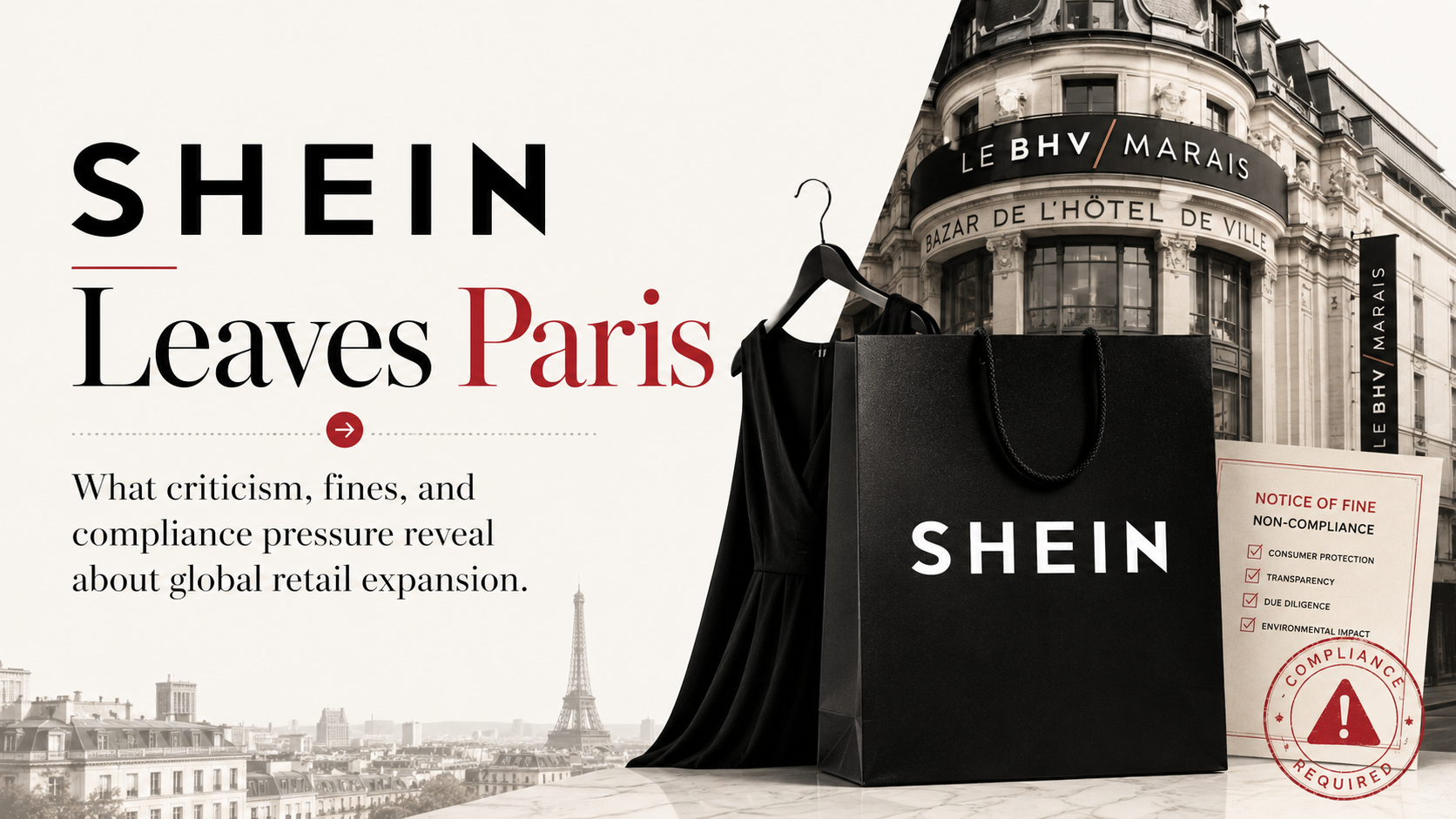
What Shein’s forced retreat from BHV Marais says about global retail expansion, local resistance and the new price of weak compliance.
The Paris Store That Became a Warning Sign
Shein’s short-lived presence inside BHV Marais was supposed to show that an online ultra-fast-fashion machine could step into the symbolic center of Paris retail and become physical, local and visible. Instead, less than a year after the opening, the Paris experiment has become a warning sign for every international retailer that wants to enter a protected, emotional and highly regulated market.
Reuters reported on June 16 that BHV and Shein had ended their partnership only seven months after the permanent Shein space opened inside the Paris department store. The change came together with a change of control at BHV Marais, where the Société des Grands Magasins is selling the Parisian store to the current management team led by Karl-Stéphane Cottendin. According to Reuters, Cottendin described the Shein partnership as a mistake. Spiegel, citing French media, reported that the new management wants Shein to leave by the end of the year, although no exact exit date has been announced.
The event is easy to misread as another cultural battle against fast fashion. It is more than that. It is a retail case study about market entry, local legitimacy, compliance exposure and the gap between consumer demand and institutional acceptance. Shein can still sell online in France. There is no verified reporting that the company is closing its French business completely. The current facts point to a withdrawal from the BHV Marais location in Paris, not to a full French market exit. Available reporting also does not show a confirmed replacement location in Paris. Shein told Reuters that its collaboration with SGM had always been intended as temporary, but the timing and the public language around the exit tell a different strategic story: the location had become politically and commercially difficult to defend.
The Drama Behind the Location
BHV Marais is not just another retail building. It is a historic department store near the Hôtel de Ville, in a city that treats fashion as culture, employment, national soft power and urban identity. Putting Shein into that environment created an immediate collision between two models of retail. One model is built on local history, curated assortment, craftsmanship, recognizable brand neighbors and physical trust. The other is built on speed, algorithmic demand, global sourcing, low prices, aggressive online discovery and near-infinite assortment.
That collision was visible from the beginning. Reuters reported that the launch in November was met with protests. It also reported that the French government tried to suspend Shein’s platform on the launch day, although that attempt was later overturned by a Paris court. According to Reuters, some loyal Shein shoppers who queued for the opening were underwhelmed because prices in the physical store were much higher than on Shein’s online platform. Spiegel reported that some brands left BHV after Shein arrived and that customer traffic did not develop as hoped, while also noting pre-existing payment delays at BHV. The problem was therefore not only moral outrage or political pressure. The store had to deal with brand exits, reputation damage, assortment confusion and an unclear customer proposition.
For a retailer, location is not real estate alone. Location is permission. A brand can rent square meters and still fail to earn the right to belong there. In Paris, Shein was not entering an empty shopping center looking for footfall. It was entering a cultural retail institution in a country already mobilizing politically and legally against ultra-fast fashion. That made every weakness in Shein’s compliance and public positioning more dangerous.
The Compliance Issue Behind the Fine
The compliance topic is central because it gave critics a practical weapon. It is one thing for local competitors, trade associations, politicians and consumer groups to dislike a foreign platform. It is another thing when regulators can point to concrete consumer-law breaches.
On June 3, the French consumer and competition authority DGCCRF announced two administrative fines against Shein-linked entities totaling more than 22 million euros. The official DGCCRF notice said the sanctions concerned non-compliance with withdrawal rights, insufficient environmental-quality information and non-compliant order confirmations sent to consumers. The first fine, 5.7645 million euros against Infinite Styles Ecommerce Co Limited (Infinite Styles Services Co. Limited is an Irish corporate entity based in Dublin that operates the European online regional websites and handles various regional services for the global fast-fashion and lifestyle retailer SHEIN), related to the legal right of withdrawal and to missing information about product traceability and plastic microfibers. The second fine, 16.73319 million euros against Infinite Styles Services Co Limited, related to order confirmations that lacked mandatory information such as the price, delivery date or delivery period, seller identity and contact details, legal guarantees, mediation options and information about the withdrawal form and right.
This is not a minor back-office issue in cross-border retail. In European e-commerce, the order confirmation is part of the legal infrastructure of trust. It gives the buyer the evidence needed to cancel, claim a refund, identify the seller and understand legal guarantees. If that document is incomplete, the customer relationship is no longer only operationally weak. It becomes legally fragile.
The June fines also followed a larger French enforcement history. In July 2025, Reuters reported that French authorities fined Shein 40 million euros for deceptive business practices involving misleading discounts. The DGCCRF’s own press release said its investigation found that 57 percent of verified announcements offered no real price reduction, 19 percent offered a lower reduction than advertised and 11 percent were in fact price increases. The same official release said Shein could not justify certain environmental claims, including a message that suggested the company would limit its impact by reducing greenhouse-gas emissions by 25 percent. Shein said it had addressed the issues and, in the later June 2026 matter, said it would contest the sanctions as disproportionate. That does not change the strategic point. Once a brand becomes a regulatory target, every expansion step becomes easier to attack.
Local Resistance Needs an Opening
International retailers often underestimate how market defense works in mature economies. Local players rarely say directly that they want to block a foreign competitor because it is foreign, cheap or more efficient. That would sound protectionist and weak. Instead, they attack the places where the entrant is vulnerable: compliance, labor standards, environmental claims, consumer protection, marketplace controls, data, product safety, customs, taxation and brand fit.
This does not mean local criticism is automatically unfair. Consumers deserve compliant order confirmations, truthful discount claims and clear withdrawal rights. Environmental claims must be substantiated. Marketplaces must police illegal products. The point is more practical. If an international retailer enters a new country with weak compliance, it gives local opponents the most effective argument possible. The discussion no longer has to be about taste, nationalism or competition. It becomes about rules.
That is why compliance is not only a legal function. It is market-entry armor. The larger and more disruptive the foreign retailer is, the more carefully it must close the gaps that others can use against it. Shein’s low prices and global speed made it attractive to consumers, but those same strengths made it threatening to local retail ecosystems. Once French regulators, politicians and brand partners could connect the Shein name to fines, missing information, misleading price reductions and wider platform controversies, the BHV partnership became a reputational burden for the host as much as a commercial experiment.
What Shein Is Likely to Do Next
Based on the currently available reporting, Shein is not leaving the French market. The company is expected to leave the BHV Marais location in Paris, ideally by the end of the year according to Le Parisien as summarized in several reports. Reuters reported that Shein respected BHV’s decision while saying the collaboration had been temporary. There is no reliable public evidence that Shein has announced a full shutdown of its French online business or a confirmed move to another Paris location.
The more likely scenario is a tactical retreat from the most symbolic and politically exposed physical address. Shein can continue to operate online, continue to contest fines, improve compliance documentation and decide whether physical retail in France should remain an ambition, move to less controversial formats or wait for a more favorable context. Reports about the broader BHV network are more nuanced: the Paris store and BHV Parly 2 are part of the management buyout story, while some regional BHV locations that had hosted Shein are tied to the continuing SGM structure according to French regional reporting. That distinction matters. The headline is not that Shein has disappeared from French commerce. The headline is that its most visible Paris physical retail experiment has lost the local legitimacy needed to remain in place.
The Retail Lesson
The Shein-BHV story shows that physical retail is still powerful because it makes a business visible. The same visibility that can humanize an online platform can also concentrate resistance. Online, a controversial platform is everywhere and nowhere. In a department store, it has an address, a floor, neighbors, employees, landlords, local politicians and a public face. Physical retail turns a business model into a civic object.
For global retailers, the lesson is clear. Before entering a new market, especially a market with strong local traditions and organized retail interests, compliance must be treated as part of the brand promise. Price localization, order documentation, refund rights, seller identity, environmental communication, marketplace controls and product safety are not technical details. They are proof that the retailer understands the country it wants to enter.
The strongest international expansion strategy is not to move fast and fix compliance later. That may work in a digital-first growth story for a while, but it does not work forever when the brand becomes large enough to threaten local incumbents and visible enough to attract regulators. The stronger strategy is to enter with no easy target. That means local legal review before launch, transparent consumer communication, auditable promotional logic, reliable environmental claims and internal escalation when the marketplace model creates risk.
Shein’s Paris exit is therefore not only a story about fast fashion. It is a story about the cost of giving opponents a handle. Every retailer entering a foreign market should assume that local players will protect their market, regulators will test the entrant’s weakest processes and the public will judge whether the business has earned the right to belong. In that environment, compliance is not the boring part of retail. It may be the part that decides whether the door stays open.
Sources
[1] Reuters, “Shein and Paris department store end controversial partnership,” June 16/17, 2026. https://www.reuters.com/business/retail-consumer/french-store-bhv-ends-partnership-with-retailer-shein-french-media-say-2026-06-16/
[2] Der Spiegel, “Shein soll wieder aus Pariser Kaufhaus ausziehen,” June 16, 2026. https://www.spiegel.de/ausland/shein-bhv-marais-trennt-sich-nach-kritik-vom-chinesischen-modekonzern-a-6b1924d5-1902-4afe-bcca-36072bfb40a5
[3] DGCCRF official notice, “La DGCCRF sanctionne SHEIN pour de nouveaux manquements,” June 2026. https://www.economie.gouv.fr/dgccrf/laction-de-la-dgccrf/injonctions-et-sanctions/la-dgccrf-sanctionne-shein-pour-de-nouveaux-manquements
[4] DGCCRF official press release, “Fast fashion: SHEIN sanctionné d’une amende de 40 millions d’euros,” July 3, 2025. https://www.economie.gouv.fr/files/files/directions_services/dgccrf/media-document/cp-dgccrf-SHEIN-sanctionne-amende-40millions.pdf
[5] Reuters, “France fines Shein $26 million over consumer rule breaches; Shein to challenge,” June 3, 2026. https://www.reuters.com/business/retail-consumer/france-fines-shein-22-million-shein-calls-fines-disproportionate-2026-06-03/
[6] Reuters, “France fines retailer Shein 40 million euros for misleading discounts,” July 3, 2025. https://www.reuters.com/sustainability/boards-policy-regulation/france-fines-shein-40-million-euros-deceptive-business-practices-2025-07-03/
[7] Le Parisien search summary, “C’était une erreur: Shein au BHV Marais, c’est fini,” June 16, 2026. https://www.leparisien.fr/economie/consommation/cetait-une-erreur-shein-au-bhv-marais-cest-fini-16-06-2026-ZYUKG7FPARDW5ASRIGYQ6VGACY.php
[8] Le Dauphine / AFP summary, “Une erreur stratégique: le BHV Marais va arrêter sa collaboration avec Shein,” June 16, 2026. https://www.ledauphine.com/economie/2026/06/16/une-erreur-strategique-le-bhv-marais-va-arreter-sa-collaboration-avec-shein
