


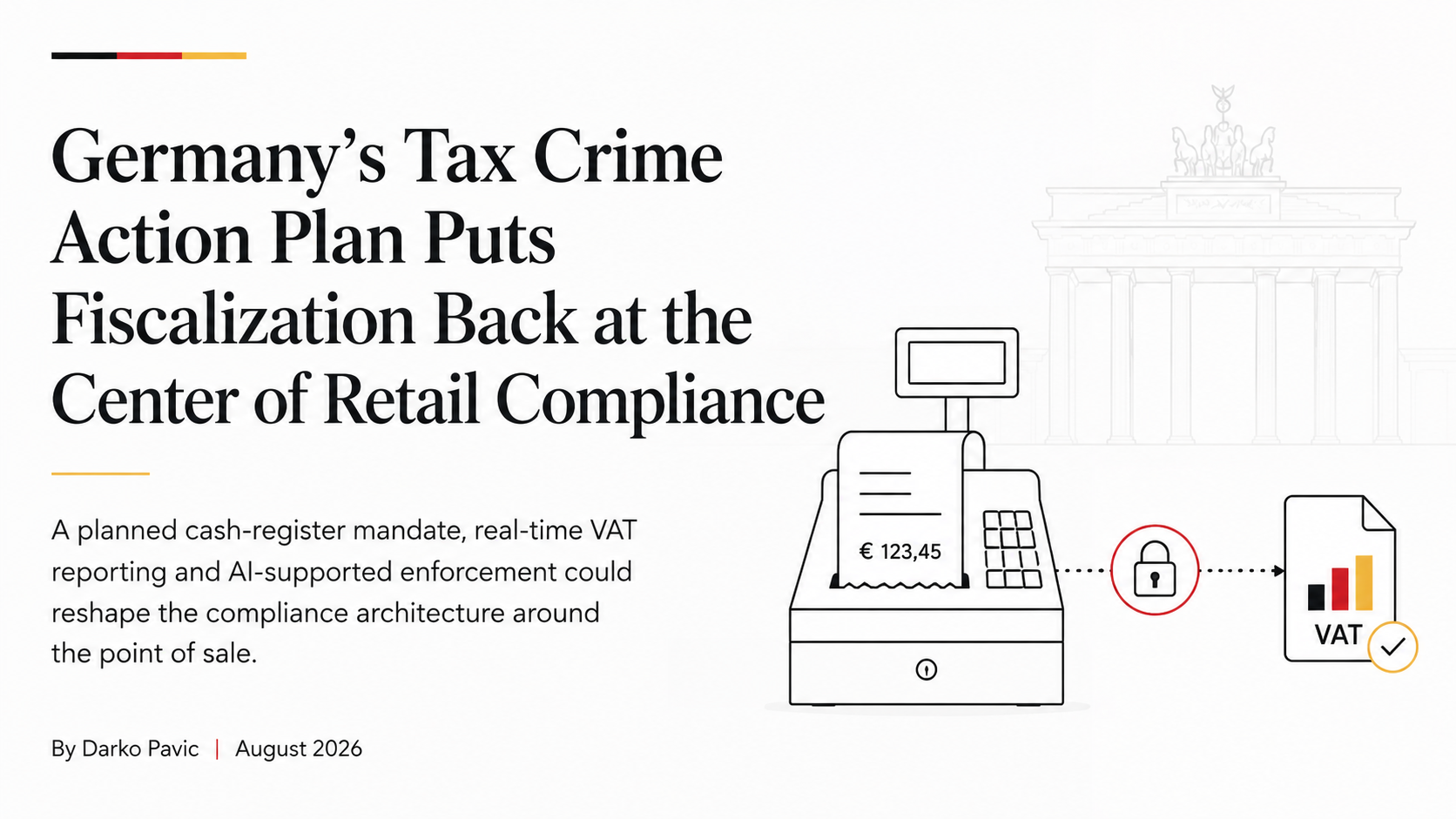
A planned cash-register mandate, real-time VAT reporting and AI-supported enforcement could reshape the compliance architecture around the point of sale.
Germany’s federal finance and justice ministries presented a 26-point action plan on 16 July 2026 that is intended to increase the risk of detection and strengthen enforcement against tax and financial crime. For retailers and POS solution providers, the most important elements are not the proposed criminal penalties, but a group of measures that sit directly around transaction data: a mandatory cash-register requirement for cash-intensive sectors, an electronic VAT reporting system, a central tax-data platform with AI-supported analysis, longer retention periods and new data-access requirements.12
Taken separately, each measure would create a substantial compliance project. Taken together, they point toward a broader change in German fiscalization, moving from the protection of individual cash-register transactions toward an enforcement model in which authorities can connect, compare and analyse data from several parts of the retail architecture.
A policy direction, not yet a final rule
The action plan should not be read as a finished technical specification. It contains policy objectives, while the detailed scope, affected sectors, thresholds, transition periods, exceptions and sanctions still have to be defined through legislation and implementing rules. The German Chamber of Commerce and Industry has also emphasised that the 26 measures are currently general targets rather than drafted legal provisions.3
That distinction matters, particularly for companies that need certainty before changing their POS landscape. It does not, however, justify waiting until every detail has been published. Retail technology programmes, contractual changes, store rollouts and fiscal integrations usually take much longer than the political process assumes, especially when hundreds or thousands of locations are involved.
The cash-register mandate changes the scope of fiscalization
Germany already has a developed fiscalization framework for businesses that use electronic recording systems. Transactions recorded through an electronic cash register must be protected by a certified technical security system, commonly known as a TSE, while data must remain available through the standardised fiscal export structure. Electronic recording systems are also subject to notification requirements, with the ELSTER and ERiC reporting procedure available since January 2025.45
The important gap is that German law has so far not imposed a general obligation to use an electronic cash register. A business can still operate an open cash drawer if it fulfils the applicable accounting and documentation requirements. The planned Registrierkassenpflicht would therefore not merely adjust the rules for existing electronic systems; it would bring additional businesses into the electronic fiscalization environment for the first time.6
For retailers, this means much more than purchasing a device. It affects store processes, master data, connectivity, staff training, device inventories, maintenance, incident handling and the migration of historical records. For POS vendors, it could expand the market, but it will also create demand for solutions that are affordable, remotely deployable, easy to operate and still capable of producing complete, audit-ready data under real retail conditions.
The larger change may be the data model
The action plan also proposes an electronic VAT reporting system under which businesses would report revenues individually and promptly. At the same time, the authorities intend to create a central data platform and use AI-supported analysis to identify patterns and suspicious cases more quickly. KPMG describes this as part of a broader movement toward continuous transaction controls and closer alignment with Germany’s ongoing e-invoicing development.17
It is too early to conclude that every retail receipt will be transmitted to the tax authority in real time, because the action plan does not define the reporting model in sufficient detail. The direction is nevertheless important. POS data is likely to become more directly connected with VAT reporting, accounting, e-invoicing and tax analytics, which means that inconsistencies between systems will become more visible and potentially easier to identify.
A valid TSE signature remains essential, but it cannot repair an incorrect VAT rate in the merchandise system, a return that is posted differently in the ERP, a payment value that does not reconcile with the acquirer, or a cancellation that disappears during an offline recovery. Transaction identifiers, timestamps, tax categories, payment types, discounts, deposits, gift cards, returns, voids and omnichannel flows must remain connected throughout the complete lifecycle. Every exception that is operationally normal in retail must still be explainable in compliance terms.
This is where the action plan could have its strongest influence on fiscalization. The control point is no longer only the cash register and its security component. It increasingly becomes the complete path from the sale at the POS to tax reporting, accounting, storage and audit access.
Retention and data access become architectural requirements
The government also plans to extend the retention period for accounting vouchers to 15 years and to require companies from third countries to keep tax-relevant data on mirror servers in Germany. The final legal scope remains open, and the reference to accounting vouchers should not automatically be interpreted as a 15-year retention rule for every category of POS data. Even so, global retailers and international SaaS providers should review where fiscal data is stored, who can access it, how it can be exported and whether it remains readable after a system replacement or provider change.1
A technical backup is not the same as an audit-ready archive, because an archive must preserve meaning as well as files. Data formats, software versions, fiscal configuration, TSE references and the documentation needed to interpret historical transactions must survive for the required period. This becomes especially important in cloud environments, where operational responsibility may be distributed among the retailer, the POS provider, the fiscalization provider and the hosting company.
What retailers and POS vendors should prepare now
Retailers should begin with a structured review of their German store landscape, including the use of electronic and open cash drawers, the completeness of POS and TSE registrations, the reliability of fiscal exports and the reconciliation between POS, ERP, payment and VAT data. Archiving contracts and data-access procedures also deserve attention, particularly where systems are hosted outside Germany or operated by non-EU providers.
POS vendors should prepare their products for a compliance model that is more data-driven and more closely connected to tax reporting. Regulatory logic should be versioned and separated from ordinary business logic where possible, while audit trails, export functions, remote configuration and offline recovery must be treated as core product capabilities rather than additional modules. Vendors that can demonstrate consistent data across the full retail process will be better positioned than those that focus only on the formal connection to a TSE.
Germany’s action plan is not yet a final fiscalization law, but it gives the market a clear signal. The next stage of German retail compliance is likely to combine mandatory electronic recording with broader tax-data reporting and more sophisticated analysis by the authorities. For compliant retailers, better risk-based enforcement may eventually reduce unnecessary scrutiny, but only when their systems can prove that the data is complete, coherent and available. The practical work therefore starts before the final legislation, because the architecture required for that level of transparency cannot be added at the end of a POS rollout.
Sources and regulatory references
5. Federal Ministry of Finance, application guidance for Section 146a AO and the KassenSichV.
7. KPMG, “Germany: Real-time VAT reporting to combat tax fraud,” 29 July 2026.8. Fiskaly, “Germany plans mandatory electronic cash registers: The BMF action plan explained,” 23 July 2026.
