


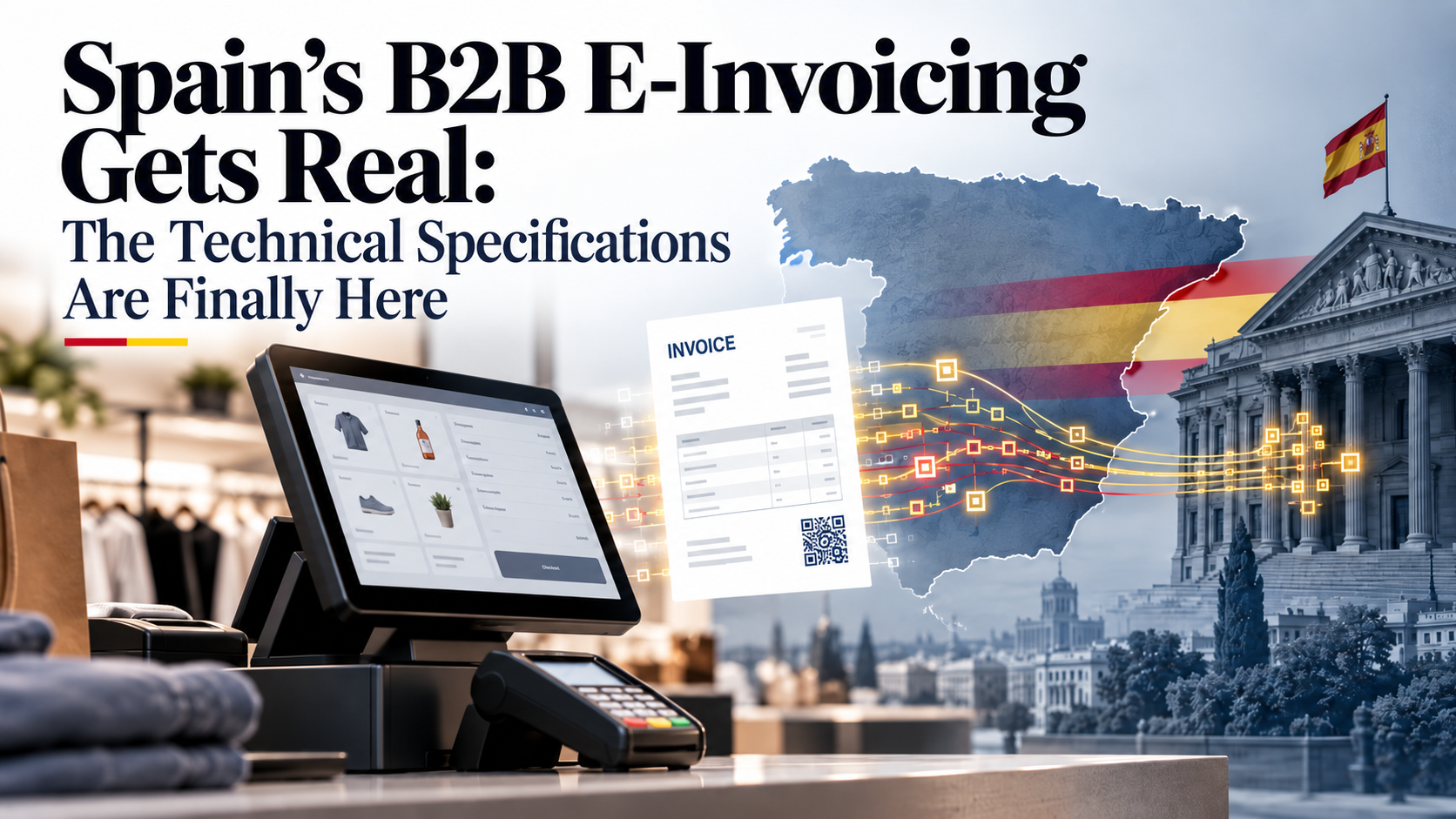
The new Order HAC/1028/2026 is a B2B e-invoicing measure, not a new consumer-receipt mandate, but for retailers and POS providers the important story is where the two worlds begin to meet.
At first glance, Spain’s newly published Order HAC/1028/2026 looks like a story for finance departments, e-invoicing teams and ERP providers. It regulates the technical and functional elements of Spain’s public electronic invoicing solution under the country’s mandatory B2B e-invoicing framework. For retailers, however, stopping the analysis there would be a mistake, because the order creates another compliance layer that can begin far closer to the point of sale than the title of the regulation suggests.
The legal scope is important. The obligation addressed by the order concerns invoices between businesses and professionals, and the underlying framework requires electronic invoicing when the recipient is a business or professional established in Spain. In other words, this is not a general rule forcing every supermarket receipt, fashion purchase or other ordinary consumer transaction into the new public e-invoicing system. A normal B2C checkout remains a different compliance scenario.
That distinction sounds simple until we look at how retail actually works. A retailer does not operate in two perfectly separated worlds called B2C and B2B. The same store, the same checkout and sometimes the same transaction flow can serve both. A consumer buying a pair of shoes is one case, while a company employee buying equipment and requesting a proper business invoice is another. The moment the transaction becomes a B2B invoice, the new Spanish architecture can become relevant, even if the commercial interaction started at a retail POS.
This is where the order becomes interesting for POS and retail technology teams. Spain’s public solution is not designed merely as a government web portal for companies that do not have their own software. The Spanish model combines private e-invoicing platforms with a public solution managed by the tax administration. Businesses may use private platforms, the public solution or a combination of both, but where a private platform is used instead of the public solution for issuance, a faithful electronic copy of the invoice must be sent simultaneously to the public solution.
The technical direction is equally clear. The order requires invoices handled through the public solution to follow the EN 16931 semantic model using UBL syntax. For retailers that already operate complex POS, ERP and invoicing landscapes, this means that compliance cannot be treated as a PDF-generation exercise. The transaction data must be transformed into a structured, machine-readable invoice that fits the required model, passes validation and can move through the Spanish public infrastructure.
The architecture therefore starts to look familiar to anyone working in fiscalization. A commercial transaction is created in the retailer’s system, compliance logic determines which document is required, the data is transformed into the prescribed structure, the document is transmitted through an approved channel and the administration validates or receives it. The legal category is e-invoicing, not classical cash-register fiscalization, but from a system-design perspective the distance between these domains is becoming smaller.
Spain also adds something that makes the model more than a simple invoice-delivery network. Each electronic invoice in the public solution receives a unique code constructed from the issuer’s NIF, the invoice series and number, and the issue date. The recipient must also communicate relevant invoice-status information, including rejection, the effective full-payment date and the payment due date, while the issuer may report collection or non-payment information. This turns the system into an infrastructure that follows the invoice beyond issuance and into its commercial lifecycle.
For large retailers, this matters on both sides of the business. They issue invoices when selling to business customers, but they are also major recipients of supplier invoices. The same regulation therefore affects outbound and inbound processes, creating requirements that can reach POS, order management, e-commerce, ERP, accounts payable and tax systems. What looks like a tax-document project can quickly become an enterprise architecture project.
There is another reason why retailers should pay attention now. The order states that its entry into force starts the clock for the implementation periods established by the underlying legislation and Real Decreto 238/2026, while the public solution itself must be available at least two months before the first effective application. The publication is therefore more than another technical document; it is a concrete step in moving Spain’s mandatory B2B e-invoicing framework from legislation toward operation.
For POS solution providers, the practical message is not that every retail receipt in Spain has suddenly become an electronic B2B invoice. It has not. The message is that the boundary between checkout, invoicing and tax reporting is becoming more important, and POS architectures that can distinguish transaction types, collect the right business-customer data and hand compliant invoice information into an e-invoicing layer will be easier to adapt than systems in which invoicing is treated as a separate afterthought.
This development also illustrates a broader trend in retail compliance. Fiscalization, e-invoicing, transaction reporting and payment-status reporting are often regulated through different legal instruments, but technically they are converging around the same core idea: governments increasingly expect structured transaction data to move from business systems into controlled digital infrastructures. For international retailers, the challenge is no longer only to make the POS compliant country by country, but to design a transaction architecture that can support several compliance obligations around the same sale.
Spain’s latest order should therefore not be described as a new retail fiscalization mandate, because that would overstate what it does. It is a B2B e-invoicing regulation. Yet for retailers and POS providers it deserves close attention precisely because it shows how quickly the traditional borders between POS compliance, invoicing and government reporting are disappearing.
Source document
Order HAC/1028/2026 of 2 October 2026 regulates the technical and functional elements of Spain’s public electronic invoicing solution under the mandatory B2B e-invoicing framework. Download the original Spanish order here.
