


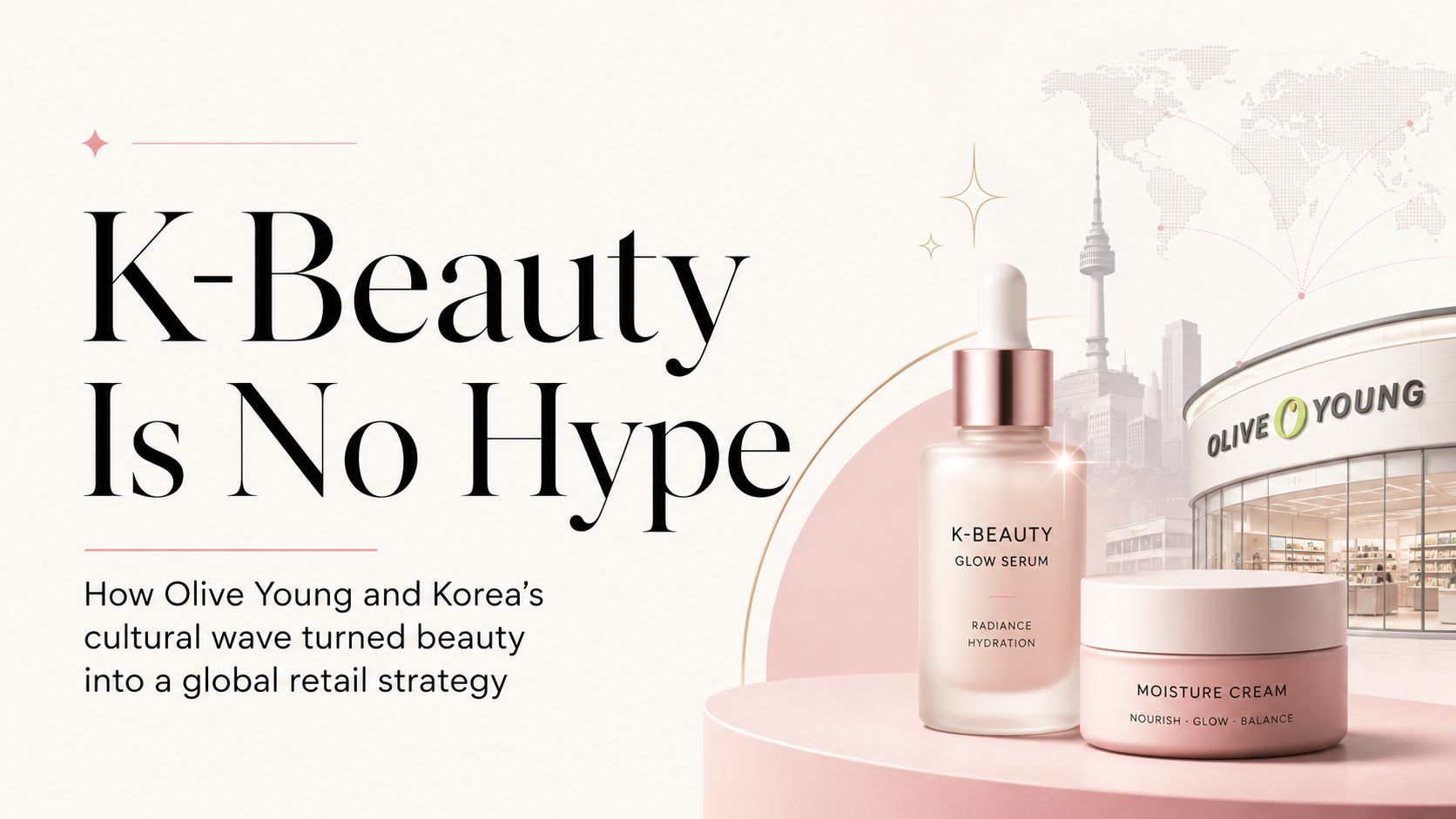
How Olive Young’s U.S. debut shows what happens when culture, product innovation, social media and physical retail are engineered into one commercial machine.
A queue in Pasadena, a signal for global retail
The opening of Olive Young’s first U.S. store in Pasadena was not a small retail anecdote. It was a visible signal that physical retail can still create urgency when the store is connected to a larger cultural movement and when the customer feels that entering the location means entering the source of a trend.
The store is large enough to matter and specific enough to feel curated. The Pasadena location covers 8,647 square feet and presents hundreds of brands and thousands of products across skincare, makeup, hair care, wellness and inner beauty. Customers reportedly queued around the block, with some waiting from the early morning hours, not because the world suddenly discovered cosmetics, but because Olive Young has managed to turn a beauty store into the physical expression of K-Beauty’s global momentum.
That distinction matters. A store can still attract attention if it is not merely a place where inventory waits for a transaction. The best stores today function as media, education, social proof and identity infrastructure. Olive Young’s U.S. debut is therefore not only a story about one Korean retailer entering California. It is a case study in how a retail platform can convert cultural heat into foot traffic.
The beauty market is big enough to reward the winners
The global beauty market remains one of the most attractive arenas in consumer retail. McKinsey has estimated that the beauty sector could reach about $590 billion by 2028, growing at roughly 6 percent per year, which makes the category too large to be treated as a temporary social-media fashion.
Within that market, South Korea has become one of the most important manufacturing and trend-setting powers. France remains the historical leader in cosmetics exports, but South Korea has moved into the top tier of global beauty exporters, supported by industrial depth, strong product development, social commerce, cultural visibility and an unusually fast innovation cycle.
The American market shows the same pattern. NielsenIQ reported that K-Beauty sales in the United States reached about $2 billion in 2025, with facial skincare leading the category and social platforms helping brands move from viral content into real commercial channels. The growth is especially important because it is not driven only by one hero product, one celebrity endorsement or one retailer. It is driven by a system that produces discovery again and again.
Why skincare became the perfect social-media product
Skincare is unusually well suited for short-form video and creator-led commerce because it is visual, intimate, repetitive and easy to demonstrate. A cream can be applied. A toner pad can be shown. A serum can be layered. A routine can be repeated every morning and every evening, and each repetition creates another small piece of content around glow, hydration, glass skin, clean pores or a healthier skin barrier.
TikTok did not create K-Beauty, but it accelerated the movement by giving routines an algorithmic distribution engine. A product that once would have needed shelf space, magazine coverage and expensive advertising can now travel through a creator video, a product haul, a ranking, a before-and-after clip, an ingredient explanation and a shopping link. In this environment, beauty is not only a category. It becomes a ritual that can be watched, copied and purchased.
This is why Olive Young’s role is more powerful than the role of a normal beauty retailer. It does not only sell brands. It curates the movement, translates the noise into categories, gives emerging products a platform, and provides consumers with a trusted filter in a market where discovery can easily become overwhelming.
South Korea built an ecosystem, not only a trend
K-Beauty’s rise was not an accident and it was not created by one viral moment. During the 2000s, South Korea developed a powerful cosmetics ecosystem in which manufacturers, ingredient suppliers, brand creators, retailers, entertainment companies and digital platforms gradually reinforced each other. The result was a market where product development cycles could become much faster than in many Western beauty markets and where competition forced brands to improve value without abandoning quality.
The domestic market mattered because it created pressure. When many brands compete for a sophisticated customer, speed becomes a discipline rather than a slogan. New textures, lightweight sunscreens, toner pads, cushion formats, masks, serums and ingredient-led products could be tested, improved and replaced quickly. This produced a feeling that K-Beauty was always slightly ahead of the next small discovery, which is exactly the feeling that keeps a category alive on social media.
The Korean government has also treated beauty as more than a private consumer category. In late 2025, South Korea announced a comprehensive strategy to strengthen the global standing of K-Beauty, showing that the sector has become part of the country’s wider export, tourism, culture and industrial strategy. That kind of coordinated support helps explain why K-Beauty feels less like a random consumer wave and more like a national commercial system.
K-Culture turned desire into demand
K-Beauty cannot be separated from the broader Korean Wave, often called Hallyu. K-Pop, K-dramas, Korean food, fashion, language, entertainment and lifestyle content created a global cultural halo in which Korean products became not only acceptable but desirable. Beauty benefited from that halo because appearance is one of the easiest cultural signals to translate into commerce.
The BTS story remains one of the clearest examples of how this mechanism works. Big Hit Entertainment did not simply push a band through the old machinery of celebrity marketing. It built intimacy at scale by using social platforms, direct communication, self-produced content and a sense of everyday access. Fans were not only watching performances. They were watching routines, meals, travel, practice, humor, vulnerability and identity.
This inverted the traditional relationship between celebrity and fan. In the older model, fans tried to pull celebrities into their own lives through magazines, posters and television appearances. In the BTS model, the group opened a continuous window into its own world, and that world included style, skin, lifestyle and routine. When a fan wants to come closer to an idol’s world, beauty becomes one of the most accessible entry points.
The commercial formula can be stated simply. K-Pop made Korean culture desirable, and K-Beauty made that desire shoppable.
Netflix, fandom and the long life of a cultural wave
The Korean Wave has also been reinforced by global streaming platforms, which turned Korean cultural production into a mainstream international habit. Squid Game became Netflix’s most successful debut series, reaching 142 million subscriber households in its first month, while KPop Demon Hunters later demonstrated how Korean pop aesthetics could become an animated global phenomenon, with Netflix saying the film became its most popular movie of all time with more than 236 million views.
These entertainment properties do not sell toner pads directly, but they keep Korean cultural codes visible, familiar and emotionally charged. That is the environment in which K-Beauty operates. A consumer may first admire an idol’s skin, then watch a routine on TikTok, then compare ingredients, then read rankings, then visit Olive Young online, and finally queue outside a store because the physical location feels like entering the origin point of a global trend.
This is what many retailers still underestimate. Culture now creates traffic before retail sees the signal in sales data. By the time a category becomes obvious in store reports, the real work may already have happened on entertainment platforms, social networks, creator channels and fan communities.
Olive Young is a platform disguised as a store
Olive Young’s strategic strength is that it behaves less like a conventional cosmetics chain and more like a platform for K-Beauty discovery. The retailer offers assortment, ranking, education, category logic, trend translation and omnichannel access. In Korea, its physical network gives brands distribution and credibility. Internationally, its online presence lets customers participate in the trend even before a store opens near them.
The U.S. store therefore matters because it gives the movement a stage. The reported use of services such as skin scans, scalp analysis, category zones and guided product discovery suggests that Olive Young understands that modern beauty retail must be educational as well as transactional. Consumers do not always need more choice. They need help making choice meaningful.
That is the reason the store can become more than a point of sale. It can become a place where a customer learns the logic of a routine, discovers why one ingredient matters, compares textures, receives social confirmation and leaves with the feeling of having entered a curated system rather than a random aisle of products.
The retail lesson behind the K-Beauty wave
The deeper lesson for retailers is that product innovation, price-value balance, routine logic, education, social proof, cultural halo and platform curation work best when they reinforce each other. K-Beauty is strong because these elements do not live separately. They form a retail engine.
Product innovation keeps the category moving. Accessible pricing makes experimentation less risky. Routine logic increases basket size because customers are not only buying one product; they are building a sequence. Education reduces confusion and increases confidence. Social proof spreads trust through creators, rankings, reviews and bestseller culture. Culture gives the products emotional meaning beyond their functional promise. Retail platform logic brings all of this together and turns scattered demand into structured discovery.
That combination explains why the Olive Young story is more important than another successful store opening. It shows that physical retail can still create excitement when it is attached to a cultural movement, when it curates rather than merely stores inventory, and when it turns discovery into an experience that digital channels alone cannot fully replace.
Conclusion: culture is now a traffic driver
The success of K-Beauty and the arrival of Olive Young in the United States should be read as a warning and an opportunity. Retailers that look only at category sales may miss the early signals. The next wave may already be forming in music, streaming, creator communities, fan cultures and lifestyle content long before it appears in traditional retail data.
Culture is now a traffic driver. That statement may sound soft, but it has very hard commercial consequences. When a retailer manages to ride a cultural wave with the right product, the right platform, the right store experience and the right timing, the store can become a destination again.
Olive Young’s Pasadena opening is therefore not proof that every physical store can create a queue. It is proof that a store can still create a queue when it is the visible front door to something much larger than itself.
