


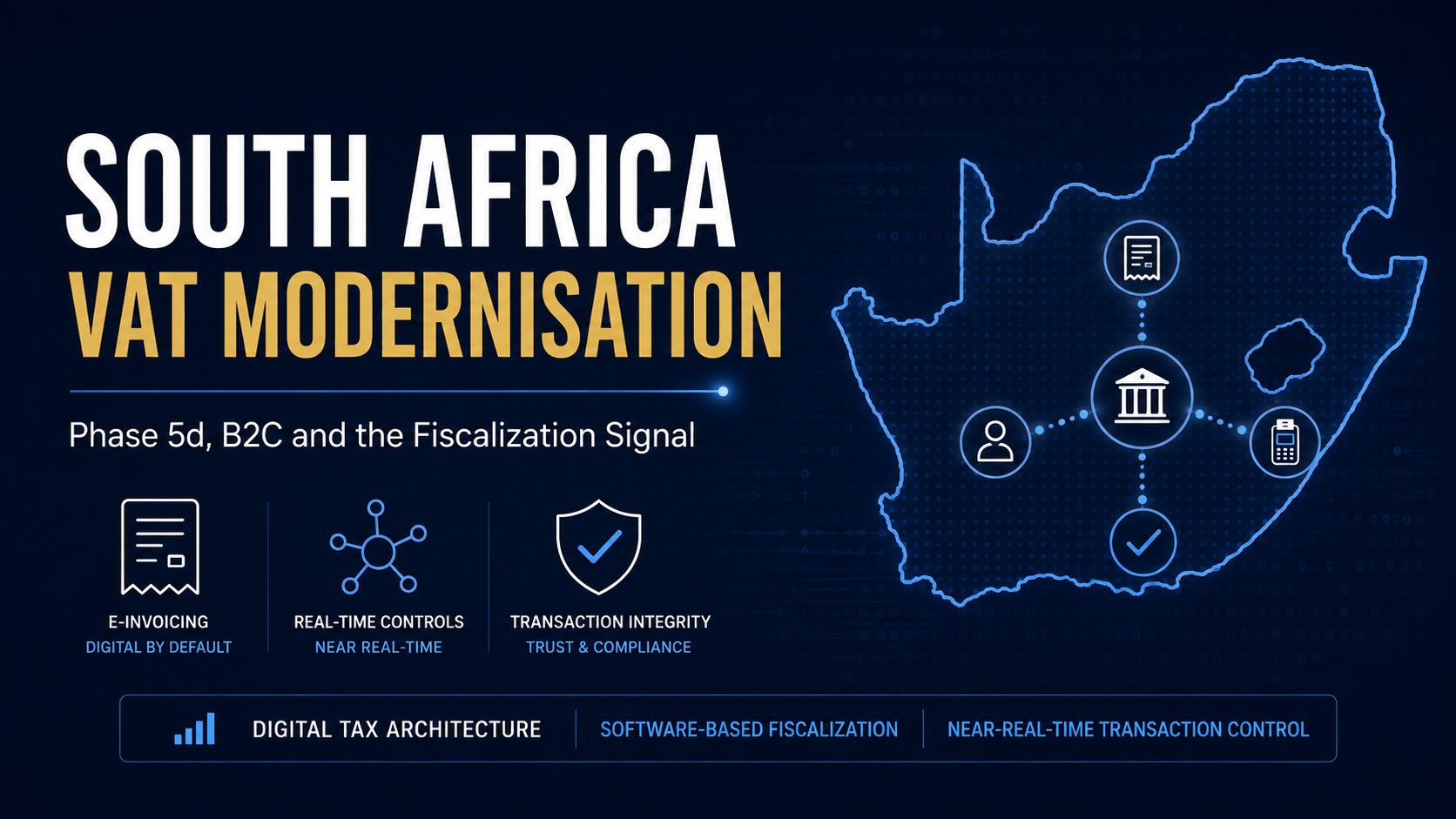
The strongest signal is not the planned B2B e-invoicing regime, but a later phase that explicitly brings B2C and end-consumer transactions into South Africa’s Digital VAT Model.
South Africa has not announced a classical retail fiscalization system, and it would be premature to describe the country as a new fiscal market today. Yet the South African Revenue Service’s August 2026 consultation paper on VAT modernisation contains a signal that should attract the attention of every retailer, POS vendor and fiscal technology provider operating in the country: Phase 5d of the proposed implementation journey is intended to cover business-to-consumer transactions involving end consumers and other non-VAT-registered recipients.
That sentence changes the way the entire consultation paper should be read from a retail perspective. Most of the document is framed around e-invoicing, interoperability and VAT reporting, areas that are often treated separately from fiscalization. Once B2C transactions are explicitly included in the final rollout, however, the proposed model begins to approach the same territory as modern software-based fiscalization: transaction data close to the point of sale, validation against tax rules, near-real-time reporting, digital authentication and a direct role for the tax authority inside the transaction-data flow.
SARS is still consulting on the model, the technical specifications are not final, and important retail questions remain unanswered. Even so, the direction is much clearer than it was before this paper was published.
The B2C signal is the one retailers should watch
The proposed roadmap divides the eventual implementation into several segments. Large taxpayers and B2B transactions come first, followed by business-to-government transactions and then smaller B2B taxpayers. Phase 5d is the part that matters most from a fiscalization point of view because SARS states that it will cover transactions involving non-VAT-registered taxpayers, businesses and end consumers in order to strengthen economy-wide visibility. The paper also says that incentives may be considered to encourage invoice acceptance and validation in this segment.
This does not yet mean that every retail receipt will become a cleared e-invoice. The consultation paper is careful to acknowledge that some VAT transactions do not ordinarily require an invoice and therefore fall outside the proposed e-invoicing requirement, with these cases left for consultation and detailed solution design. That unresolved point is precisely where the future definition of South African retail fiscalization may emerge. SARS has said that B2C is part of the destination, but it has not yet said what technical object will represent an ordinary consumer sale on that journey.
For retailers, that distinction is fundamental. A supermarket receipt, a fashion-store sale, a restaurant transaction and an e-commerce order cannot simply be assumed to follow the same document model as a B2B tax invoice. The final architecture could use a simplified fiscal dataset, a structured electronic receipt, a reduced e-invoice, a dedicated B2C reporting message or another mechanism. The consultation paper leaves this open, which means South Africa has defined the policy direction before defining the retail transaction model.
The surrounding architecture already looks familiar to fiscalization
The B2C phase would be less significant if the rest of the proposal were only about exchanging invoices between businesses. It is not. SARS proposes what it calls a Decentralised Continuous Transaction Control and Exchange model, or DCTCE, built on e-invoicing, an interoperability framework and e-reporting. The paper describes a move away from retrospective, declaration-based VAT administration toward structured transaction data that is shared with SARS in near real time and, over time, used for increasingly automated VAT assessment.
Continuous Transaction Controls are an explicit part of the design. The consultation paper defines CTC as a model in which transaction or invoice data is validated, reported or made available to SARS in real time or near real time as part of the business process. It also says that e-reporting through CTC can involve VAT transactional data being submitted just before, during or shortly after the actual exchange between supplier and buyer. From a fiscalization perspective, this matters because control is no longer positioned at the end of the reporting period; it moves closer to the economic event itself.
Transaction-level reporting is equally central. SARS’s fifth corner in the proposed five-corner model is a tax-authority access point that receives prescribed VAT transactional data from the supplier and recipient sides of the network. The data is intended to support risk analysis, validation, pre-filled VAT returns and future auto-assessment. This is a very different tax-control philosophy from a periodic VAT return assembled weeks after the sale, and it creates the technical foundation on which B2C transaction reporting could later be built.
Clearance and validation are also embedded in the model. The supplier’s accredited access point is expected to receive an e-invoice, apply prescribed technical standards and VAT legislative requirements in near real time, and either clear the document or reject it for correction and resubmission. The recipient side performs its own validation before the information is passed onward. In other words, the system is being designed to enforce compliance at source rather than relying exclusively on later audit.
Digital authentication is another important element. SARS’s own transformation table contrasts the current environment, which it describes as lacking real-time transaction validation and digital signature authentication, with a future state that includes near-real-time validation and digital signature authentication of e-invoices. The exact security mechanisms are not yet prescribed, but the direction again matches the architecture of modern fiscal systems in which the authenticity and integrity of transaction data are part of the legal control model rather than a separate IT feature.
A likely software-based fiscalization architecture
Taken together, these elements point toward a model that would be fundamentally different from older fiscalization regimes built around dedicated fiscal printers, protected memory modules or tax-authority hardware installed at the checkout. The consultation paper instead describes a network of software systems and accredited service providers, connected through secure interfaces and governed by common semantic, technical and legal rules.
In the proposed five-corner model, the supplier is Corner One, the supplier’s accredited access point is Corner Two, the buyer’s access point is Corner Three, the buyer is Corner Four and SARS’s own service provider or access point becomes Corner Five. For B2B transactions, the flow is relatively clear: the supplier creates a structured e-invoice, its access point validates and clears it, the buyer-side access point processes it, and prescribed transaction data is also delivered to the SARS side of the network.
If this architecture is extended to retail B2C transactions, a plausible fiscalization design would place the POS, commerce platform or retailer transaction service at the edge of the same software network. The retail system would create a prescribed transaction dataset and send it through an accredited access point, where technical and tax validations could be applied before or around completion of the transaction, while the relevant fiscal data would be transmitted to SARS in near real time. The customer-facing receipt could remain a retail document, while the legally significant transaction record would exist as structured data inside the control network.
That is an inference from the architecture, not a requirement that SARS has already adopted. The paper does not state that the POS must connect directly to an access point, does not define a retail transaction message and does not say whether every B2C sale will require clearance. Still, the architecture makes a software-based model considerably more likely than a return to traditional dedicated fiscal hardware, particularly because SARS repeatedly emphasizes interoperability, accredited service providers, structured machine-readable data and integration with existing ERP, accounting, invoicing and payment systems.
What South Africa has not defined
The missing details are substantial enough that the future system cannot yet be classified as a fully defined retail fiscalization regime. SARS has not specified whether ordinary consumer receipts will be subject to mandatory real-time or near-real-time reporting, whether B2C transactions will require clearance before completion, or whether a simplified transaction message will be used instead of the full e-invoice structure. The meaning of near real time itself is still left for future legislation and public comment.
The paper also does not define a fiscal receipt identifier, transaction sequence rules, QR-code requirements, POS registration, certified POS software, dedicated fiscal devices, mandatory fiscal counters, receipt-signing rules, certificate ownership or storage architecture for retail transactions. There are no defined procedures for store-level offline operation, authority downtime, communication failures, delayed submission, retries, duplicate messages or disaster recovery, all of which become critical once a transaction-control system reaches the checkout.
Returns, cancellations, refunds and corrections will also require detailed treatment. A B2B e-invoice network can rely on debit and credit notes, but a retail environment produces a much wider range of operational events, including suspended transactions, post-payment voids, partial returns, order modifications, split tenders, loyalty redemptions and omnichannel returns. Whether these events become separate fiscal messages, modifications to earlier records or exceptions handled outside the main clearance flow will have a major influence on the complexity of the final POS integration.
Another unresolved issue is the relationship between invoicing and payment data. The executive summary says the future model should integrate VAT processes with ERP, accounting, invoicing and payment systems, but the consultation paper does not yet define whether payment information will become part of the reportable B2C dataset or merely an adjacent source used for risk analysis. For retailers, that decision will matter because payment method, settlement timing and transaction finality often determine when a sale is considered complete in the operational system.
These gaps do not weaken the fiscalization signal. They show that South Africa is still at the architecture and policy stage rather than at the implementation-specification stage. The eventual answers will determine whether the country should be described as implementing e-invoicing with B2C reporting, a broader CTC regime, or a new software-based fiscalization model that covers retail transactions directly.
A long roadmap, with retail at the later end
The timetable gives businesses time, but it also shows that this is not a theoretical exercise. SARS plans a multiyear implementation journey beginning with preparation and stakeholder consultation in 2026 and 2027. Solution development, including standards, specifications and operating models for connectivity, interoperability and data exchange, is expected during 2027 and 2028. Quality-assurance testing is planned for approximately six months in 2028 and 2029, followed by a production-like pilot during 2029 and 2030.
Phased implementation is then expected to start during the 2030 calendar year and extend for approximately 36 months. Large taxpayers and B2B transactions are prioritized first, with B2G and smaller B2B segments following before the B2C phase. The paper does not assign a separate date to Phase 5d, so it would be wrong to present a fixed B2C go-live date today. What can be said is that consumer transactions are explicitly part of the end-state and that their implementation comes later in a rollout that SARS currently expects to begin around 2030.
The consultation itself is already part of that process. SARS asks stakeholders to comment on the Digital VAT Model, technology, implementation timeframes, readiness, costs, challenges and benefits, with feedback due by 16 October 2026. The paper says the submissions will feed structured working groups involving associations, software vendors, government bodies and taxpayers before final policy is adopted.
Two Compliance Layers May Make More Sense for Retailers
If South Africa eventually extends the Digital VAT Model into a genuine B2C fiscalization framework, retailers may have to make an important architectural distinction between e-invoicing and fiscalization. Although both areas deal with tax-compliant transaction data and may ultimately communicate through the same national infrastructure, they originate in very different business processes.
For most large retailers, the e-invoicing solution will logically sit close to the ERP and accounting environment. This is where supplier invoices, accounts payable and receivable, VAT accounting, credit and debit notes, invoice matching and other finance-related processes are already managed. SARS itself expects accounting and ERP systems to become compatible with the new e-invoicing standards and to connect with accredited service providers through secure interfaces.
Retail fiscalization would have a different operational starting point. It happens at the moment of sale and therefore belongs much closer to the POS, e-commerce checkout and other systems that create consumer transactions. If future B2C requirements introduce transaction reporting, validation, receipt controls, signatures, sequencing or other fiscal mechanisms, these functions would most naturally be handled by a dedicated fiscalization layer connected directly to the retail transaction flow.
This does not mean that the two solutions should become isolated systems. On the contrary, integrating the e-invoicing and fiscalization layers could reduce duplicate interfaces, reuse master data and tax logic, simplify monitoring and provide a more consistent compliance architecture. A common integration layer or middleware platform could connect both areas while still allowing each solution to remain aligned with the process it actually supports.
From an architectural perspective, this separation is important. E-invoicing primarily supports accounting and invoice-related processes, while fiscalization governs the legal treatment of retail transactions at or close to the point of sale. Trying to force both into one process simply because they share VAT data could create unnecessary complexity. A better approach would be to integrate them technically where this reduces effort, while keeping their operational responsibilities clearly separated.
If SARS ultimately defines B2C transaction controls in Phase 5d, this distinction could become one of the most important design decisions for international retailers preparing their South African architecture.
What retailers should take from the paper
For large retailers, the immediate conclusion is not that a South African fiscal project should start now. The technical rules are not mature enough for that. The more useful conclusion is that architecture decisions made over the next few years should not assume that South African VAT compliance will remain a periodic finance process isolated from POS and commerce systems.
The proposed direction is toward continuous transaction monitoring, automated validation and structured data flows embedded into ordinary business processes. SARS itself says finance and tax teams will gradually move away from month-end compilation toward overseeing automated invoice validations and real-time exceptions. If B2C follows the same control philosophy, the boundary between VAT reporting and store-level fiscal compliance will become increasingly thin.
South Africa therefore should not yet be classified as a country with a defined general retail fiscalization mandate. It can, however, be classified as a market with a strong fiscalization signal under consultation. The combination of an explicit B2C phase, Continuous Transaction Controls, near-real-time transaction reporting, decentralized clearance, tax-authority access to transactional data and digital authentication provides the foundation. The missing retail rules will determine the final form.
The most important thing to watch now is what SARS decides an ordinary B2C retail transaction should become inside the Digital VAT Model. That decision will tell us whether South Africa is simply extending digital VAT reporting to consumers or building a new generation of software-based fiscalization.
Sources and official references
South African Revenue Service, Consultation Paper on VAT Modernisation: E-Invoicing, Interoperability Framework and E-Reporting, August 2026. Consultation paper PDF
South African Revenue Service, media release: SARS invites public input on a new Digital VAT Model to modernise VAT administration. SARS media release
South African Revenue Service, VAT Modernisation information page. SARS VAT Modernisation
South African Revenue Service, stakeholder consultation survey referenced in the consultation paper; feedback deadline stated in the paper as 16 October 2026. SARS consultation survey
OECD, Tax Administration 3.0: The Digital Transformation of Tax Administration, 2020, cited by SARS as background for the proposed model. OECD publication
OECD, Tax Administration 3.0 and Electronic Invoicing: Initial Findings, 2022, cited in the consultation paper’s discussion of international trends. OECD e-invoicing findings
European Commission, VAT in the Digital Age (ViDA), referenced by SARS in its international comparison. European Commission ViDA
Editorial note: This article analyses a consultation paper and distinguishes between requirements proposed by SARS and architectural implications inferred from the proposed model. The consultation paper itself states that the proposals may be refined after stakeholder input and legislative or policy processes.
I used generative AI as a research and writing assistant while preparing this article, mainly to analyse the source material, structure the argument and support drafting. I reviewed the underlying sources, refined the analysis and take full responsibility for the final content.
