


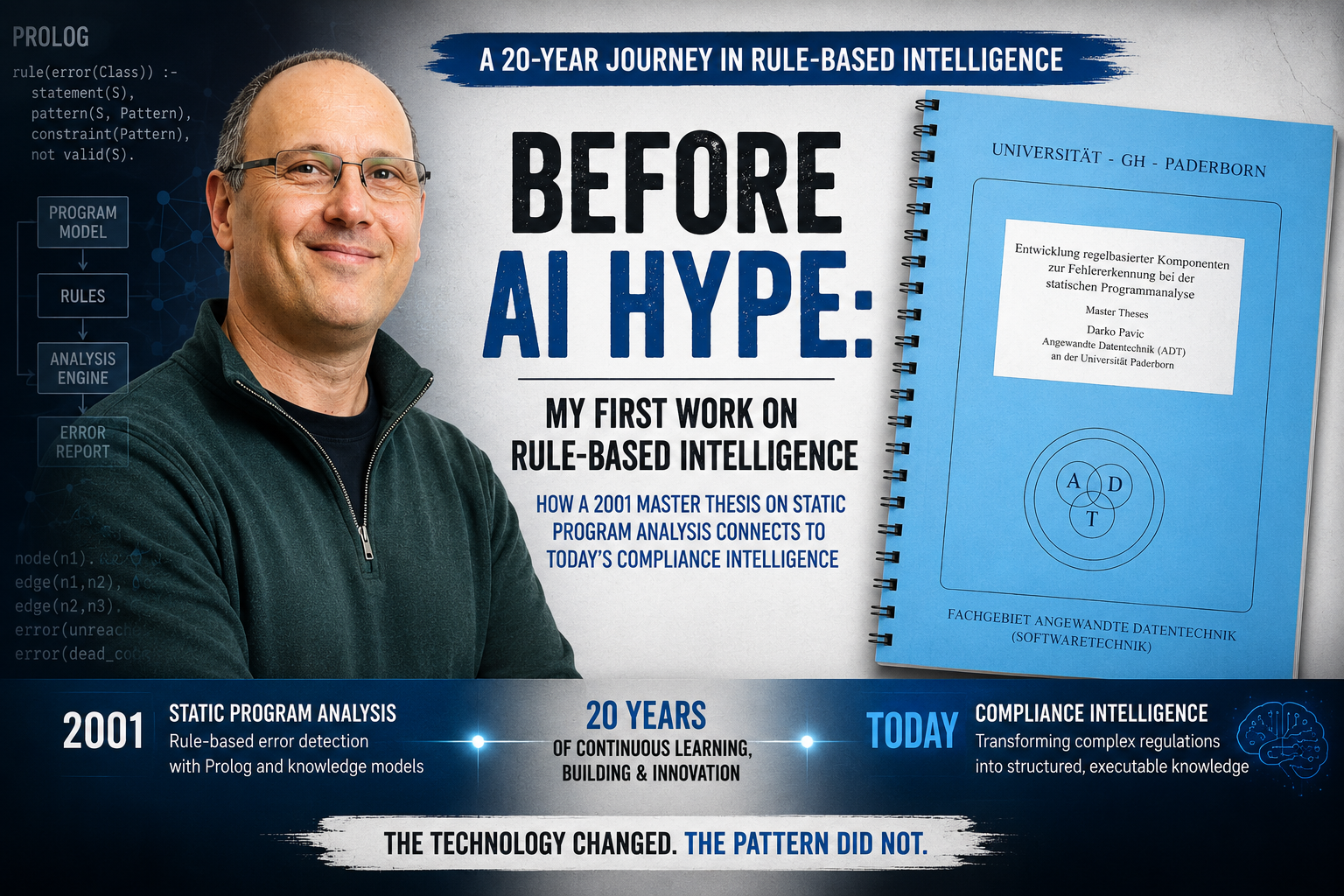
A 2001 diploma thesis, a blue cover, and the long road from rule-based software analysis to the next generation of compliance intelligence.
I recently opened a document that looked as if it belonged to another technological era. It had a blue cover, a university logo, a bound spine, and the unmistakable seriousness of an academic report printed at a time when software still felt more physical than invisible. On the cover stood the title of my diploma thesis at the University of Paderborn: “Development of Rule-Based Components for Error Detection in Static Program Analysis.” It was published in 2001 as Technical Report 2001/7, long before generative AI became a boardroom topic and long before every company presentation needed a slide about artificial intelligence.
At first, it felt like a piece of personal history, but reading it again changed that impression. The tools were different, the language was different, and the world of software development was slower, more formal and less cloud-driven than it is today, yet the core ambition was surprisingly familiar: complex knowledge had to be structured in a way that allowed a machine to analyze it, reason about it, detect risks and explain what had gone wrong.
That ambition has followed me for more than two decades, even when I did not always describe it in those words. In 2001, the domain was software quality, and the problem was the detection of potential errors in programs before they became expensive failures in production. The approach was rule-based, knowledge-oriented and formal, and the implementation was built around Prolog, a logic programming language that requires a different way of thinking because it is based on facts, relationships and rules rather than procedural instructions alone.
The Old Problem That Never Went Away
This was not fashionable language at the time, and it was not called AI transformation, intelligent automation or knowledge infrastructure. It was software engineering, static analysis and rule-based reasoning, but the intellectual pattern was already there because a program had to be transformed into a model, potential errors had to be grouped into classes, knowledge about those errors had to be formalized, and rules had to be applied to the model in a way that remained traceable for a human reviewer.
Looking back, that pattern feels surprisingly modern because much of today’s discussion about AI, compliance and automation still circles around the same challenge. The world produces more rules than organizations can comfortably process, while regulators expect more transparency, more evidence and more consistency from systems that have become too complex to inspect manually. The promise of technology is therefore not simply that it can process more data, but that it can turn complexity into structure and structure into reliable action.
The old thesis focused on software programs, yet the deeper idea was about formalizing expertise. A human expert recognizes certain weaknesses, understands which patterns are dangerous and knows where the structure of a system creates risk, while a machine can only use that expertise when it has been expressed in a form that can be processed. That bridge from human expertise to machine-readable logic was the interesting part then, and it is becoming one of the most important questions again today.
The next generation of digital business will not be built only on documents, databases and dashboards. It will be built on systems that can understand rules, compare them with real-world events, identify deviations, preserve evidence and explain decisions. In some industries, this transition is already visible, while in others it is just beginning to emerge behind the scenes, often disguised as a technical integration project when it is really a deeper change in how knowledge is represented.
From Software Quality to Compliance Intelligence
Retail compliance is one of the places where this shift matters most. A transaction at the point of sale can look simple to a customer, but behind it sits a dense network of fiscal rules, tax logic, receipt requirements, reporting obligations, data structures, signatures, platform connections, local exceptions and audit expectations. The surface is commercial, while the machinery underneath is regulatory, and when that machinery expands across countries, channels and business models, the old way of managing compliance through documents, manual interpretation and isolated implementation notes reaches its natural limit.
I do not believe the future will be defined by replacing human experts with machines, because that is the wrong frame for regulated environments. The more interesting future is one in which expert knowledge becomes structured enough to be used consistently by systems, while humans remain responsible for judgement, interpretation and accountability. In that world, the value does not come from asking a large language model to improvise around regulation, but from building the layer that connects rules, data, process logic and evidence in a way that can be trusted.
That is why the thesis matters to me today. It reminds me that some ideas do not arrive suddenly, but mature slowly, move from one domain to another, and wait for infrastructure, data, market pressure and timing to catch up. What was once a focused academic exercise in rule-based static program analysis now feels like an early signal of a much larger movement: the transformation of complex professional knowledge into operational intelligence.
There is also a personal lesson in this continuity. Careers often look fragmented from the outside because one chapter begins in university research, another in software projects, another in entrepreneurship, another in regulatory technology and another in AI. With enough distance, however, a line becomes visible, and for me that line runs through models, rules, analysis, auditability and the belief that complex systems need more than automation because they need logic that can be inspected.
Why This Matters Now
In the current AI wave, it is tempting to treat every new idea as if it appeared overnight, although meaningful technology rarely develops that way. Most serious ideas have a long prehistory shaped by earlier tools, older limitations and problems that refused to disappear. Today, we have more powerful infrastructure, better data platforms, cloud systems, knowledge graphs, machine learning, large language models and far more computing capacity than we had in 2001, yet the hard part is still not only technical power. The hard part is knowing what should be formalized, how it should be represented and how much trust a system deserves when business and compliance consequences are real.
This is the part I find most exciting now, not because AI makes everything easy, but because it makes the old question urgent again. If machines are going to support decisions in regulated environments, then knowledge cannot remain trapped in PDFs, scattered interpretations, informal know-how and undocumented implementation habits. It has to become structured, versioned, contextual, explainable and operational, which means that the real innovation is not a small feature inside existing software, but a new layer of infrastructure.
I am currently working on ideas in this direction, although the details are not yet ready to be shared publicly. What I can say is that the most interesting opportunities will not come from asking AI to guess its way through regulation, but from combining human domain expertise, formal structures, curated knowledge, transaction-level context and controlled reasoning into systems that can support compliance at a much deeper level than most tools do today.
More Than a Memory
When I look again at the old blue thesis cover, I see more than a memory from university. I see the beginning of a way of thinking that has stayed with me for more than twenty years. The terminology has changed, the market has changed, and the technology has changed completely, but the underlying ambition has remained remarkably stable: build models, define rules, detect risks, preserve evidence and make complex systems understandable.
That may be the real story behind the document. The future often begins much earlier than we think, and sometimes it starts as a diploma thesis printed on paper, bound with plastic and then waiting two decades for the world to become ready for the idea behind it.
