


What Gartner’s 2026 Hype Cycle gets right about the technology—and what it misses about the speed of business transformation
Artificial intelligence can be overhyped, underestimated and already productive at the same time. That apparent contradiction is the defining feature of the market in 2026, as companies discover that extraordinary advances in model capability do not automatically translate into reliable, profitable business systems.
Gartner’s new Hype Cycle for Artificial Intelligence captures the growing frustration with enterprise implementation, yet its familiar curve risks obscuring the different speeds at which the technology, its users and the institutions adopting it are moving.
The most provocative placement in Gartner’s chart is generative AI near the bottom of the Trough of Disillusionment. AI agents have just passed the Peak of Inflated Expectations, while agentic commerce has barely begun its climb and knowledge graphs are already approaching established productivity. These positions provide a useful map of prevailing expectations, but they should not be mistaken for a single forecast of technological progress.
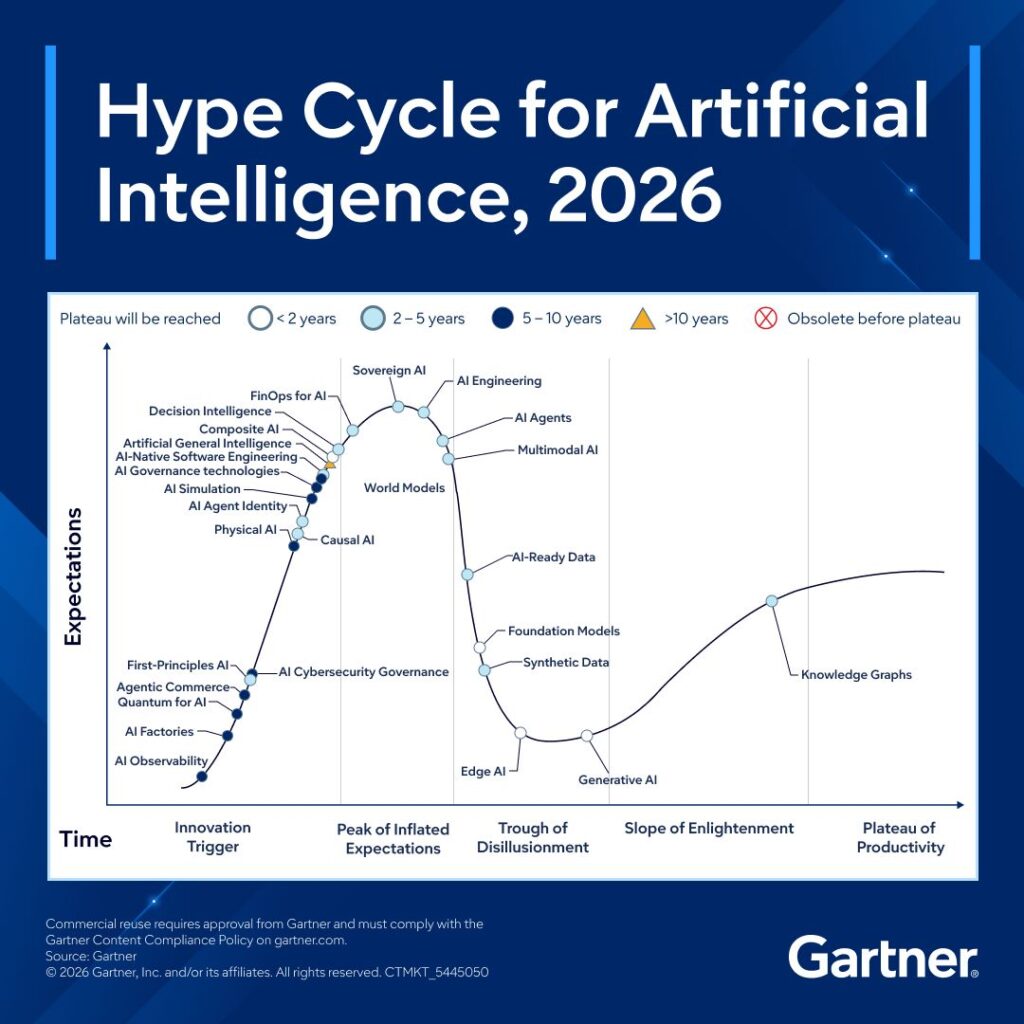
Figure 1. Gartner Hype Cycle for Artificial Intelligence, 2026. Source: Gartner; reproduced from the graphic supplied for this article. © 2026 Gartner, Inc.
From technological possibility to accountability
The Gartner model distinguishes five stages: the Innovation Trigger, the Peak of Inflated Expectations, the Trough of Disillusionment, the Slope of Enlightenment and the Plateau of Productivity. Its vertical axis represents expectations rather than measured technical performance, and its horizontal progression depicts maturity over time rather than a fixed calendar. Gartner’s accompanying October analysis argues that management attention has shifted from whether AI systems can be built to whether their behaviour, costs and risks can be controlled.
That diagnosis is persuasive. Early enthusiasm encouraged businesses to distribute AI tools, commission pilots and expect rapid productivity gains, only to discover that deployment at scale requires integration, reliable data, redesigned processes and careful handling of exceptions. In an enterprise, a model that performs impressively in a demonstration can still fail the operational test if it cannot explain a consequential decision, recover from an interrupted workflow or operate within the permissions of existing systems.
Gartner’s concern about autonomy is also grounded in adoption figures. Its analysis cites a survey in which 17% of organisations had deployed AI agents while more than 60% expected deployment within two years, and it forecasts that more than 40% of agentic AI projects will be cancelled by the end of 2027 owing to costs, uncertain value or inadequate controls. The cancellation estimate is a prediction, not an observed failure rate, but it underlines the difference between enthusiasm and sustainable implementation.
The adoption paradox
Generative AI’s position in the trough becomes more intriguing when measured against evidence from outside Gartner. Stanford’s 2026 AI Index reports that 88% of surveyed organisations adopted AI in 2025, while population-level generative AI adoption reached approximately 53% within three years. McKinsey’s August 2026 global survey finds that 44% of respondents say AI is scaling across their enterprises, up from 38% a year earlier. These statistics describe different samples and different thresholds of use, but they point in the same broad direction: practical adoption is expanding, not collapsing. [3][4]
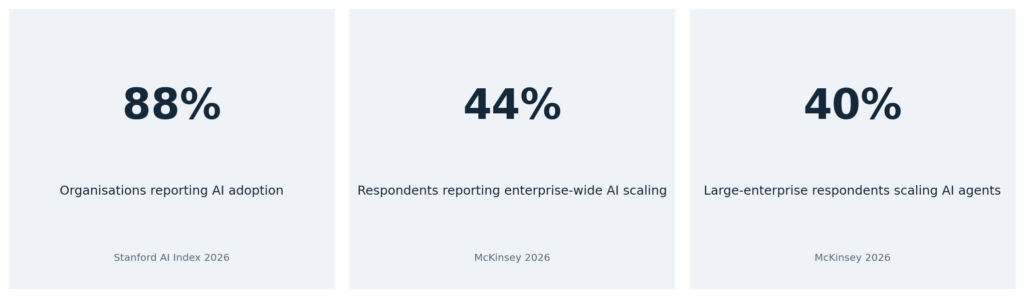
Figure 2. Selected AI adoption and scaling indicators. These are distinct survey measures and must not be compared as percentages of the same population. Sources: Stanford HAI and McKinsey, 2026.
Stanford also summarises empirical productivity gains of roughly 14% to 15% in customer support and 26% in software development in the studies it reviews, although the benefits vary considerably by task and the ease with which work can be monitored. The problem, therefore, is not that artificial intelligence has stopped delivering value; it is that the gains are unevenly distributed and difficult to translate into a consistent organisation-wide financial outcome.
I would separate three trajectories that the single Hype Cycle encourages readers to blend together. Model capability continues to advance rapidly, individual adoption spreads almost immediately when tools are useful, and enterprise operational maturity improves at a slower and less predictable pace. Each trajectory has different constraints, and a company making an investment decision needs to know which one it is actually evaluating.
AI agents expose the difference between a demonstration and a business process
Gartner places AI agents just beyond the peak and estimates another two to five years before widespread productivity. That is a reasonable warning for autonomous systems entrusted with complex cross-functional decisions, yet it understates how useful narrowly bounded agents have already become. McKinsey finds that software coding agents are among the most widely scaled agent applications and that 32% of its respondents report forgoing at least one software purchase or feature because their organisations could build equivalent functionality internally using agentic coding tools. [4]
This is consequential for the software industry. If an AI agent can create a custom workflow that previously required a specialist application, the economic value of some packaged software begins to shift. I do not expect software itself to disappear, because the underlying transaction engines, data controls, identity systems and audit records will remain essential. What may disappear for many users is the need to navigate separate application interfaces to complete each task.
Agentic commerce illustrates a similar tension. Gartner places it near the beginning of the cycle and estimates five to ten years to reach the plateau. That may be plausible for broadly autonomous purchasing across merchants, payment methods and jurisdictions, but agent-assisted discovery and checkout can become commercially important much sooner. Platforms that control the AI interface may gain influence over which merchants appear in recommendations, which options are compared and how conveniently purchases are completed, even before autonomous shopping becomes a mainstream behaviour.
For retailers, the strategic consequence arrives before the technology is fully mature. Merchants may be forced to adapt to the infrastructure and policies of a powerful intermediary that increasingly mediates customer attention. In my view, some assisted purchase journeys could scale within one to three years, whereas highly autonomous cross-retailer purchasing may take considerably longer; these are scenario estimates rather than established forecasts.
The overlooked importance of observability, governance and verification
Gartner gives growing importance to AI observability, governance technologies and agent identity, arguing that enterprises need visibility into autonomous behaviour and controls that prevent unacceptable costs or actions. I strongly agree, but there is a further distinction that becomes indispensable in regulated industries. Observability tells an organisation what an AI system did, governance determines what it was permitted to do, and verification establishes whether its conclusion or action can be justified against reliable evidence. These functions overlap without being interchangeable.
Imagine a retailer asking an AI assistant whether a POS configuration complies with France’s fiscal requirements. A sophisticated monitoring system may retain the prompt, source documents, model output, execution trace and cost; that record is valuable, but it does not establish that the legal conclusion is correct. A verifiable answer requires the applicable rules, their authoritative sources, structured obligations, relevant exceptions and a process capable of checking the resulting conclusion. In fiscal compliance, the last step matters at least as much as the first two.
This is why the combination of knowledge graphs and language models deserves attention. Gartner places knowledge graphs close to the productivity plateau, and their ability to represent explicit relationships between entities, requirements and dependencies makes them a natural complement to probabilistic language generation. The graph does not make an interpretation automatically correct, but it provides a structured foundation against which reasoning can be traced and, where possible, tested.
A different view of maturity
My alternative is not to discard the Hype Cycle, but to distinguish expectation maturity from practical applicability. Generative AI, for example, may be in a period of disappointed enterprise expectations while already being an established tool for bounded writing, research and development tasks. Likewise, governance technology may remain immature as a product category while the need for governance is immediate and non-negotiable.
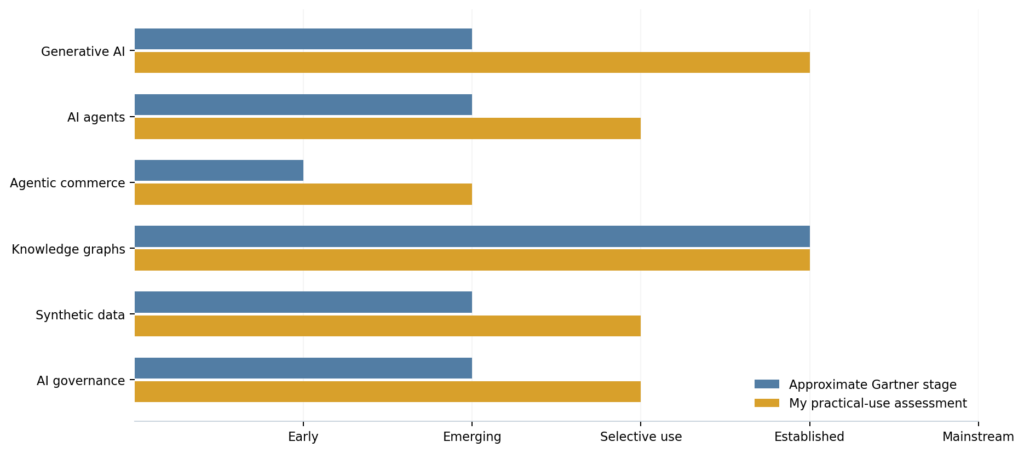
Figure 3. Illustrative comparison of Gartner’s positions and my assessment of practical usefulness in selected applications. The numerical levels are editorial judgements, not Gartner scores or a direct reproduction of its methodology.
The greatest limitation of a single curve is that it can make waiting appear prudent. In reality, competitive advantage often emerges before a technology reaches the productivity plateau, when companies are still learning how to apply it and rivals are hesitating. The challenge is to invest in areas where the business problem is clear, evidence can be measured and the system can be governed, without assuming that every new AI concept warrants a major commitment.
What this means for retail technology and compliance
For businesses operating across markets, I see the strongest long-term opportunities in the infrastructure that makes advanced AI dependable. Authoritative domain data, well-maintained knowledge graphs, explainable decisions, secure transaction services and independently verifiable outcomes may become more valuable as language models grow more interchangeable. These assets are harder to replicate than a conversational interface because they embody both domain expertise and responsibility for real-world consequences.
In our work on Compliance Intelligence and the Compliance Compiler, the strategic goal is to turn regulatory material into structured, explainable knowledge that AI systems can use while preserving the distinction between a plausible answer and a defensible conclusion. That direction aligns with Gartner’s emphasis on accountability, even if I am more optimistic about the pace at which AI agents will become an everyday interface to business capabilities.
The same logic applies to retail commerce. An intelligent agent may handle product discovery, coordinate a purchase and present the customer with a seamless experience, but somebody must still maintain pricing integrity, payment controls, VAT determination, fiscal records, invoices and dispute processes. The less visible traditional software becomes to the user, the more important its reliability becomes behind the scenes.
The real lesson of the 2026 Hype Cycle
Gartner is right to warn that AI enthusiasm has run ahead of enterprise readiness and that governance, observability and costs can no longer be postponed. It is less convincing when its single maturity curve is read as a measure of how fast artificial intelligence itself is progressing. Technological capabilities, market adoption and organisational execution are moving at different speeds, which explains how the same technology can generate genuine productivity gains, disappointing projects and exaggerated promises at the same moment.
My conclusion is that companies should resist both extremes: assuming that AI will solve every problem immediately and waiting for a consulting framework to declare it mature. The stronger strategy is to build the knowledge, controls and processes that make useful AI trustworthy today, while preparing for a commercial environment in which intelligent agents increasingly become the interface between customers, businesses and software. In that future, the enduring advantage may belong less to whoever owns the smartest model than to whoever can make its decisions reliable.
Sources
[1] Gartner, The Latest Hype Cycle for Artificial Intelligence Puts Control Ahead of Capability, 1 October 2026 https://www.gartner.com/en/articles/hype-cycle-for-artificial-intelligence
[2] Gartner, Hype Cycle for Artificial Intelligence 2026, research abstract, 28 August 2026 https://www.gartner.com/en/documents/8319853
[3] Stanford HAI, AI Index Report 2026, Economy and Technical Performance https://hai.stanford.edu/ai-index/2026-ai-index-report
[4] McKinsey, The State of AI in 2026, 25 August 2026 https://www.mckinsey.com/capabilities/quantumblack/our-insights/the-state-of-ai
[5] Gartner, What the 2026 Hype Cycle for Agentic AI Reveals, 15 April 2026 https://www.gartner.com/en/articles/hype-cycle-for-agentic-ai
