


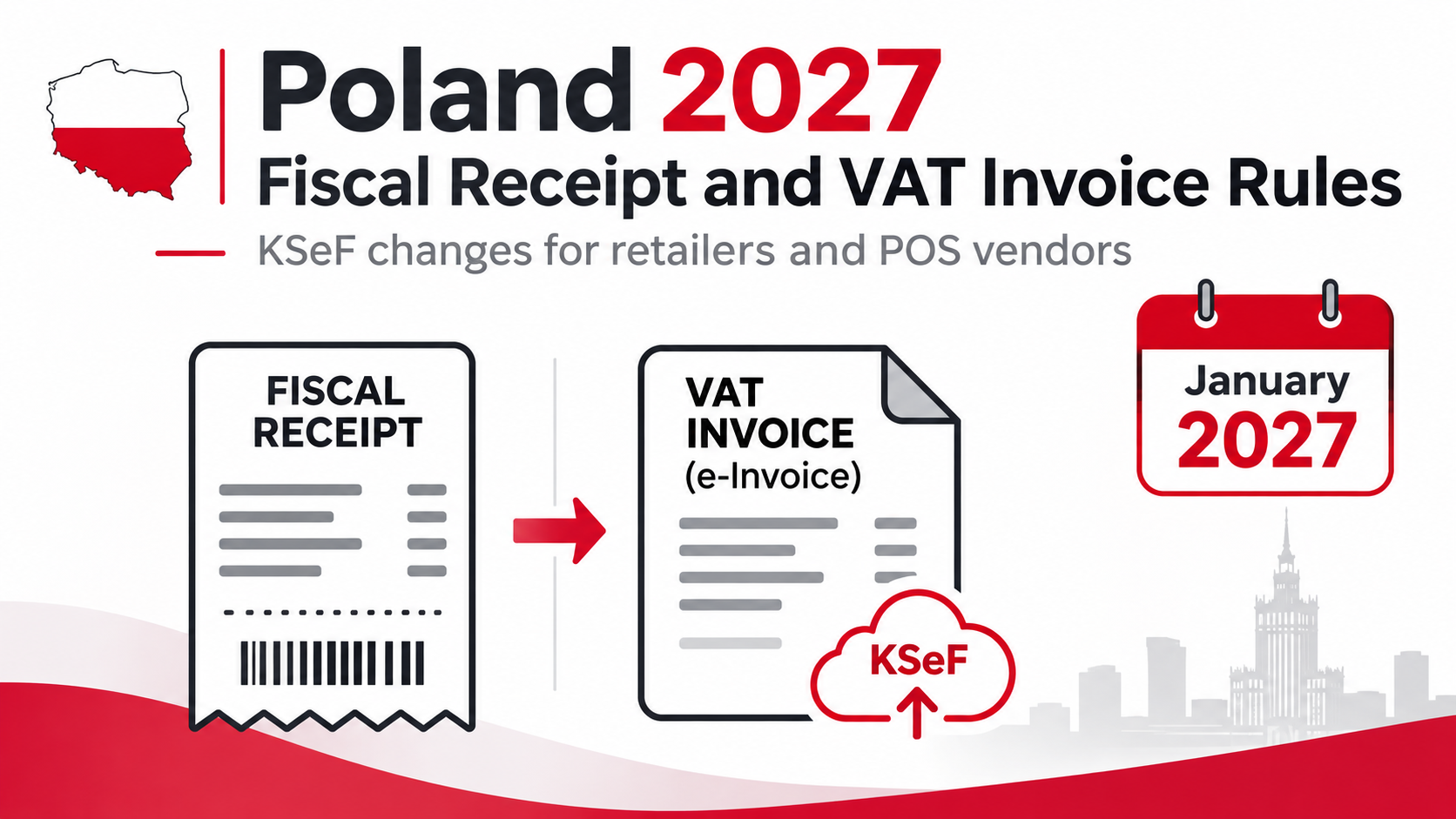
Why a seemingly small change to Polish invoicing rules could have significant consequences for retailers and POS software providers?
Imagine a customer walking into a retail store in Poland, purchasing goods worth PLN 300 and asking for a receipt containing the company’s tax identification number, known as NIP.
Today, that is a relatively simple situation. If the relevant legal conditions are satisfied, a fiscal receipt containing NIP and not exceeding PLN 450 (or EUR 100) can serve as a simplified VAT invoice. The retailer does not necessarily need to issue a separate invoice.
From 1 January 2027, this will change.
The retailer can still issue a fiscal receipt containing the buyer’s NIP, but that document will no longer qualify as a simplified VAT invoice under the transitional rules. Where a VAT invoice is required, it must be issued separately and, for transactions within the mandatory scope, through Poland’s National e-Invoicing System, KSeF.
At first glance, this may look like a relatively minor change in invoicing procedures.
I think it is considerably more interesting than that.
The important development is not simply the disappearance of one type of simplified invoice. It is the increasingly clear distinction between two regulatory processes that have been closely connected in retail systems for many years: fiscalization and VAT invoicing.
And understanding that distinction is becoming essential for retailers and the companies developing their software.
Two systems, two obligations, one retail transaction
One misconception I encounter in international retail technology is the assumption that mandatory electronic invoicing will eventually replace fiscalization.
Poland provides a useful example of why we should be careful with that assumption.
Under Article 111 of the Polish VAT Act, businesses generally have to record sales to private consumers and flat-rate farmers through fiscal cash registers, unless an applicable exemption exists.
That obligation is not being abolished in January 2027.
Retailers must continue recording transactions through fiscal cash registers where legally required. Introducing KSeF does not eliminate this responsibility.
VAT invoicing, meanwhile, follows a different regulatory process.
KSeF is responsible for issuing, receiving and storing structured invoices within its legal scope. Mandatory participation was introduced in phases during 2026, beginning with the largest taxpayers in February and expanding to other businesses in April.
From January 2027, the remaining transitional arrangements come to an end, including those concerning invoices issued through fiscal cash registers and low-value fiscal receipts treated as simplified invoices.
This means that two processes will continue to exist.
The fiscal cash register records the relevant retail sale and produces the required fiscal documentation.
KSeF handles the structured VAT invoice when mandatory electronic invoicing applies.
Both may concern the same underlying commercial transaction, but they have different legal purposes, different requirements and different technical processes.
An invoice issued through KSeF does not replace a required fiscal receipt. And a fiscal receipt does not automatically replace a required VAT invoice.
That distinction is at the center of the changes coming in January.
The PLN 450 rule is disappearing — but only for fiscal receipts
One of the most visible changes concerns the treatment of fiscal receipts containing the buyer’s NIP.
Until 31 December 2026, a qualifying fiscal receipt with NIP may serve as a simplified VAT invoice when the total amount does not exceed PLN 450 or EUR 100.
This has been particularly convenient for smaller business purchases at retail stores, where the customer needs VAT documentation but does not necessarily require a separate invoice.
From 1 January 2027, that shortcut disappears.
A receipt with NIP will remain a valid type of fiscal receipt, but it will no longer acquire the status of a simplified VAT invoice merely because its value falls below the threshold.
Where a VAT invoice is required, the retailer must issue one through the appropriate invoicing process, generally KSeF.
An important detail is that Poland is not abolishing simplified VAT invoices as a general legal category. The change removes the special transitional treatment of qualifying fiscal receipts. Simplified invoices may still exist under the applicable invoicing rules, but a fiscal receipt with NIP will no longer serve as that invoice.
For retailers, this means reviewing what happens when a business customer purchases goods in a store and requests VAT documentation.
For POS software developers, it means reconsidering existing workflows that treat a low-value NIP receipt as the final and sufficient invoicing document.
The most important moment may be before the receipt is issued
There is another detail that I consider particularly important from the perspective of POS software development.
Under Article 106b(5) of the Polish VAT Act, when a sale has already been recorded through a fiscal cash register and confirmed by a fiscal receipt, a VAT invoice for a business purchaser can generally be issued only if that receipt contains the buyer’s relevant tax identification number.
This rule is not disappearing in 2027.
Imagine that a customer completes a purchase, receives a fiscal receipt without NIP and only afterwards explains that the purchase was made for the company and requests a B2B VAT invoice.
In the ordinary situation covered by Article 106b(5), the missing identification on the original receipt prevents the retailer from subsequently issuing that B2B invoice for the fiscalized sale.
The problem cannot simply be solved by connecting the POS system to KSeF after the transaction.
The correct information must be collected at the correct point in the retail process.
This is where regulatory compliance becomes much more than issuing documents or sending information through an API.
The POS application needs to distinguish business purchases from consumer purchases, collect the appropriate buyer identification before completing a fiscalized transaction and understand which subsequent invoicing options remain legally available.
These decisions are part of the checkout process itself.
And when they are implemented incorrectly, the problem may only become visible after the transaction has already been finalized.
There is also a useful simplification
Not everything is becoming more complicated.
Another change, already applicable from February 2026, concerns the documentation that connects fiscal receipts with subsequently issued VAT invoices.
Under Article 106h(1), when an invoice relates to a sale recorded through a fiscal cash register, the business can keep the fiscal receipt’s document number and the unique cash-register number together with the information identifying the invoice.
Alternatively, the business can retain the paper fiscal receipt.
This removes the need to retain the original paper receipt in every such case and supports more digitalized documentation.
For retailers processing thousands or even millions of transactions, I consider this an important operational improvement.
But it also brings us back to software architecture.
A retailer must be able to connect two documents that may originate in different systems.
The fiscal receipt may be created by a POS application communicating with a fiscal cash register, while the VAT invoice may be created later through an invoicing service connected to KSeF.
The business needs a reliable relationship between them.
The receipt number, unique cash-register number, transaction reference and applicable invoice identifier must remain traceable, including when invoices are issued after the original sale.
This is not necessarily a difficult technical problem. But it requires deliberate design, particularly in large retail environments with multiple stores, checkout channels and invoicing systems.
What does this mean for POS software vendors?
If I were responsible for developing a POS application operating in Poland, I would pay particular attention to the transaction lifecycle rather than treating the change as another invoicing interface requirement.
The first question would be how the POS application identifies the customer and determines which type of documentation is required.
The second would be how fiscal receipts and VAT invoices are connected without confusing their respective regulatory roles.
The third would concern what happens after a transaction has been completed.
Retailers regularly handle returns, cancellations, invoice requests, corrections and situations where communication with external services is temporarily unavailable.
Not all of these situations introduce new obligations under the January amendments, but they are precisely the scenarios in which poorly designed integrations can create compliance problems.
A modern POS architecture should therefore consider:
- How buyer identification is collected and validated before fiscal receipt issuance.
- How transactions are routed to the appropriate fiscalization and invoicing processes.
- How receipt and invoice identifiers are stored and linked.
- How returns, corrections and delayed invoice requests are handled.
- How the system responds when KSeF or another required service is temporarily unavailable.
These are implementation considerations, not a new list of statutory obligations introduced on 1 January 2027. Each scenario needs to be evaluated against its own applicable rules.
There is also an important distinction between B2B and B2C transactions.
Invoices issued to private consumers remain outside mandatory KSeF. Businesses may voluntarily use KSeF for those invoices, but they can also continue using other legally permitted methods.
Similarly, ordinary B2B transactions that do not require recording through a fiscal cash register do not automatically need a fiscal receipt simply because an invoice is issued through KSeF.
In other words, the implementation should not force every transaction through every compliance process.
It should apply the right processes to the right transaction.
January 2027 is also the final stage of the KSeF rollout
On 16 November 2026, Poland’s Ministry of Finance published an additional update confirming that the final stage of mandatory KSeF implementation begins on 1 January 2027.
This includes the smallest businesses that have benefited from transitional relief for monthly invoiced sales not exceeding PLN 10,000 gross, as well as businesses previously relying on cash-register invoices or qualifying low-value NIP receipts.
The Ministry also announced that legislation under consideration would extend the postponement of specific KSeF monetary penalties until the end of 2027.
It is important to distinguish this proposal from legislation already in force. A possible extension of penalty relief also does not remove the obligation to comply with KSeF from the applicable implementation date.
For retailers and software providers, I would therefore treat 1 January 2027 as an implementation deadline, not as a date to begin planning.
What I find most interesting about this development
I have spent much of my professional life working with retail software and fiscalization across different countries.
One observation keeps returning: regulatory requirements may look similar on the surface, but the way they interact with everyday retail operations can be fundamentally different.
And the complexity often lies not in an individual requirement, but in the relationship between several requirements.
Poland’s changes illustrate this very well.
The country is not replacing fiscalization with electronic invoicing. It is retaining the existing fiscal cash-register obligations while making the separation between fiscal receipts and VAT invoices more explicit.
For a retailer, this means operating two related compliance processes correctly.
For a POS software provider, it means ensuring that those processes work together throughout the lifecycle of a transaction.
And for international retailers, it is another reminder that deploying a global POS application requires much more than supporting different tax rates, receipt layouts or invoice formats.
The real challenge is understanding how national requirements influence the behavior of the software at every stage of a transaction.
This becomes even more relevant as retail technology continues to evolve toward mobile checkout, unified commerce and increasingly autonomous software systems.
We often discuss how quickly new technologies can be introduced into retail. But we should spend just as much time thinking about how regulatory processes are going to work within them.
Poland’s January 2027 changes may appear to concern a fairly small aspect of VAT invoicing.
In practice, they remind us of something much broader: fiscalization and electronic invoicing are different regulatory systems, and connecting them correctly is becoming an increasingly important responsibility for retail technology providers.
That, in my view, is the real significance of this change.
References and further reading
The analysis is based primarily on Polish legislation and official Ministry of Finance documentation. Technical and operational observations are my interpretation of the implications for retailers and POS providers.
- Polish VAT Act — consolidated text, Dz.U. 2026, item 1263. Particularly Articles 106b, 106e, 106ga, 106h, 111 and 145n. Official legislation (PDF)
- Polish Ministry of Finance — Final stage of KSeF implementation, changes from 1 January 2027. Published 16 November 2026, updated 17 November 2026. Official announcement
- Polish Ministry of Finance — Scope of mandatory KSeF. Implementation phases, exclusions and transitional arrangements. Official KSeF guidance
- Polish Ministry of Finance — Rules governing KSeF and legal provisions. Includes the official clarification that NIP receipts can still be issued in 2027 but no longer qualify as simplified invoices. Official questions and answers
- Polish Ministry of Finance — KSeF 2.0 Frequently Asked Questions. Guidance on cash-register invoices, B2C invoicing and KSeF workflows. Official KSeF FAQ
- Polish Ministry of Finance — KSeF 2.0 Handbook, Part III. Further guidance concerning buyer identification and fiscal receipts, including Article 106b(5). Official handbook (PDF)
- Fiscal Portal — Poland to change fiscal receipt and VAT invoicing rules from January 2027. Nikolina Basić, 17 November 2026. Read the Fiscal Portal analysis
Research and legal status reviewed: 19 November 2026. This article discusses general regulatory developments and their technical implications, rather than legal advice for a particular transaction or business.
