


Retail standardization has moved from product identification and device interfaces to shared transaction models and ontologies. The next major gap is compliance.
Standards rarely make headlines
Fiscal Solutions held recently a webinar on a subject that usually receives far less attention than artificial intelligence, robotics or new store formats, even though it sits underneath almost every one of them: retail technology standards. The session, “From UPOS to the Future of AI-Driven Retail,” was led by Roland Zališevskij, co-founder and board member of Fiscal Solutions. Roland leads the fiscalization working group within OMG and coordinates international work around standards for fiscalization in retail. The discussion was a useful reminder that much of modern retail works only because thousands of companies have agreed, over decades, to use the same identifiers, interfaces, data structures and definitions.
Standardization is easy to overlook precisely because its best work becomes invisible. A cashier does not need to know which company manufactured the scanner, an ERP system should not have to reinterpret the meaning of a sale every time a new POS platform is introduced, and a retailer opening in another country should not need to redesign the entire transaction model simply because the local technology stack is different. Standards reduce the number of things that must be reinvented. In a global retail environment, that reduction is not a technical detail; it is one of the foundations of scale.
The first wave was product identity
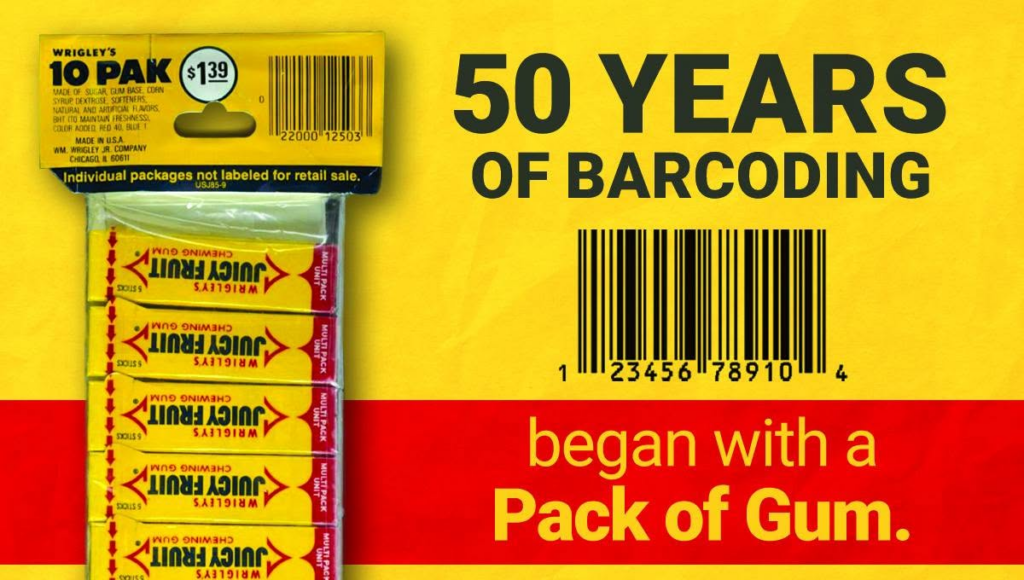
Retail standardization began long before cloud platforms and APIs. One of its most consequential moments came in 1973, when U.S. grocery-industry leaders agreed on the barcode that became the Universal Product Code. GS1 records the first commercial scan on June 26, 1974, when a pack of Wrigley’s gum passed over a scanner at a Marsh supermarket in Ohio. The European Article Numbering Association followed in 1977 with a system compatible with the U.S. UPC, and by 1989 the organization had published its first international standard for electronic data interchange. The important achievement was not the black-and-white symbol itself. It was the agreement that the same product could be identified in a consistent way across manufacturers, distributors, stores and countries.
That principle became one of retail’s most powerful economic tools. A globally recognized product identifier reduced ambiguity in ordering, receiving, inventory, pricing and checkout, and later provided a foundation for e-commerce and supply-chain automation. The barcode showed something that would repeat throughout the history of retail technology: the value of a standard grows as more participants use it, while the cost of proprietary variation grows with every additional supplier, system and market.
The second wave made POS hardware interchangeable
By the 1990s, the same problem had moved inside the store. Retailers were operating scanners, printers, cash drawers, scales, displays and payment-related devices from different manufacturers, while POS vendors often built proprietary interfaces for each device family. The practical consequence was clearly: a retailer using a multi-vendor environment could face new integration work whenever a peripheral changed, while even familiar business terms such as transaction, tender or discount were represented differently from one vendor to another.
The Association for Retail Technology Standards, or ARTS, emerged from that environment. OMG’s historical account says the group began as a retail CIO share group in 1991, was incorporated as ARTS in 1993 and was acquired by the National Retail Federation in 1998. OPOS, short for OLE for Point of Sale, introduced a vendor-neutral approach to POS peripherals in the Microsoft environment, while JavaPOS extended the concept to Java. UnifiedPOS brought the two approaches into a broader specification for point-of-service device interfaces. The objective was practical rather than philosophical: a POS application should be able to work with devices from different vendors without rewriting the application around every hardware change.
That principle remains relevant today. OMG describes UnifiedPOS as an architectural specification that lets retailers select peripherals with much less programming work when devices are changed or added. The standard has continued to evolve; version 1.16, for example, expanded support to retail communication service devices such as service robots. The technology around the POS changed dramatically, but the underlying economic argument stayed the same: interoperability preserves choice and lowers the cost of change.
The third wave standardized the transaction itself
Once device access became more structured, the next problem was data. Retail applications still needed a common way to describe what had happened in a transaction. ARTS developed a shared data model and vocabulary for concepts such as products, parties, locations and transactions, while POSLog provided a vendor-neutral XML structure for recording and exchanging sales, returns, tenders, taxes and other point-of-sale events. According to the webinar material, POSLog was developed under IXRetail and ARTS in 2003 and has since grown into a specification generation with more than 7,000 data elements and attributes.
That scale illustrates both the strength and the weakness of traditional standardization. A sufficiently rich model can cover an enormous range of retail scenarios, which is valuable for large international retailers and Tier-1 software vendors. At the same time, a standard can become so comprehensive that implementation itself becomes a project. Roland made this point during the webinar: standards are intended to simplify integration, yet over time they can become heavy enough to create their own complexity. Modern standardization is therefore increasingly trying to preserve semantic depth while making interfaces and implementation models simpler.
The ARTS Digital Receipt followed a similar path. Its XML specification represented the customer-facing receipt in a structured form and supported use cases beyond printing, including loyalty, warranties, returns and dispute resolution. The more recent OMG Digital Receipt API moves the concept into a modern API environment. OMG lists Digital Receipt API 1.0 as a formal specification adopted in June 2025, with JSON, REST-oriented interfaces and mappings into the Retail Industry Ontology. The shift is significant because the receipt is no longer treated merely as a printable image. It becomes structured transaction data that can be rendered for a consumer, exchanged between systems or used as part of other business and reporting processes.
The standards organization evolved with the technology
The institutional history changed as well. In 2017, OMG and the National Retail Federation entered a long-term agreement to manage and develop the retail standards that had grown out of ARTS, creating the OMG Retail Domain Task Force as the home for this work. In October 2025, the EDM Association completed its acquisition of OMG’s assets, bringing OMG’s technology standards and communities under a broader organization focused on data, software, systems and knowledge engineering. The structure has changed, but the retail mission remains recognizable: create shared business models, terminology and technical specifications that allow retailers, suppliers and technology providers to exchange data and integrate systems more reliably.
The status quo in 2026 reflects a retail industry that is between technology generations. UnifiedPOS 1.x still represents the mature device-interoperability world, while work on UnifiedPOS 2 is intended to move device access toward RESTful web APIs, JSON payloads and networked environments that better fit mobile POS, cloud services and shared store infrastructure. The webinar emphasized that this work is still ongoing and has taken longer than originally expected. At the same time, the Retail Industry Ontology and the Digital Receipt API are pushing standardization away from interfaces alone and toward a common understanding of the business concepts behind those interfaces.
For global retailers, standards are operating leverage
The benefits become much larger when a retailer operates internationally. A domestic retailer can sometimes survive with a local integration, a local device layer and a local vocabulary because the number of variants is limited. A retailer operating across dozens of countries cannot scale efficiently if every market becomes a separate technical architecture. Every proprietary interface increases testing, support and upgrade effort, and every local data model makes global analytics, omnichannel processes and system replacement more difficult.
Standards create a layer of stability underneath that variation. They allow a retailer to define a global transaction model while local systems map into it, to replace peripherals without rewriting the POS, to connect new services through predictable interfaces, and to create regression tests around known structures rather than around one-off implementations. They also improve procurement because responsibilities and interfaces can be described more precisely, which makes it easier to compare vendors and avoid accidental dependence on one supplier’s proprietary design.
The effect is especially important in modern retail because a transaction no longer lives only inside a cash register. It can begin in an app, continue in a store, be fulfilled from another location, be returned through a different channel and create records in payment, loyalty, inventory, tax and customer-service systems. In such an environment, standardization is less about forcing every system to be identical and more about ensuring that the systems understand the same business event. For global retailers, that difference is the line between a reusable platform and a collection of country projects.
Compliance remains the missing global layer
Fiscalization exposes the limits of retail standardization more clearly than almost any other domain. There is still no broadly adopted global fiscalization standard that allows a retailer or POS vendor to implement one interface and satisfy every country. The reason is structural. Product identification and device access are largely industry problems, while fiscalization is created by sovereign legal systems. Tax authorities define different receipt rules, document types, numbering concepts, reporting timings, security mechanisms, devices, certificates and communication protocols, and those rules can change independently of the technology standards used elsewhere in retail.
OMG itself described the problem when it issued a Fiscal API request for proposals in 2018. The organization noted that fiscal laws vary by country and by retail type, making compliance expensive to implement and maintain, and Roland Zalisevskij was one of the authors of that initiative. The webinar revisited the same issue from practical experience. Fiscal printers were not part of the original device standardization in the way scanners and cash drawers were, and terminology remains inconsistent across countries. The same word can describe different concepts in two jurisdictions, while two different words can describe essentially the same fiscal event. In many cases, English terminology is translated or invented from local legal language, which adds another layer of ambiguity for international teams.
This is why compliance cannot simply be standardized by declaring one universal fiscal format. The legal differences are real and must remain visible. A useful global standard has to separate the common retail transaction from the country-specific legal policy applied to it. That is a much more difficult task than standardizing a printer command, but it is also the direction in which scalable fiscal architecture has to move.
Existing retail standards can make compliance much better
The absence of one global fiscalization standard does not mean that compliance has to remain a collection of unrelated local solutions. Other retail standards already provide much of the foundation needed to build better fiscal systems. A retail ontology can define what a transaction, party, location, product, tender, tax, document or digital receipt means in a consistent way. A standardized transaction model can carry the commercial event before local fiscal rules transform or enrich it. A device abstraction can isolate hardware-specific behavior. A digital-receipt model can provide a common structure from which consumer receipts, audit evidence and government reporting payloads can be produced.
This was one of the most practical parts of Fiscal Solution’s webinar. Fiscal Solutions described how it uses a common retail transaction model across its products, while country-specific fiscal rules are handled inside the fiscal service layer. Its transaction payload is based on the OMG Digital Receipt JSON model, and the company applies standardized vocabulary in its fiscal knowledge assets. The point is not that an OMG specification replaces national law. It is that standards reduce the amount of the solution that must change when national law is different.
For an international retailer, this architecture can improve more than development speed. Support teams can work with a common event model, testing can reuse scenarios across markets, monitoring can compare transaction states consistently, and new country requirements can be implemented as controlled variations rather than as new architectures. It also makes collaboration between legal, business and technical teams easier because the vocabulary is less dependent on the wording used in one country’s legislation or one vendor’s product.
AI changes the purpose of standardization
The next transition is already arriving before the previous one is finished. Retail is still modernizing standards for cloud and mobile environments while AI agents are beginning to interact with product data, customer journeys, enterprise systems and operational workflows. Traditional APIs are necessary in that world, but they are not sufficient. An AI system needs to know not only how to call an interface, but what the objects and actions behind that interface actually mean, which relationships are valid and which constraints must not be violated.
This is why ontology work may become much more important than it appeared a decade ago. An ontology is a formal, machine-readable vocabulary that defines concepts and the relationships between them. In retail, that means giving a machine a consistent understanding of terms such as transaction, party, product, location and digital receipt. Roland’s argument in the webinar was that future standards will need to be understandable not only by applications and devices but also by AI agents that can interpret context, make decisions and orchestrate processes across multiple systems. The webinar also pointed to mechanisms such as Model Context Protocol as a possible bridge between AI and standardized APIs, although the wider technology landscape is still evolving quickly.
The challenge for standards organizations is therefore changing. Retail once needed standards stable enough to let a scanner or printer work for years. AI now evolves on a cycle measured in months, and sometimes weeks. The industry needs standards that remain predictable enough for business-critical systems while becoming more modular and adaptable. That balance will determine whether standardization keeps up with the next generation of retail architecture or again arrives after proprietary approaches have already fragmented the market.
The next standard will be a common language
The future of retail standardization is unlikely to be one giant specification that dictates every process. The stronger direction is a layered system in which global identifiers, shared semantic models, standardized APIs and reusable transaction structures provide the common language, while industries, retailers and countries apply their own rules on top. In compliance, this could mean that national fiscal requirements remain different but operate against a more consistent description of the underlying transaction and evidence chain.
That approach matters because retail is becoming more distributed at exactly the moment when regulation and AI are becoming more demanding. A transaction may involve a store, cloud service, payment provider, e-commerce platform, fiscal service, e-invoicing provider and tax authority, while an AI agent may increasingly coordinate part of the process. Without shared definitions, every connection becomes an interpretation problem. With them, technology can move faster without losing control over meaning.
The most successful retail standards have never eliminated competition. They have eliminated unnecessary disagreement about the basics. The barcode did not decide which products retailers should sell. UnifiedPOS did not decide which printer a retailer should buy. POSLog did not decide which POS application should win. They created a common layer that allowed competition to move to a higher level. Compliance now needs the same treatment, and AI will make the need more urgent. The next era of retail standardization will be less visible than the technologies built on top of it, but for global retailers it may be one of the most important pieces of infrastructure they never see.
Sources
The article is primarily based on the supplied Fiscal Solutions webinar slides and transcript. Historical and current-status facts not originating in those materials were cross-checked against the following primary or official sources.
Fiscal Solutions webinar materials and transcript: From UPOS to the Future of AI-Driven Retail, webinar held 27 August 2026. Slides and transcript supplied for this article.
GS1 – 50 years of GS1: https://www.gs1.org/about/50YearsOfGS1
GS1 – Historical Timeline: https://support.gs1.org/support/solutions/articles/43000734073-gs1-historical-timeline
Object Management Group – OMG & the Retail Sector: https://www.omg.org/industries/retail.htm
Object Management Group – Retail Domain Task Force: https://www.omg.org/retail/
Object Management Group – UnifiedPOS: https://www.omg.org/retail/unified-pos.htm
Object Management Group – Digital Receipt API 1.0: https://www.omg.org/spec/DRAPI/1.0/About-DRAPI
Object Management Group – Fiscal API RFP announcement: https://www.omg.org/news/releases/pr2018/10-16-18.htm
EDM Association – completion of OMG acquisition: https://edmcouncil.org/announcement/edm-association-completes-acquisition-of-object-management-group-creating-worlds-largest-data-and-standards-community/
Fiscal Solutions – Roland Zališevskij management profile: https://fiscal-solutions.com/our-management/
