


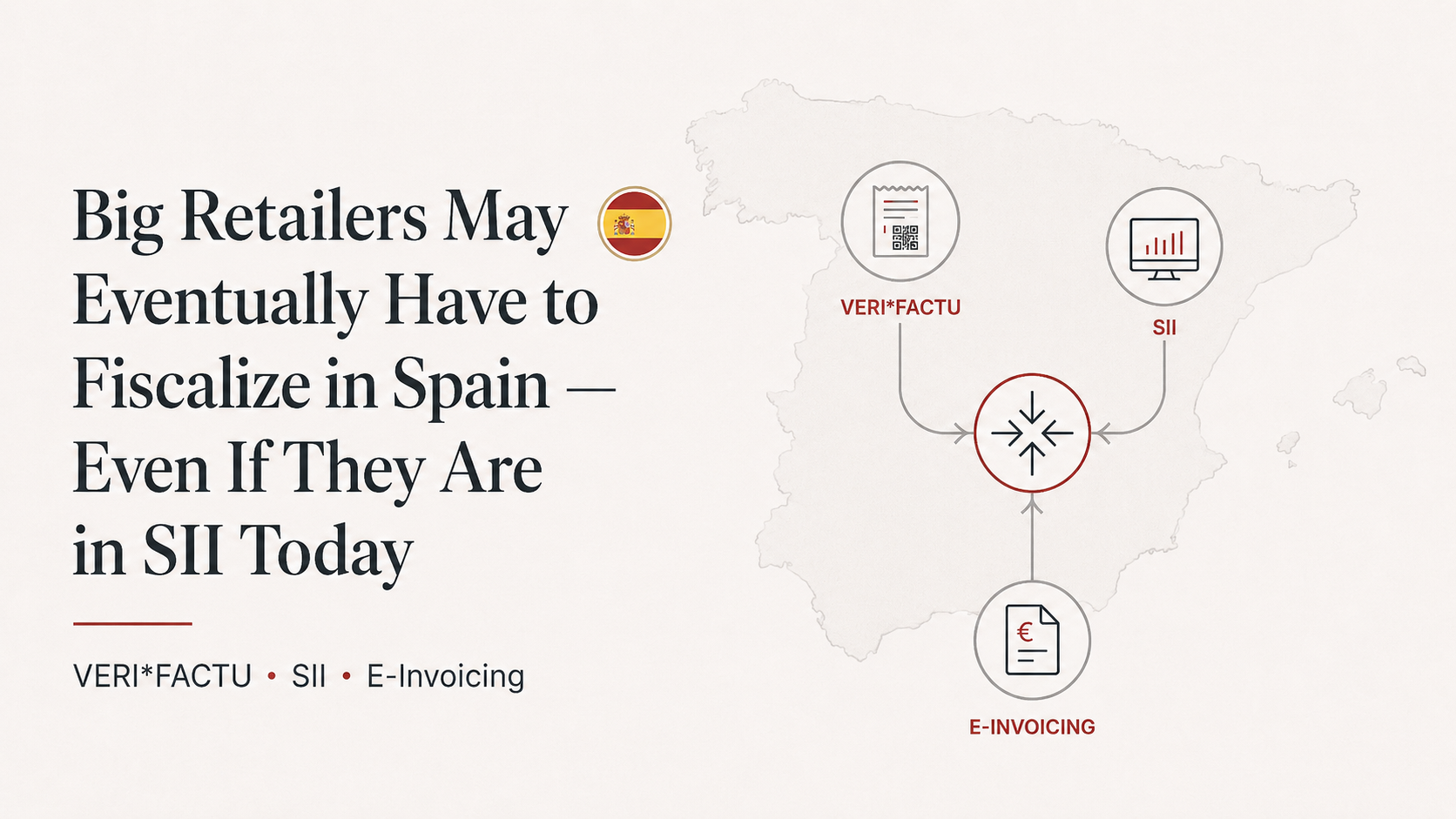
The June motion does not change Spanish fiscal law today, but if its logic becomes government policy, the country’s separate reporting systems could move toward a single transaction-reporting architecture — and large retailers currently outside VERI*FACTU may eventually be drawn into it.
The document published by the Spanish Senate on June 15 looks at first glance like another political request to the government. It is more important than that, but less immediately binding than some of the discussion around it suggests. It is not a law, and technically it is not a letter. It is an approved Senate motion asking the government to rethink the rollout of VERI*FACTU and to build a coordinated path toward the European VAT in the Digital Age framework, or ViDA.
The distinction matters for retailers. Nothing in the motion changes the current obligations of a retailer today, nothing automatically postpones VERI*FACTU, and nothing immediately places companies that are currently in the Suministro Inmediato de Información, or SII, inside the VERI*FACTU regime. At the same time, the text approved by the Senate goes much further than a simple request for another delay. It asks the government to treat VERI*FACTU, SII and mandatory electronic invoicing as transitional components of a future single reporting model. If that approach is eventually translated into regulation, it could change the compliance architecture for almost every POS software vendor and retailer operating in Spain, including the largest ones.
The motion was approved by the Senate Plenary on June 10, 2026, by 151 votes to 91, with 17 abstentions, after incorporating two amendments from the Partido Popular. The final text asks for a public roadmap, legal certainty, coordination with the autonomous and foral tax administrations, interoperability with systems such as TicketBAI, an independent impact assessment, and a gradual convergence toward a reporting channel linked to structured electronic invoicing.
What the Senate actually approved
The most important parts of the motion are not the political criticism surrounding VERI*FACTU but the architecture it proposes. The Senate asks the government to align VERI*FACTU from the beginning with Council Directive (EU) 2025/516, to prevent duplicated or incompatible transaction-reporting systems, and to define a clear roadmap integrating mandatory e-invoicing, VERI*FACTU and SII into one model connected to the invoicing process.
The text then goes a step further. It proposes using an adapted VERI*FACTU as the preferred basis for convergence toward ViDA, including received invoices and moving toward mandatory and universal use once full interoperability with the European standard has been secured. It also says that the current systems — VERI*FACTU, SII and electronic invoicing — should be regarded as strictly transitional instruments that progressively converge into a single reporting channel linked to structured electronic invoicing under EN 16931.
For a retail technology team, that is the sentence to watch. Spain today has several important digital tax and invoicing obligations that were created at different times, for different taxpayer groups and with different technical purposes. The motion is effectively asking whether Spain should stop treating them as separate projects and start designing one end state.
The motion has political weight, but it does not change the law
Under Spanish parliamentary law, a Senate motion is a non-legislative instrument of political direction and control. The Senate’s own parliamentary dictionary states that these initiatives do not have legally binding effects and that failure to follow them is addressed through political control rather than through the direct enforcement mechanisms that apply to legislation. The Constitutional Court has taken the same basic position: motions have political authority, but binding rules for the government and the administration are created through duly enacted and published law.
This means the June motion cannot itself amend Royal Decree 1007/2023, change the current SII rules, suspend the 2027 deadlines, or create a new unified reporting obligation. To do any of those things, the government would need to change the relevant regulations or legislation through the normal legal process.
There is, however, one concrete procedural consequence. Article 178 of the Senate Rules requires the government or the competent body to report within six months on the action taken in response to an approved motion. Because this motion was approved on June 10, the practical deadline is around December 10, 2026, subject to the formal date on which the Senate communicated the resolution to the government. The report must be published by the Senate. Following the 2025 reform of the Senate Rules, a government member must also appear before the Constitutional Committee during the first working month of each parliamentary session to account for these compliance reports.
That obligation to report should not be confused with an obligation to implement every point of the motion. The government can report that it considers the objective already addressed, that it is pursuing only part of the recommendation, or that it disagrees with the approach. The legal consequence of ignoring the substance is primarily political, not the automatic invalidity of the government’s existing fiscal rules.
Spain today has three major systems moving on separate tracks
The background explains why the Senate text has attracted attention. Spain is not introducing one digital fiscal system. It is currently operating or developing several systems that overlap in business processes but have different legal foundations and scopes.
SII has been in operation since 2017. It is a system for maintaining VAT ledgers through the electronic office of the Spanish Tax Agency by sending invoice-record information on a near-real-time basis. It is mandatory, among others, for large companies with annual turnover above €6,010,121.04, VAT groups and taxpayers registered in the monthly VAT refund regime, REDEME. In practice, that means many large retailers already have a substantial transaction-reporting obligation to the AEAT, but it is an SII obligation rather than a VERI*FACTU obligation.
VERI*FACTU belongs to a different regulatory project. Royal Decree 1007/2023 established technical requirements for computerised invoicing systems, including integrity, traceability and the generation of standardised invoicing records. Strictly speaking, VERI*FACTU is one operating mode under that broader regulation, in which the invoicing records are sent to the AEAT. After the postponement introduced by Royal Decree-law 15/2025, the mandatory adaptation dates are January 1, 2027 for Corporate Income Tax taxpayers covered by the regulation and July 1, 2027 for the remaining taxpayers within its scope.
The third track is mandatory B2B electronic invoicing under the Crea y Crece framework. Royal Decree 238/2026, published in March, now defines the Spanish B2B e-invoicing system, including private exchange platforms and a public solution managed by the AEAT. It adopts EN 16931 as the semantic basis and UBL as the reference syntax for the public solution. Its effective application, however, is linked to a further ministerial order governing the public e-invoicing solution. Once that order enters into force, businesses with turnover above €8 million will generally have twelve months before the obligation applies to them, while the rest will have twenty-four months. As of August 25, 2026, that ministerial order has not been published in the BOE, so this countdown has not yet started.
Above all of this sits ViDA. The European package was adopted in 2025 and introduces new Digital Reporting Requirements for cross-border B2B transactions from July 1, 2030, based on electronic invoicing. There is an important detail that is sometimes lost in the political debate: the 2030 date is the key date for the cross-border DRR model, while Member States that already had domestic real-time transaction-reporting systems can have until January 1, 2035 to align those domestic systems with the European model. The Senate motion therefore compresses several European timelines into one political objective, even though the direction of travel toward interoperability is clear.
The large-retailer VERI*FACTU exemption is real — but it needs to be described precisely
The statement that large retailers in SII do not currently need to implement VERI*FACTU is substantially correct. Article 3.3 of the regulation approved by Royal Decree 1007/2023 expressly excludes taxpayers that keep their VAT ledgers under the SII rules. The AEAT’s current FAQ is even more explicit: SII and the invoicing-system regulation are mutually exclusive for the taxpayer’s own invoices, and taxpayers subject to SII are not affected by Royal Decree 1007/2023 in relation to those invoices.
For many major retailers, this is a significant distinction. A retailer can be subject to extensive SII reporting and still be outside the VERI*FACTU/RRSIF requirements for its own sales invoices and simplified invoices. It is therefore more precise to say that these companies are exempt from VERI*FACTU-style fiscalisation under Royal Decree 1007/2023, rather than saying that they have no fiscalisation or reporting obligation at all. They already report through SII.
Mandatory B2B e-invoicing does not by itself eliminate this distinction. Royal Decree 238/2026 generally excludes ordinary simplified invoices from the B2B e-invoicing obligation, which is particularly relevant in retail because most consumer transactions are documented through simplified invoices. The potentially transformative element is not the B2B e-invoicing regulation alone. It is the Senate’s proposal to integrate SII, VERI*FACTU and electronic invoicing into a common transaction-reporting architecture.
If the Senate model is implemented, large retailers may become part of a new unified system
This is where the consequences could become much more important for retail. The final motion does not merely ask the government to make the existing systems technically compatible. It explicitly proposes that all of them should be considered transitional and that an adapted VERI*FACTU should become the preferred base for a future unified system, with received invoices added and universalisation considered once interoperability has been achieved.
If the government eventually follows that model literally, the current SII exemption would probably not survive in its present form forever. Large retailers would not necessarily be forced into today’s VERI*FACTU specification, but they would likely have to support the successor architecture that replaces or absorbs SII. That could mean new data structures, new reporting timing, new interfaces between POS, ERP and tax systems, and a different relationship between the sales transaction, the invoice and the tax report.
This conclusion should still be treated as a likely consequence of the policy direction, not as a current legal requirement. The motion does not define the future technical model, and a unified system could preserve parts of SII behind a common interface or use conversion layers that reduce changes at store level. It is therefore too early to say that every large retailer will have to implement a future version of VERI*FACTU directly in every POS. What can be said is that the Senate is explicitly challenging the current architecture in which SII taxpayers sit outside the RRSIF/VERI*FACTU regime.
For multinational retailers, that change would matter because Spain is already one of the European markets where fiscal compliance has to be distributed across several technology layers. Sales transactions may originate in POS, e-commerce or self-checkout, flow into central ERP and tax engines, be reported through SII, and increasingly interact with structured e-invoicing. A single reporting model could reduce duplication in the long term, but the transition to that model could itself create a significant implementation project.
What the government is most likely to say
The debate in the Senate gives a fairly strong indication of the government’s probable response. The Socialist spokesman, Mario Soler Santos, opposed the motion’s central premise that VERI*FACTU should be held back while Spain waits for ViDA. He argued that the current implementation should proceed and stated that the Tax Agency is already working so that VERI*FACTU, electronic invoicing and SII can be compatible with ViDA from July 1, 2030. His position was essentially to implement the current system first and make the necessary adaptations later rather than pause the project until the European framework is fully operational.
That makes an immediate government decision to stop VERI*FACTU or replace it with a newly designed unified system unlikely. The more probable response is that the government will accept the objective of interoperability while rejecting the suggestion that the current 2027 implementation should be suspended. It can point to work that is already underway: the AEAT’s 2026 control plan explicitly refers to coordination around the public e-invoicing solution, and Royal Decree 238/2026 already anchors the B2B e-invoicing model in EN 16931 and UBL, both of which support future European interoperability.
The formal report is therefore likely to say that Spain is already moving toward the alignment requested by the Senate, that VERI*FACTU and SII serve different taxpayer populations and purposes today, and that convergence with ViDA will be managed through future technical and regulatory adaptations rather than by abandoning the current rollout. It would also be consistent with the Socialist position in the June debate for the government to keep the January and July 2027 RRSIF deadlines unchanged unless another political agreement or technical problem creates pressure for a further postponement.
The government may nevertheless adopt part of the motion without describing it as a change of course. A clearer public roadmap connecting RRSIF, SII, the B2B e-invoicing system and ViDA would be difficult to argue against, particularly now that the B2B e-invoicing regulation has been published and the remaining technical order is still pending. The government could also frame the future public e-invoicing solution as the point around which several reporting flows increasingly converge.
For retailers, the motion is a signal rather than a new obligation
For retailers outside SII, the immediate planning assumption should still be the existing RRSIF timetable. The Senate resolution has not postponed anything. Companies that fall within the regulation should continue preparing for the 2027 dates unless the government changes the law.
For large SII retailers, the situation is different. They remain outside the RRSIF/VERI*FACTU scope today, and that exemption is explicitly confirmed by the AEAT. There is no legal basis at present to tell them that they must implement VERI*FACTU for their own sales. But the Senate motion makes the medium-term direction more interesting than it was before June. A serious government project to merge SII, e-invoicing and transaction reporting would almost inevitably require those companies to participate in the successor model.
The most important operational response is therefore not to start a speculative POS redesign, but to avoid building new compliance architecture around the assumption that SII will remain a permanently separate island. Retailers making long-term decisions about POS, fiscal middleware, tax engines and e-invoicing should design interfaces that can absorb a future convergence of invoice and transaction-reporting data.
The Senate has not created that future system. It has, however, put a politically approved version of that architecture on the table. By roughly December, the government must explain what it intends to do with it. The answer will show whether Spain continues with three systems that are made interoperable over time, or whether it is prepared to turn interoperability into a more fundamental redesign of the country’s fiscal reporting model. For large retail, that difference is substantial.
Legal and technical references
Spanish Senate, Motion 662/000209 and Plenary approval of 10 June 2026.
Spanish Senate Rules, Article 178, on the six-month government compliance report.
Spanish Senate parliamentary dictionary, on the non-binding legal effect of non-legislative motions.
Royal Decree 1007/2023, Article 3.3, excluding SII taxpayers from the invoicing-system regulation.
AEAT FAQ on SII and RRSIF/VERI*FACTU scope, updated in 2026.
Royal Decree-law 15/2025, postponing mandatory RRSIF adaptation to 2027.
Royal Decree 238/2026 on mandatory B2B electronic invoicing.
Directive (EU) 2025/516 and the European Commission ViDA implementation timeline.
